
This post may contain affiliate links. Please see our disclosure policy.
Canning chili con carne puts a full pot of beef and bean chili on the pantry shelf, nine pints at a time. Open a jar, heat it, and dinner is done, with no thawing and no simmering all afternoon.
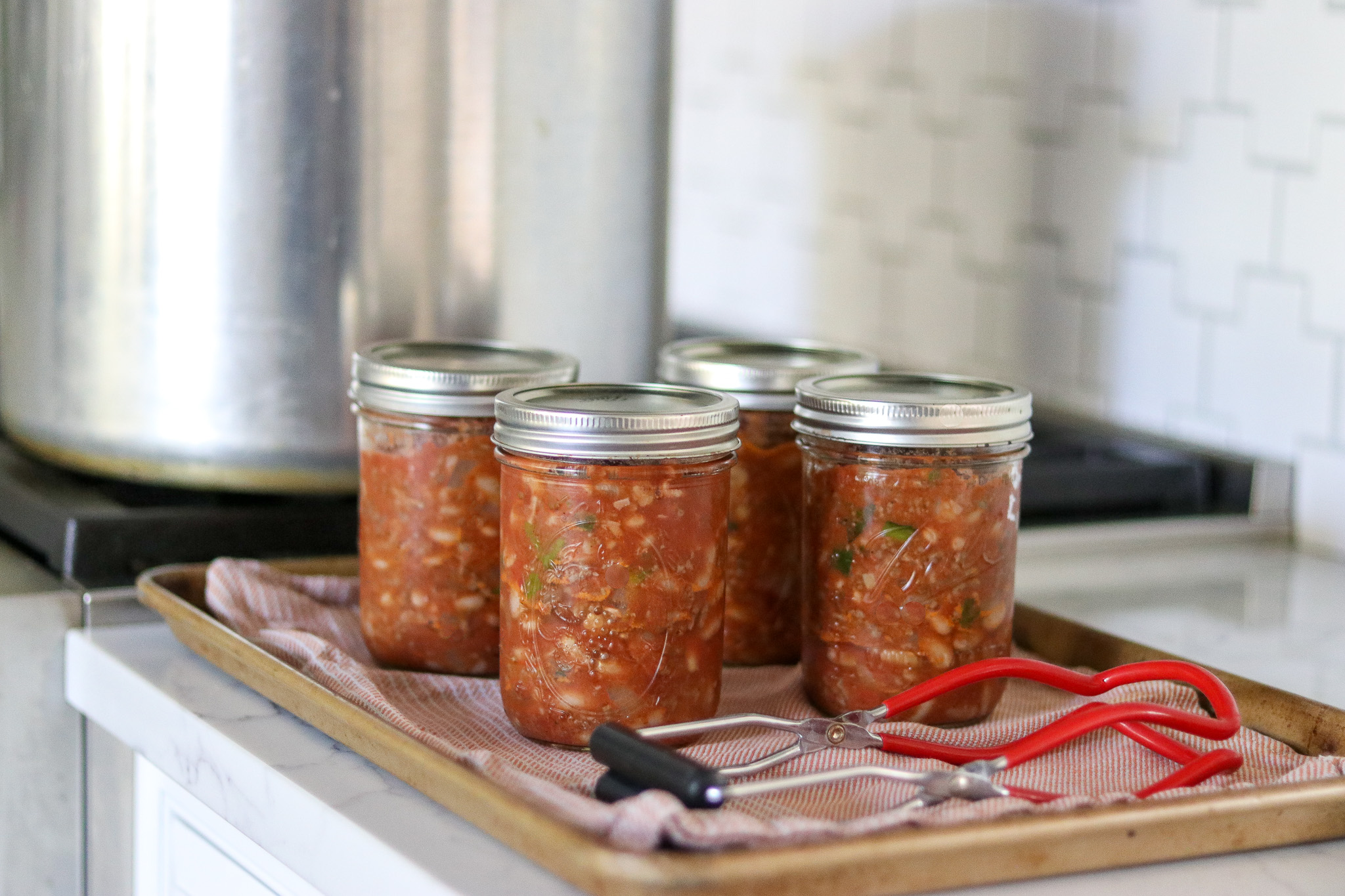
Table of Contents
- Notes from My Kitchen
- Quick Look at the Recipe
- Why Pints Only
- Ingredients for Chili Con Carne
- Chili Canning Recipe Variations
- Step-by-Step Instructions
- Canning Chili Con Carne
- Altitude Adjustments
- Serving Chili Con Carne
- Storage and Shelf Life
- Yield Notes
- Canning Chili Con Carne FAQs
- Meal in a Jar Canning Recipes
- Canning Chili Con Carne Recipe
- Bean Canning Recipes
This recipe has been reviewed for safety and accuracy by a Master Food Preserver certified through the University of Cornell Cooperative Extension.
This is the USDA’s own chili con carne, from the USDA Complete Guide to Home Canning. Ground beef, dried beans, onions, peppers, and tomatoes, with the chili powder seasoning left to your taste. It’s one of the few complete meals with a process published by the USDA itself rather than adapted from one.
That also makes it one of the strictest. This recipe is tested in pints only. There is no quart process, the batch is nine pints, and the beans have to be soaked and pre-cooked before they go in the jar. None of that is adjustable. It’s low acid, so it needs a pressure canner, and my pressure canning for beginners guide walks through a whole batch.
Within those lines, there’s more room than you’d expect. The meat, the beans, the peppers, and every dry spice can change. If you want a chili without beef, canning white chicken chili and chicken chili verde are both here too.
Notes from My Kitchen

We love homemade chili here, and this is the batch I make biggest. I run a high-capacity canner and usually double it for 18 pints, which is a long afternoon and worth every minute of it.
I add cumin. The USDA recipe doesn’t call for it, but dry spices are yours to adjust in a canning recipe, and I think cumin is what makes chili taste like chili. Hatch green chili powder is the other one I reach for.
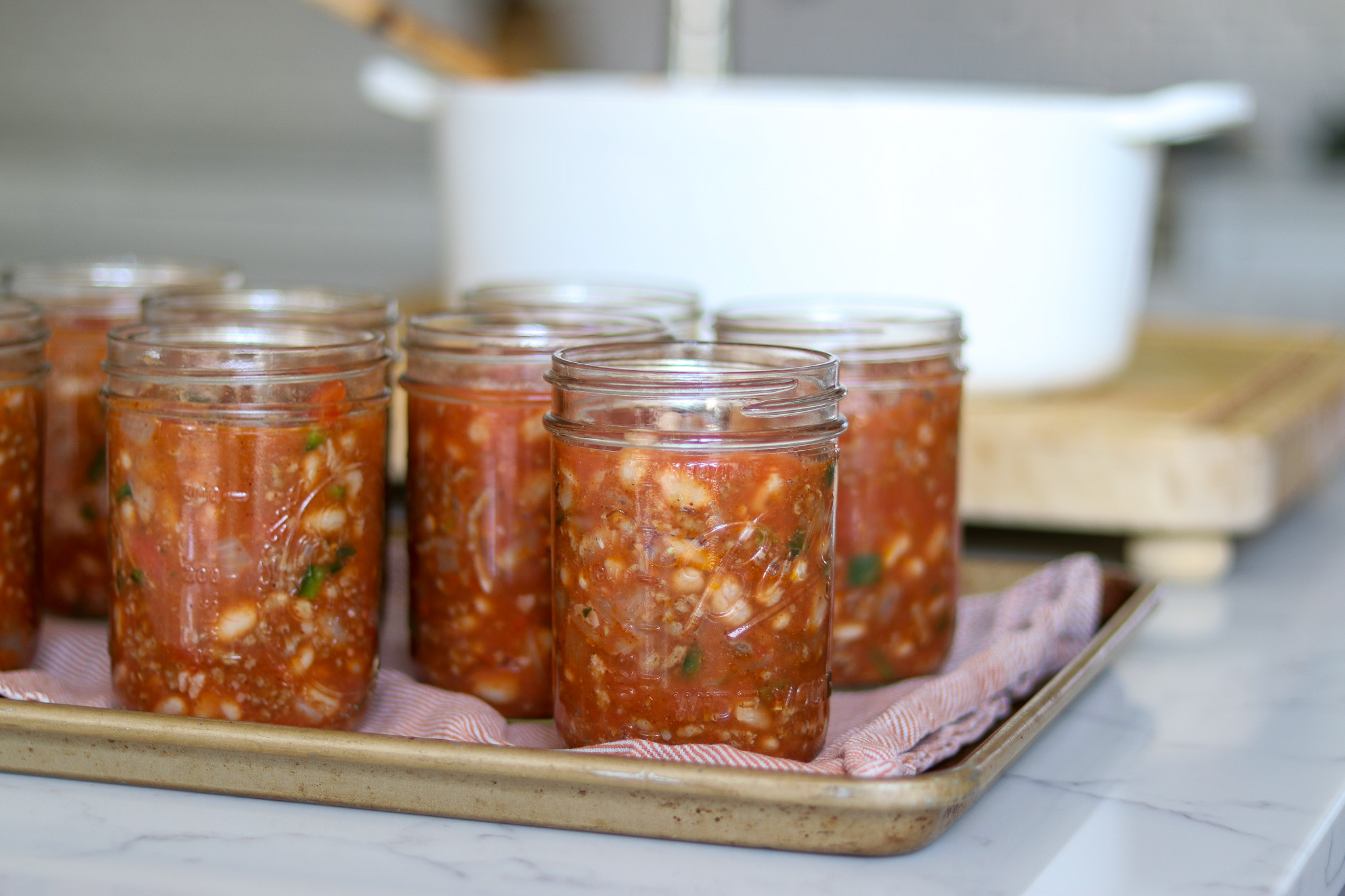
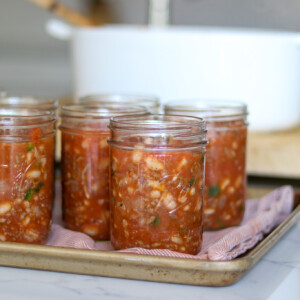
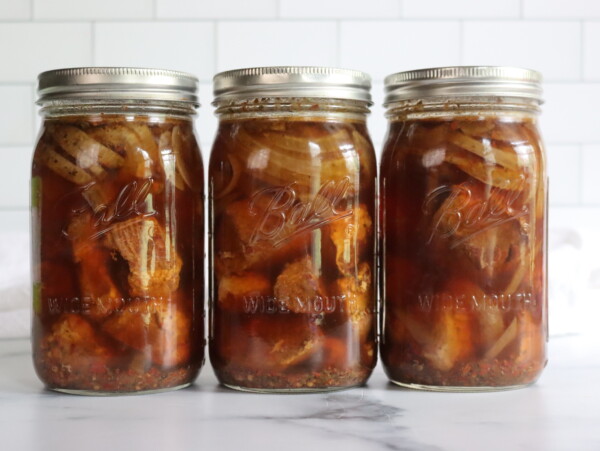
Don’t be alarmed when the jars come out looking dry. The beans keep drinking liquid while they sit, so a jar that went in soupy comes out thick. That’s how it’s supposed to look.
Quick Look at the Recipe
- Recipe Name: Canning Chili Con Carne
- Recipe Type: Meal in a Jar Canning Recipe
- Canning Method: Pressure Canning
- Prep Time: 60 minutes, after an overnight bean soak
- Cook Time: 30 minutes
- Canning Time: 75 minutes for pints
- Yield: 9 pints
- Jar Sizes: Pints only, wide-mouth or regular
- Headspace: 1 inch
- Ingredients Overview: Dried kidney or pinto beans, ground beef, onion, peppers, tomatoes, chili powder, salt, and black pepper
- Safe Canning Recipe Source: USDA Complete Guide to Home Canning
- Difficulty: Easy, but plan ahead. The beans soak overnight before you start.
- Similar Recipes: More chili and bean meals in a jar, including white chicken chili, chicken chili verde, and Cajun red beans and sausage. For more beef, there’s chipotle beef taco meat, taco soup, and beef pot pie filling.
Why Pints Only
This is the question I get most on this recipe, so it’s worth answering before anything else. The USDA tested chili con carne in pints and never published a quart process. There isn’t one to give you.
That isn’t the same as saying quarts are impossible. It means nobody has run the heat penetration study, and a jar this dense is exactly the kind where the answer matters. Beans and ground meat pack tight, and heat moves through that slowly. A quart has to carry that heat twice as far.
Wide-mouth or regular pints are both fine. Half pints work too, processed for the full pint time. What you can’t do is go up.
Ingredients for Chili Con Carne
This recipe carries its own USDA process, but the allowed changes follow the University of Alaska’s Hearty Soup protocol, publication FNH-00065, which is the framework behind most of my meal-in-a-jar canning recipes.
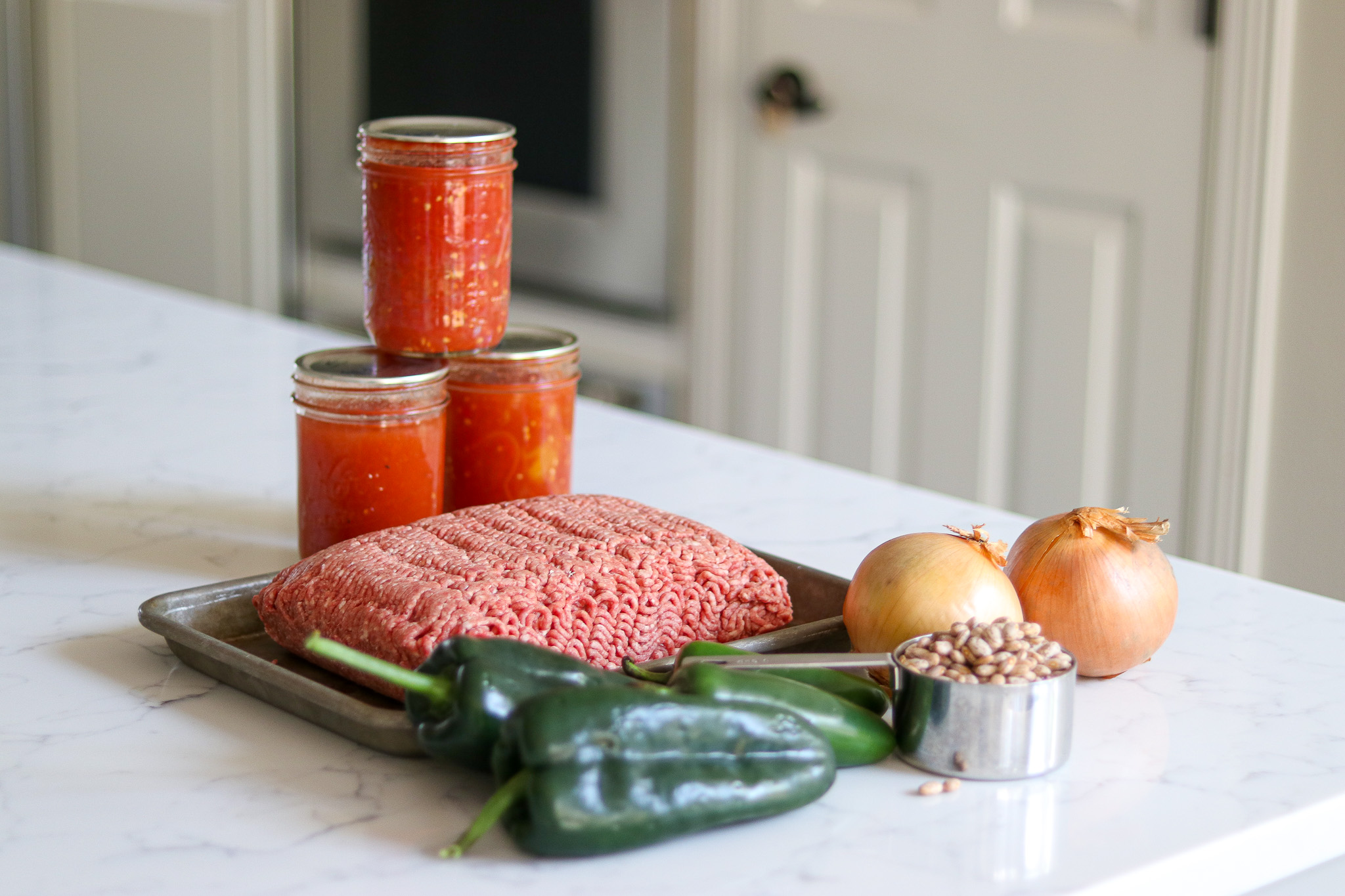
- Dried beans: Red kidney or pinto in the original. Black beans, navy beans, and chickpeas all work. They’re soaked and pre-cooked before canning, and neither step is optional. See canning dry beans for the plain version.
- Ground beef: Browned and drained first. Ground venison, pork, lamb, turkey, or chicken all substitute pound for pound. Loose Italian sausage works, as long as it isn’t cased. More in canning ground beef.
- Onion: Chopped. It can go in the pan with the beef or be sauteed first, whichever you prefer.
- Peppers: Optional, and any kind. Sweet, hot, or a mix. Poblano with a jalapeno gives heat without taking over, and frozen roasted hatch chilis go in straight from the freezer. See canning peppers.
- Tomatoes: Whole or crushed, home canned or store bought, or fresh. Tomato juice works in the same volume and makes a thinner chili. More in canning tomatoes.
- Chili powder: Three tablespoons for mild, six for hot, anywhere between for the rest of us. This is the dial to turn.
- Salt and black pepper: The salt is divided. Two teaspoons go into the bean pre-cook water and get poured off with it, and three teaspoons season the chili itself.
Any dry spice you like can go in on top of that. Cumin, oregano, garlic powder, smoked paprika, ginger, and cocoa powder are all fine. Dry seasonings don’t change the density of the jar, so they don’t change the process.
Using Canned Beans Instead
Store-bought canned beans can stand in for the dried ones, and it cuts the longest part of this recipe out entirely. Canned beans are already cooked, so you skip both the overnight soak and the 30 minute pre-cook and pick the recipe up at the browning step.
The amount is what to get right. Three cups of dried beans cooks up to roughly 9 cups, so you want about 8 to 9 cups of drained canned beans, which is five 15-ounce cans. Measure the cups rather than counting cans, since can sizes vary and a drained can runs between 1 1/2 and 1 3/4 cups.
Drain them or keep the canning liquid, either is fine. Two small things follow from the swap. The 2 teaspoons of salt that would have gone into the bean water aren’t needed, and canned beans are already saturated, so they won’t drink as much liquid in the jar as dried ones do.
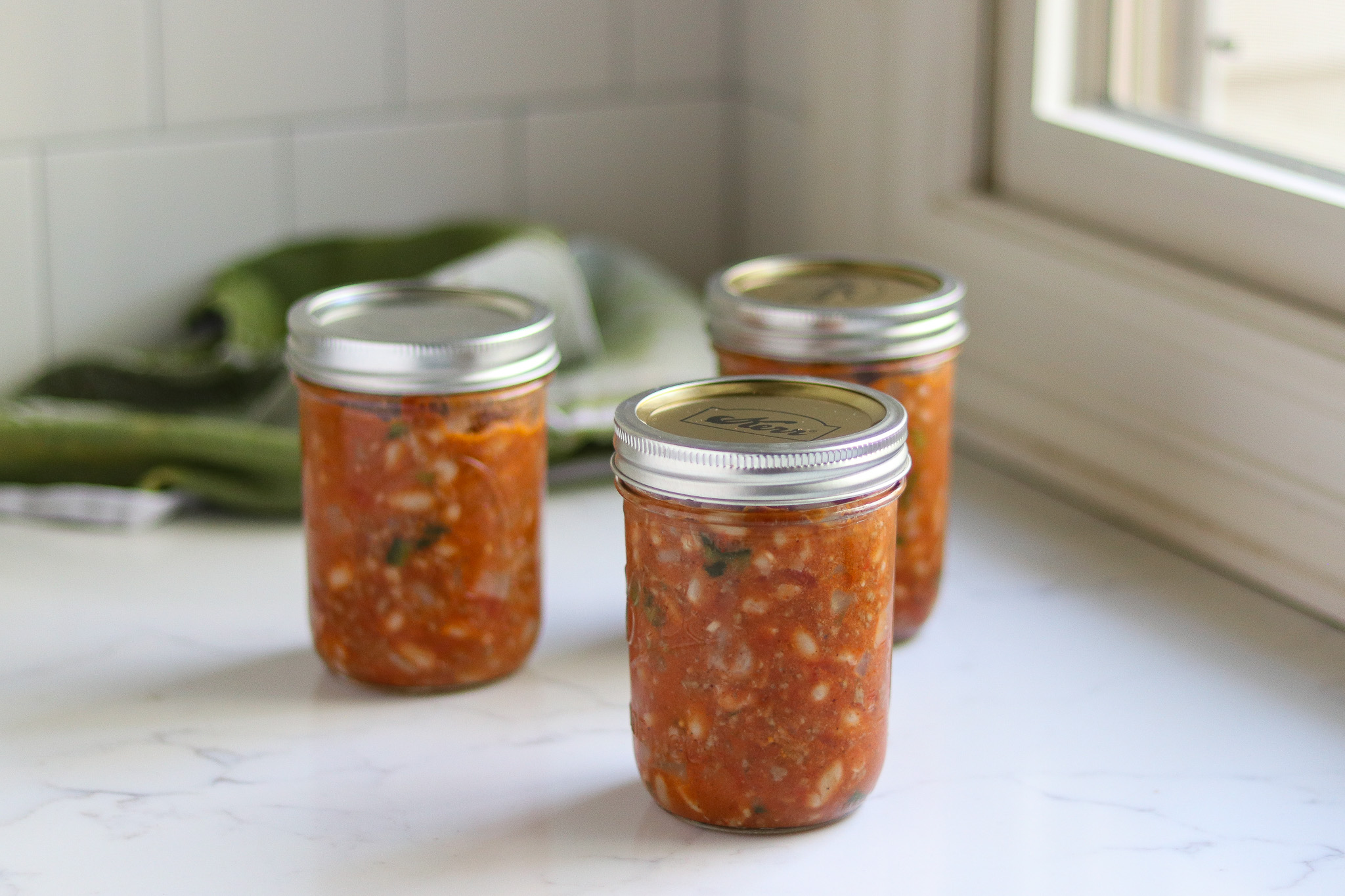
I made the chili as my first canning project with meat! This was delicious and a wonderful experience! We lose power regularly here in Michigan, and now, knowing how, I can make sure my pantry is well stocked.
Most of the questions I get on this one are about what’s allowed to change. Here’s where the lines sit.
Chili Canning Recipe Variations
The meat can be any ground meat, or chunks of meat instead of ground, or left out entirely for a vegetarian chili. The beans can be any dried bean. The peppers can be any pepper, or none. Every dry spice is yours to choose. For other options, you can read through my guide to safe canning recipe changes.
What doesn’t move is the process. Pints only, 75 minutes, and the beans soaked and pre-cooked first. Don’t thicken it before canning, and don’t reduce the liquid to make it thicker.
Extra tomatoes are the easiest safe addition if your batch comes up short of nine jars. Building something further from this recipe? How to create your own meal in a jar canning recipe lays out the full allowed list, though bean heavy recipes are the hardest ones to modify safely, and I’d suggest reading through my tested list of bean canning recipes instead.
Step-by-Step Instructions
Start the beans the night before. Everything after that happens in one afternoon. Amounts are in the recipe card below.
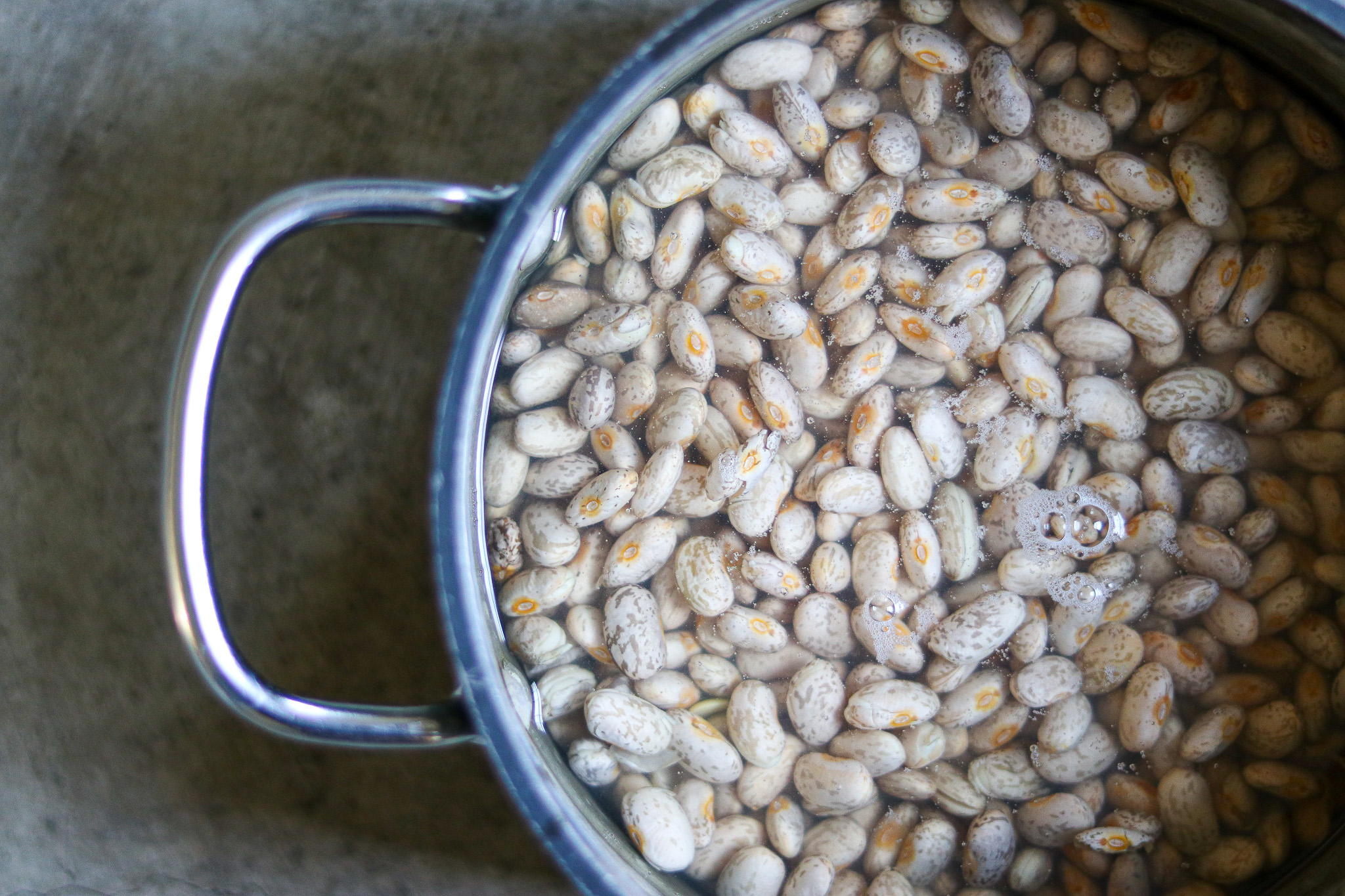
- Wash the beans and put them in a large saucepan with cold water 2 to 3 inches above them. Soak 12 to 18 hours, then drain and throw the water out. For a quick soak instead, boil them 1 minute, take the pot off the heat, and let them stand an hour before draining.
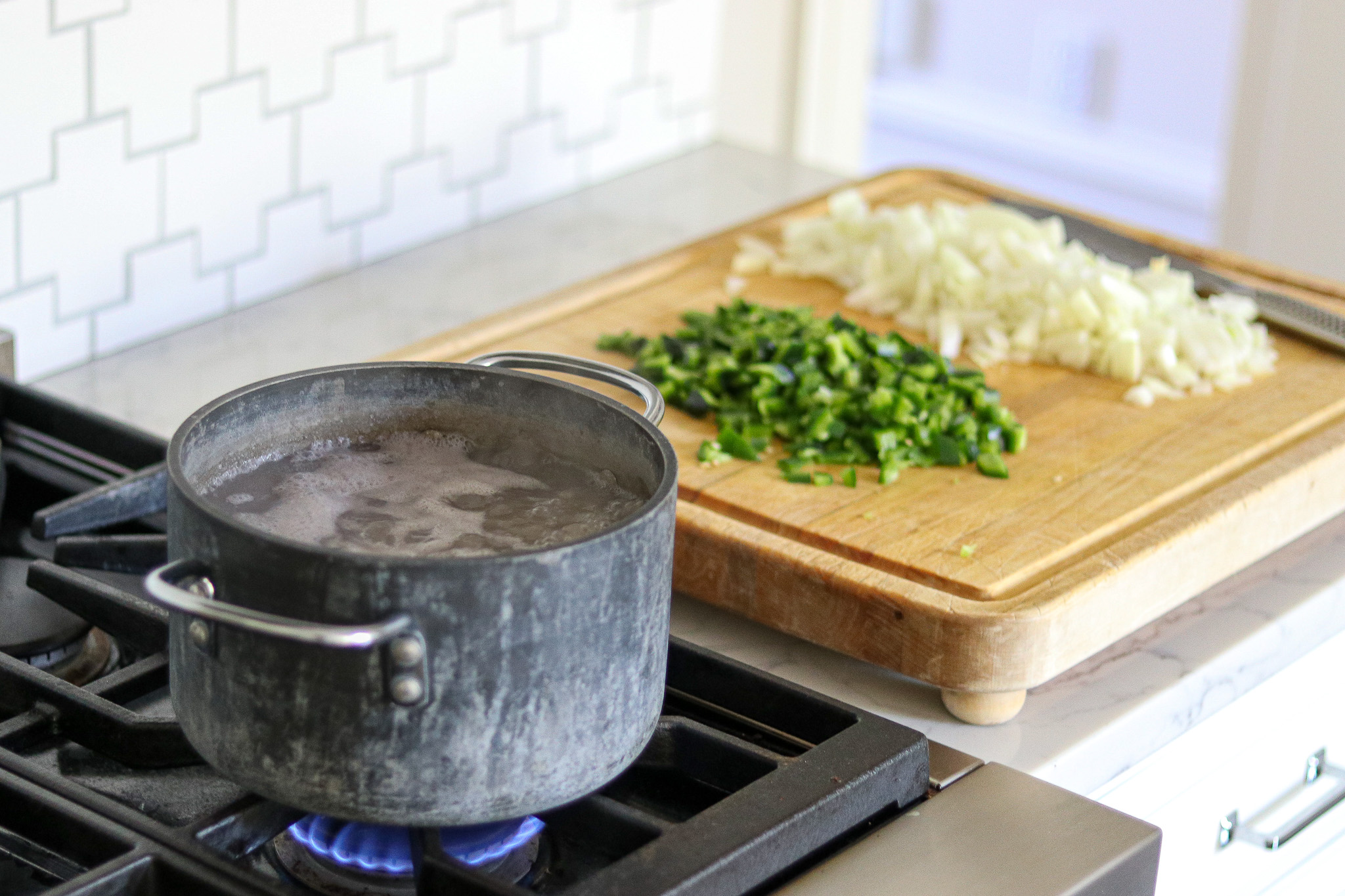
- Cover the drained beans with fresh water and the first measure of salt, bring to a boil, and simmer 30 minutes. Drain again and discard that water too. This is what gets enough water into the beans that they don’t swell in the jars and break them.
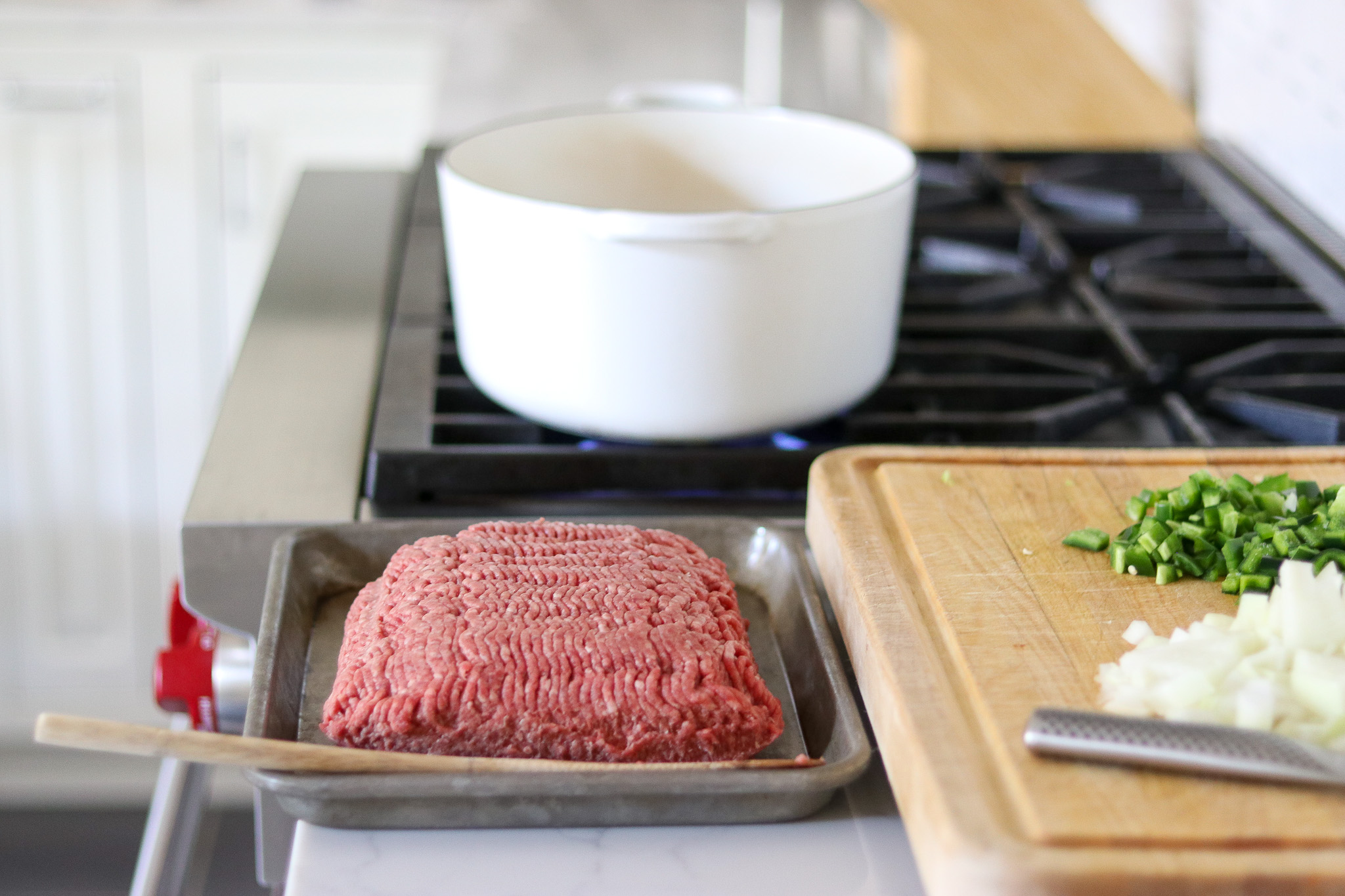
- Get your pressure canner heating with 2 to 3 inches of water and the jars warming inside, then brown the ground beef in a large pan. Browning isn’t optional. Raw ground meat clumps into a solid mass in the jar, and heat can’t get through it evenly.
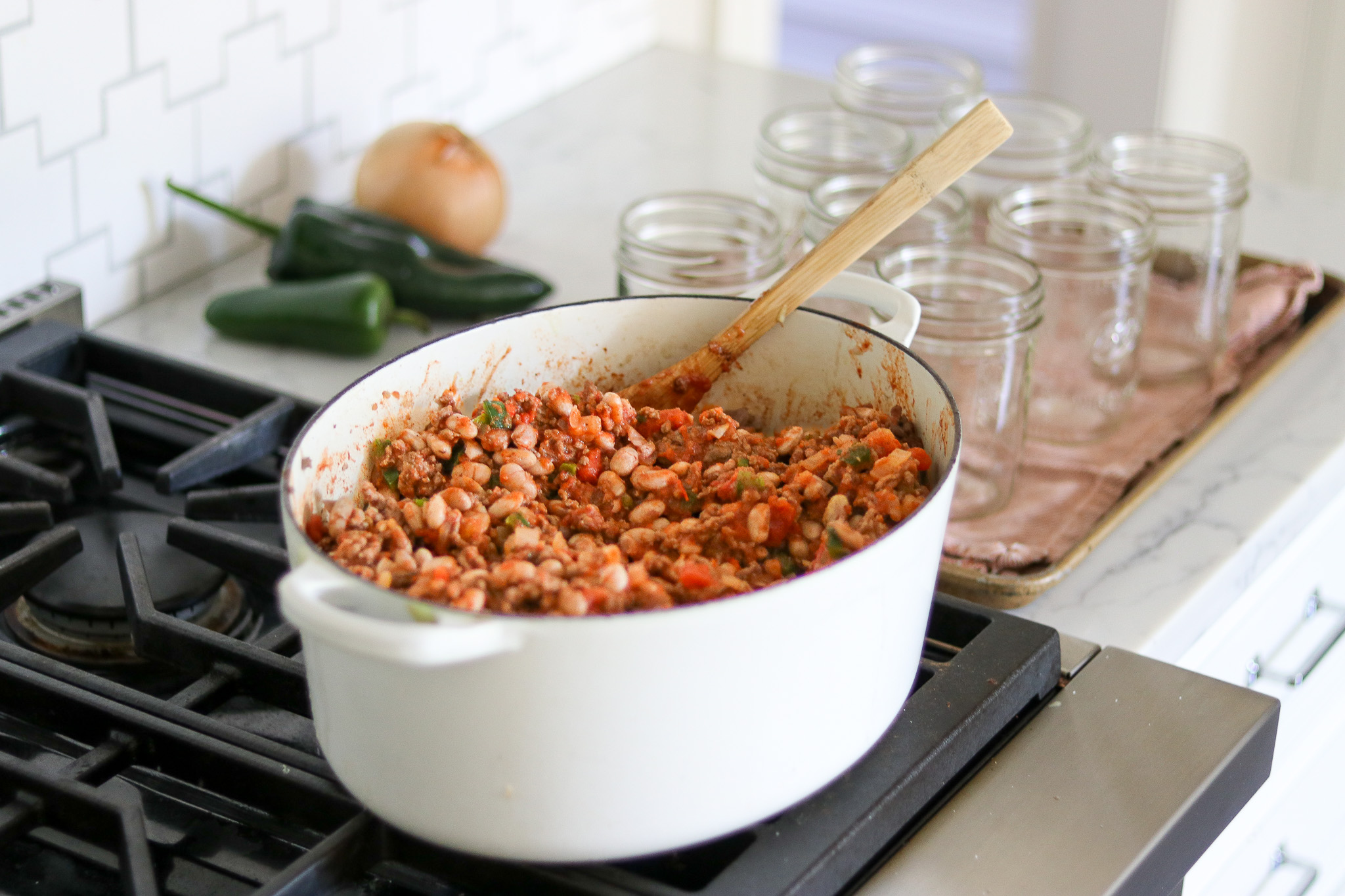
- Add the onions and peppers to the browned meat, drain off the fat, then add the rest of the salt, the black pepper, the chili powder, the tomatoes, and the drained beans. Simmer 5 minutes. It will look thin, and that’s correct. Do not thicken it.
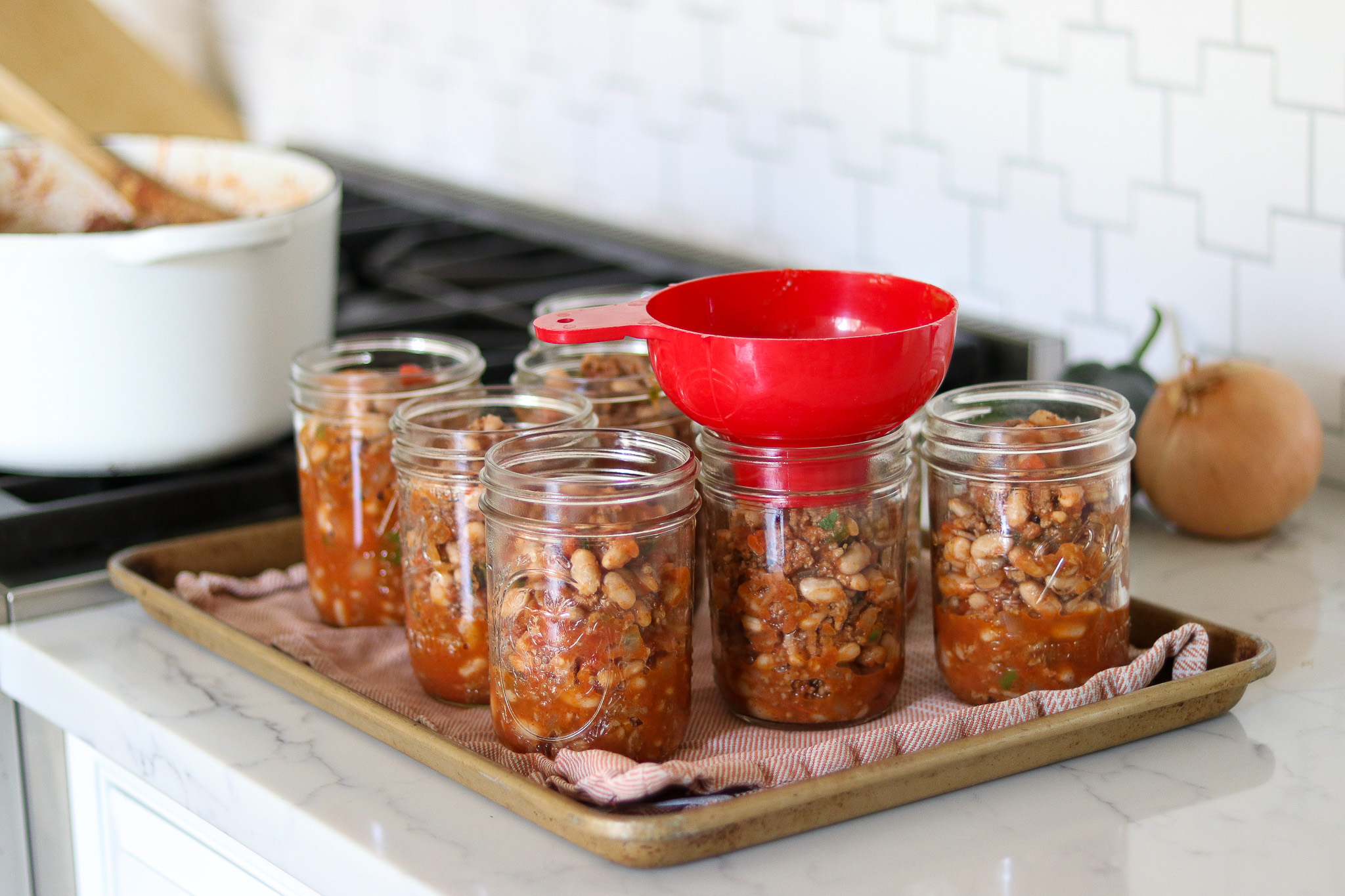
- Line up all 9 hot pints and divide the solids among them with a slotted spoon before you add any liquid. Spreading the solids first is what keeps every jar packed the same, and the pack density is part of what the 75 minutes was tested against.
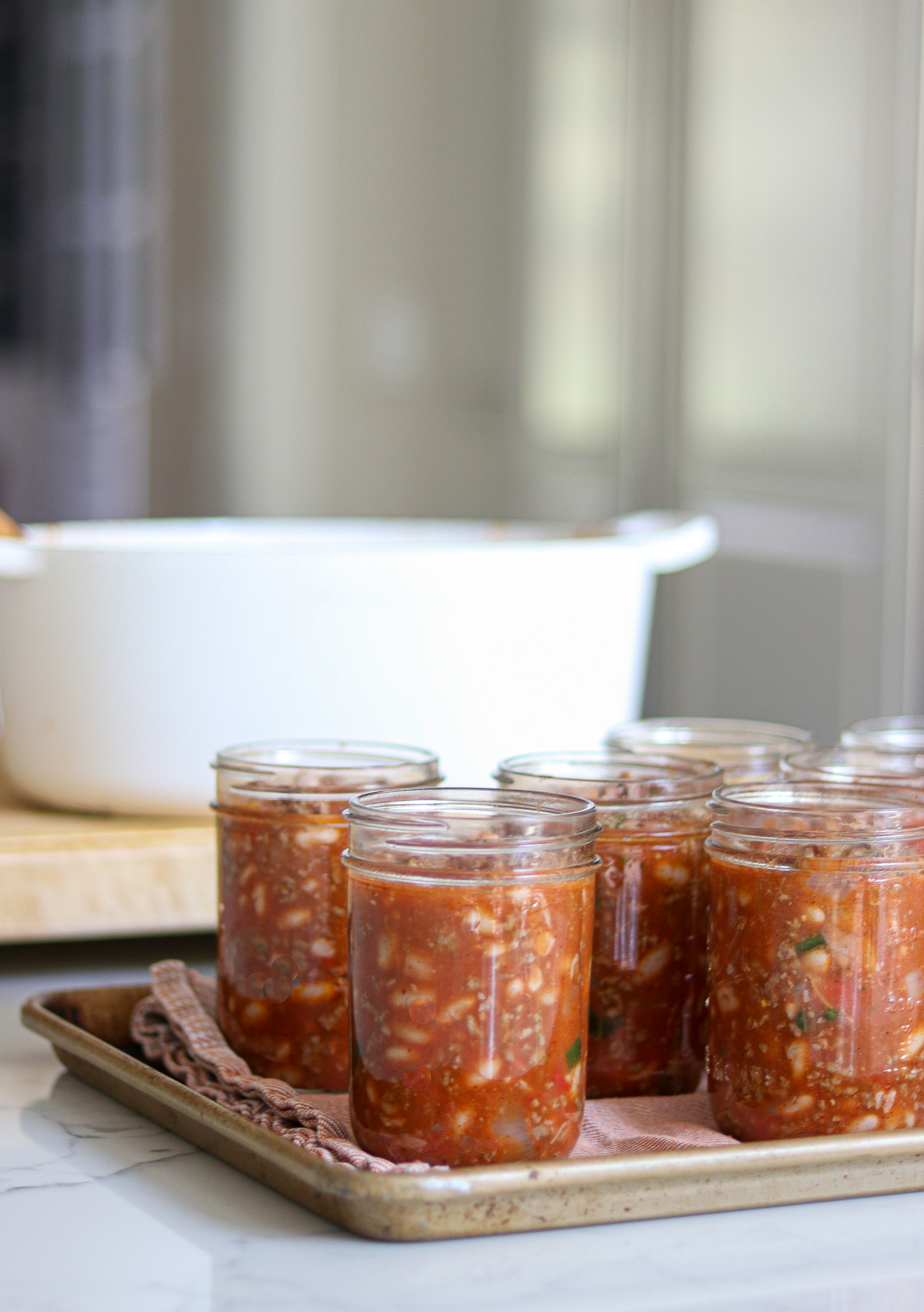
- Ladle the liquid from the pot over the solids. If you run short, top the jars up with boiling water or a little extra tomato. Use all 9 jars even if they look like they’d fill 8 more generously.
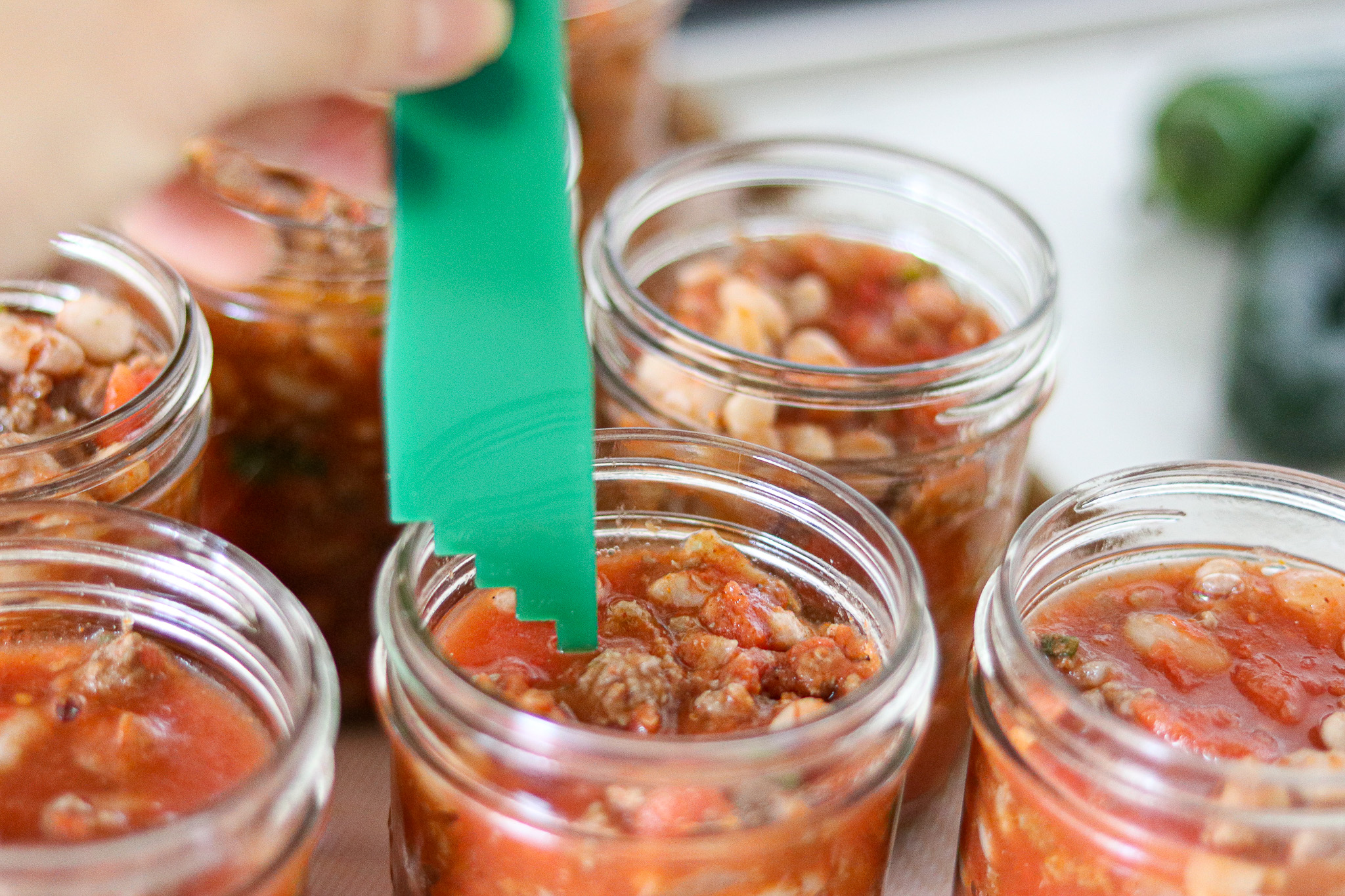
- Run a bubble tool around the inside of each jar, then check the headspace again and adjust to a full 1 inch. A thick chili traps more air than you’d think, so this step moves the level more than it does on a brothy recipe.
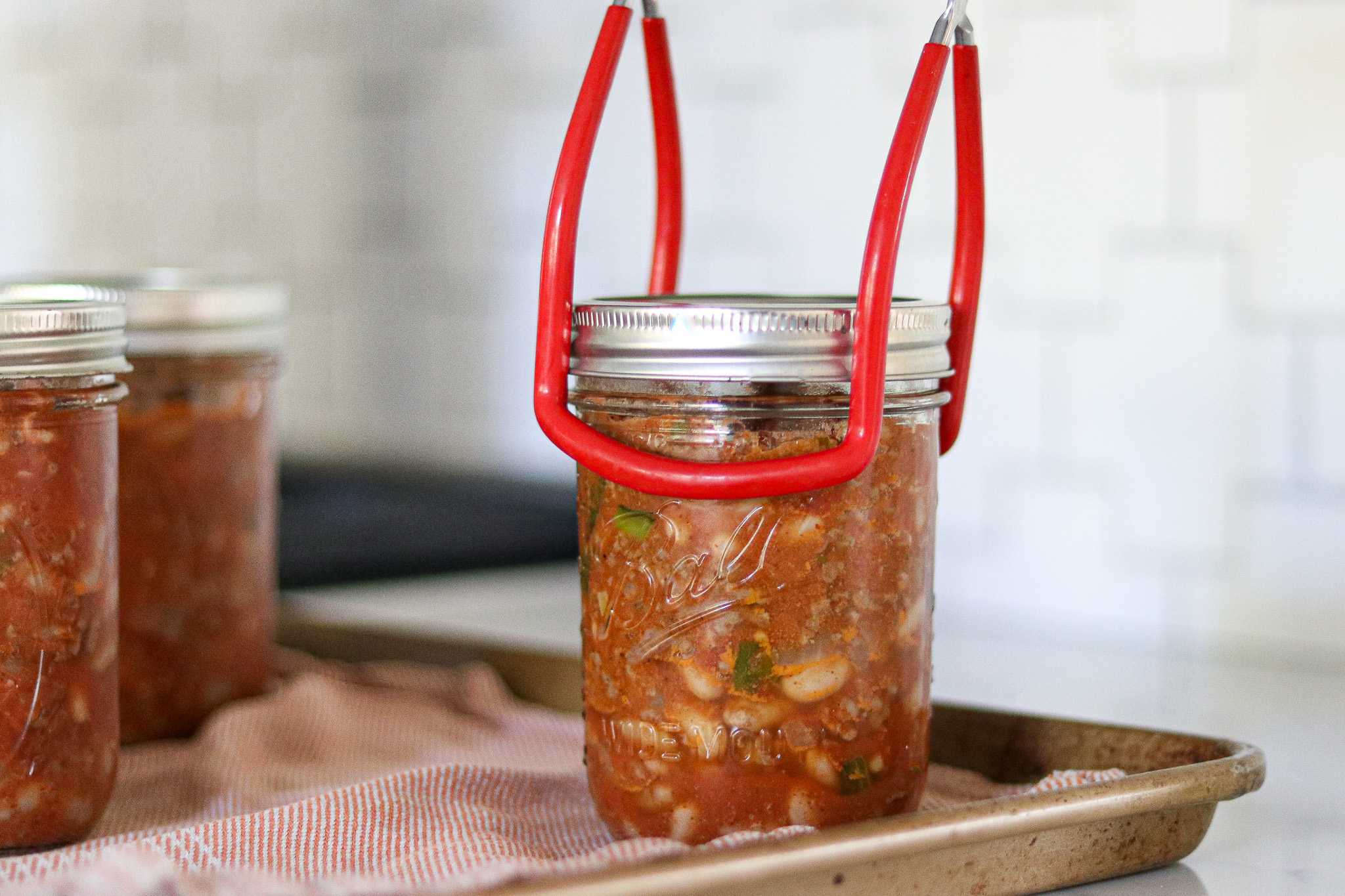
- Wipe the rims and threads clean, apply the lids and bands fingertip tight, and load the jars into the canner with a jar lifter. Chili is greasy, so wipe the rims with a cloth dipped in vinegar if plain water isn’t cutting it.
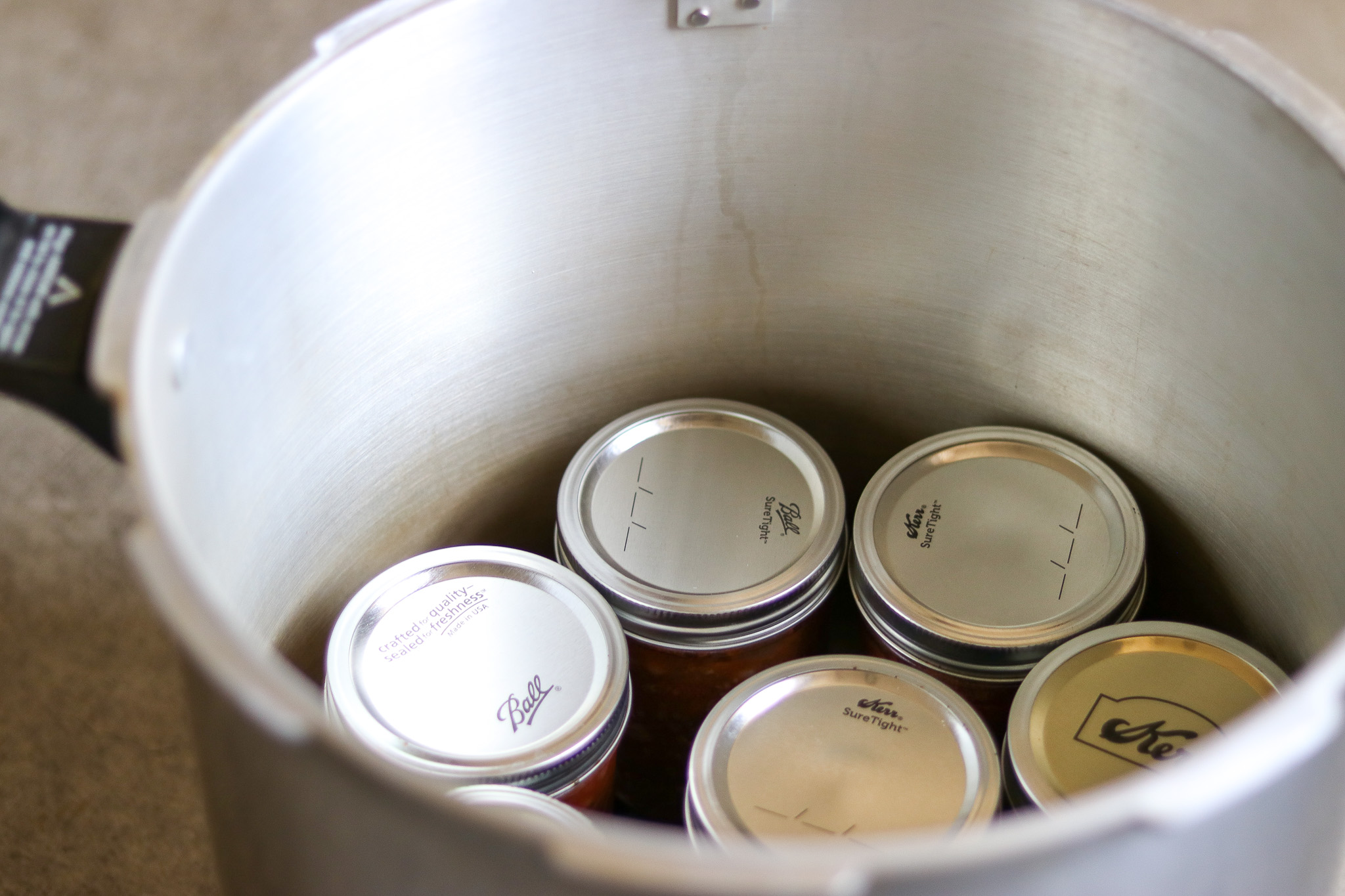
- Lock the canner lid and let steam vent in a steady stream for a full 10 minutes before you add the weight or close the petcock. Venting is what pushes the air out, and a canner with air trapped in it doesn’t reach the temperature the gauge claims.
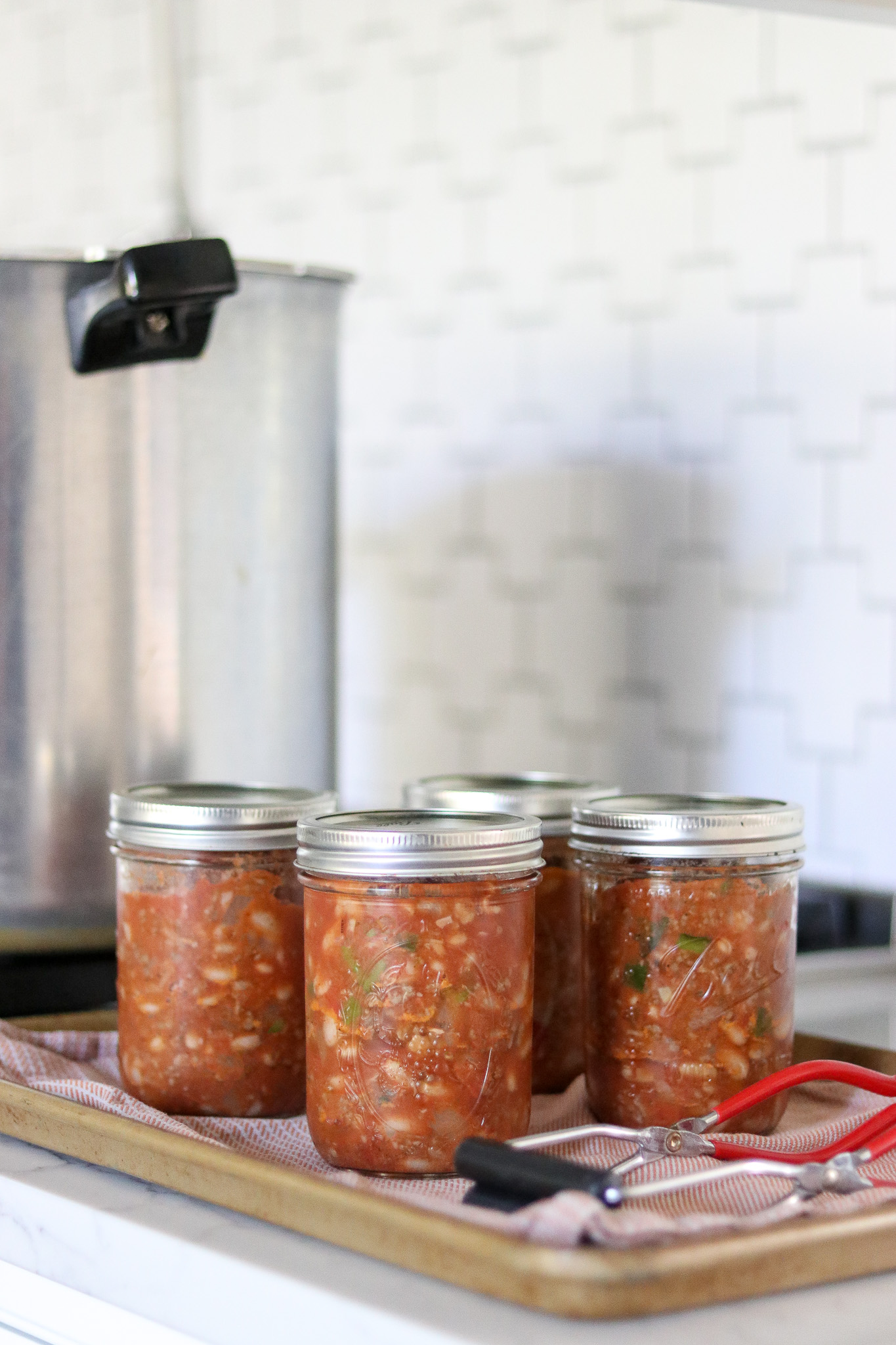
- Process pints for 75 minutes at 10 pounds pressure in a weighted gauge canner or 11 pounds in a dial gauge canner, adjusting for altitude. Let the canner come down to zero on its own, wait 5 minutes, then open the lid away from you.
Canning Chili Con Carne
This is a hot pack, so the jars need to be hot and the chili needs to come off the stove simmering. Get the canner heating while you brown the meat and keep the jars warm inside it.
Chili con carne is low acid, so it has to go in a pressure canner, dial gauge or weighted gauge. A water bath can’t reach a safe temperature for meat and beans, and there’s no tested water bath process for this at any jar size.
Process pints for 75 minutes, at 10 pounds pressure in a weighted gauge canner or 11 pounds in a dial gauge canner. Adjust for altitude with the chart below. The time stays the same at every elevation, and the pressure is what changes. If the pressure drops below your target at any point, bring it back up and start the timer over from the beginning.
Nine pints is a standard canner load, but some smaller canners won’t hold that many. Check your manual before you start. You can halve the recipe for a small canner, and you can double it if yours holds 18.
When the timer goes off, turn off the heat and let the canner come down on its own. Don’t run it under water and don’t lift the weight early. Once it reads zero, let it sit 5 more minutes, then unfasten the lid and open it away from you.
Leave the jars in the canner another 10 minutes before you lift them out. Then set them on a towel with an inch of space around each one, out of a draft, and leave them 12 hours. More recipes that run the same way are in my pressure canning recipes.
Altitude Adjustments
With pressure canning, the canning time is always 75 minutes for pints, at any altitude. Only the pressure changes as you go up. Here are the altitude adjustments for pressure canning chili con carne.
For dial gauge canners:
- 0 to 2,000 feet: 11 lbs pressure
- 2,001 to 4,000 feet: 12 lbs pressure
- 4,001 to 6,000 feet: 13 lbs pressure
- 6,001 to 8,000 feet: 14 lbs pressure
For weighted gauge canners:
- 0 to 1,000 feet: 10 lbs pressure
- Above 1,000 feet: 15 lbs pressure
Serving Chili Con Carne
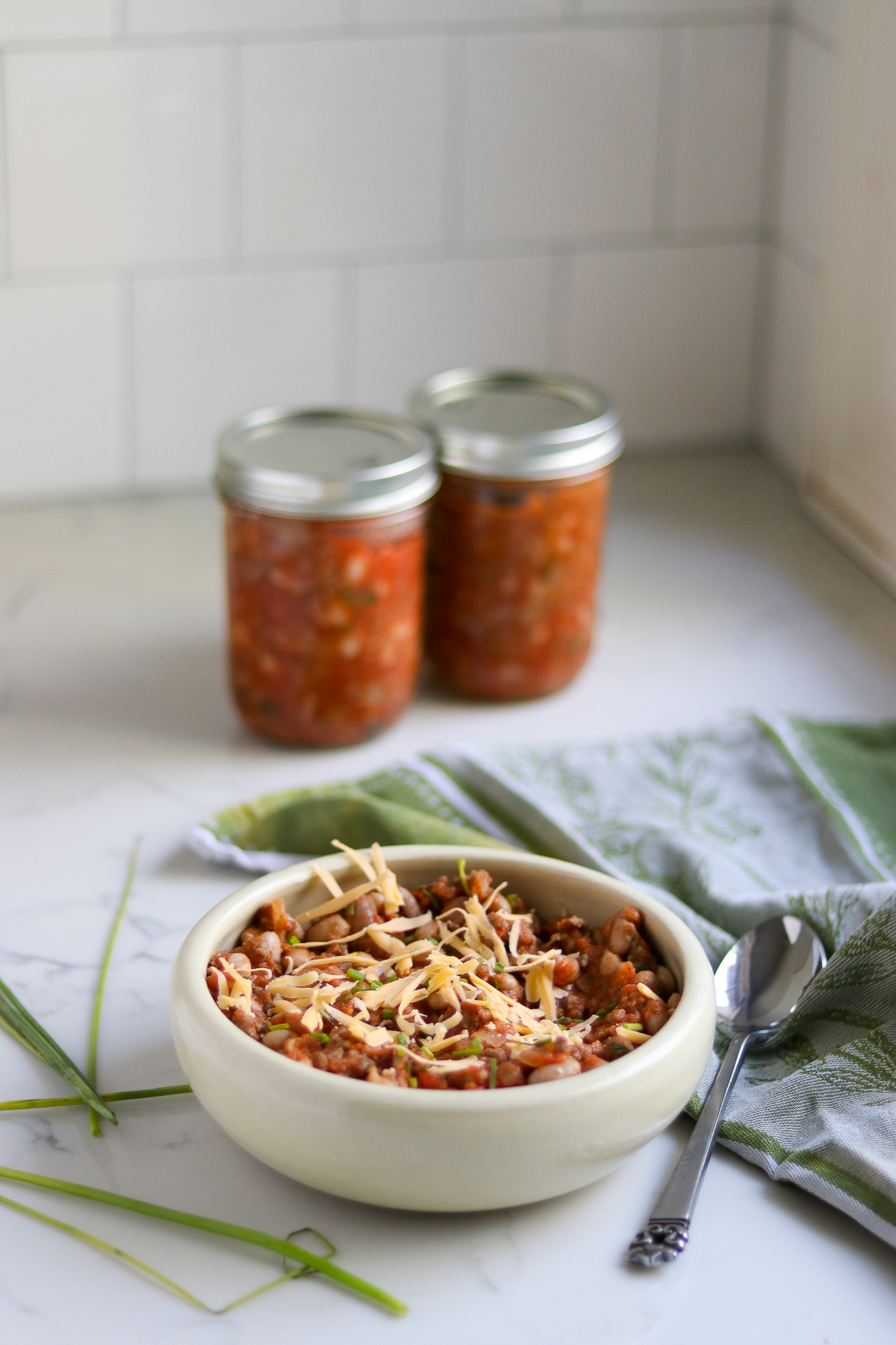
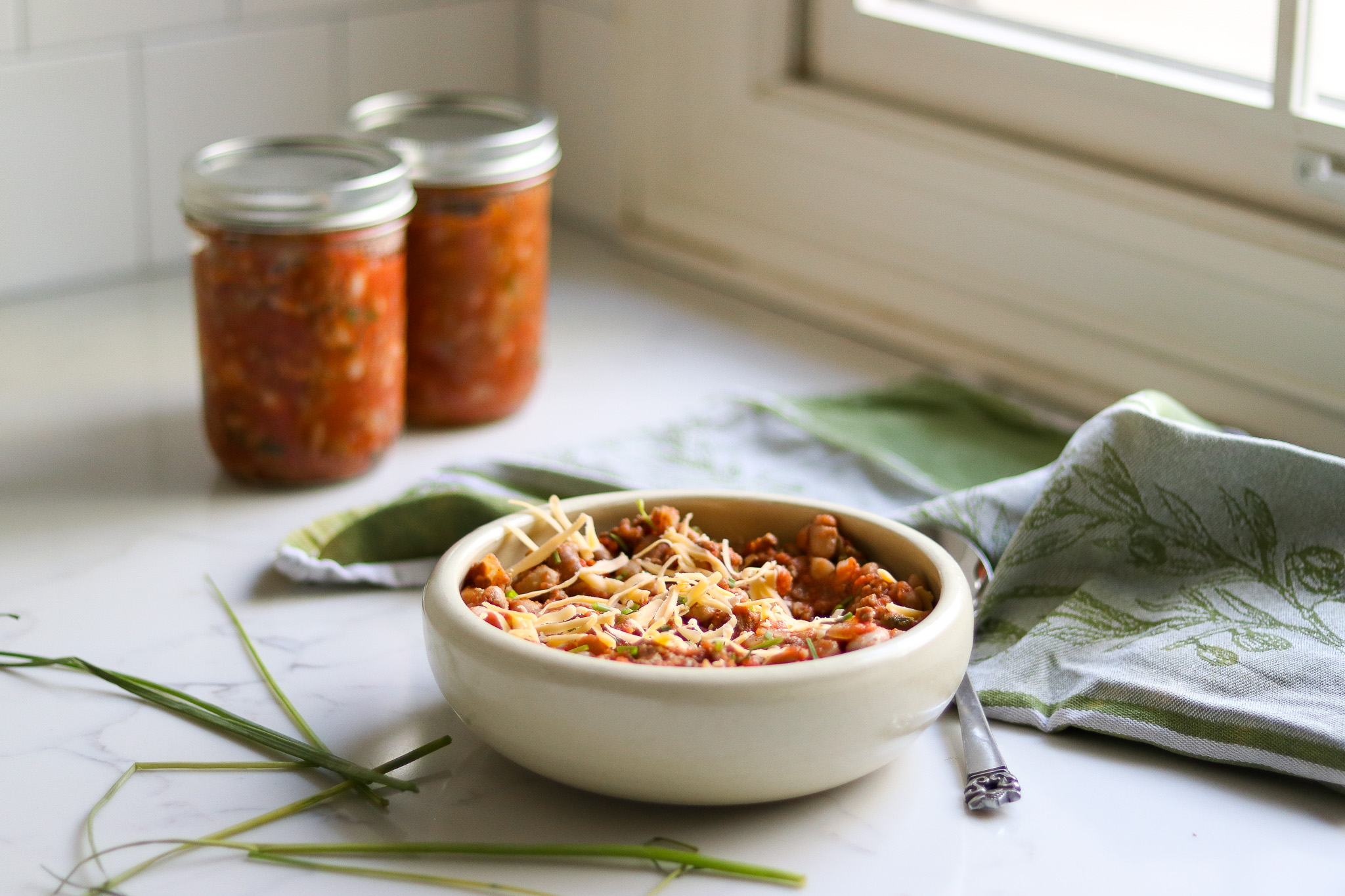
There’s nothing to do but heat it. Tip a jar into a pot, warm it through, and it’s dinner. A pint is a generous bowl for one or a normal one for two.
Everything that makes chili good goes on at the table, and most of it is off limits in the jar anyway. Grated cheese, sour cream, diced raw onion, cilantro, and a squeeze of lime all belong here rather than in the canner.
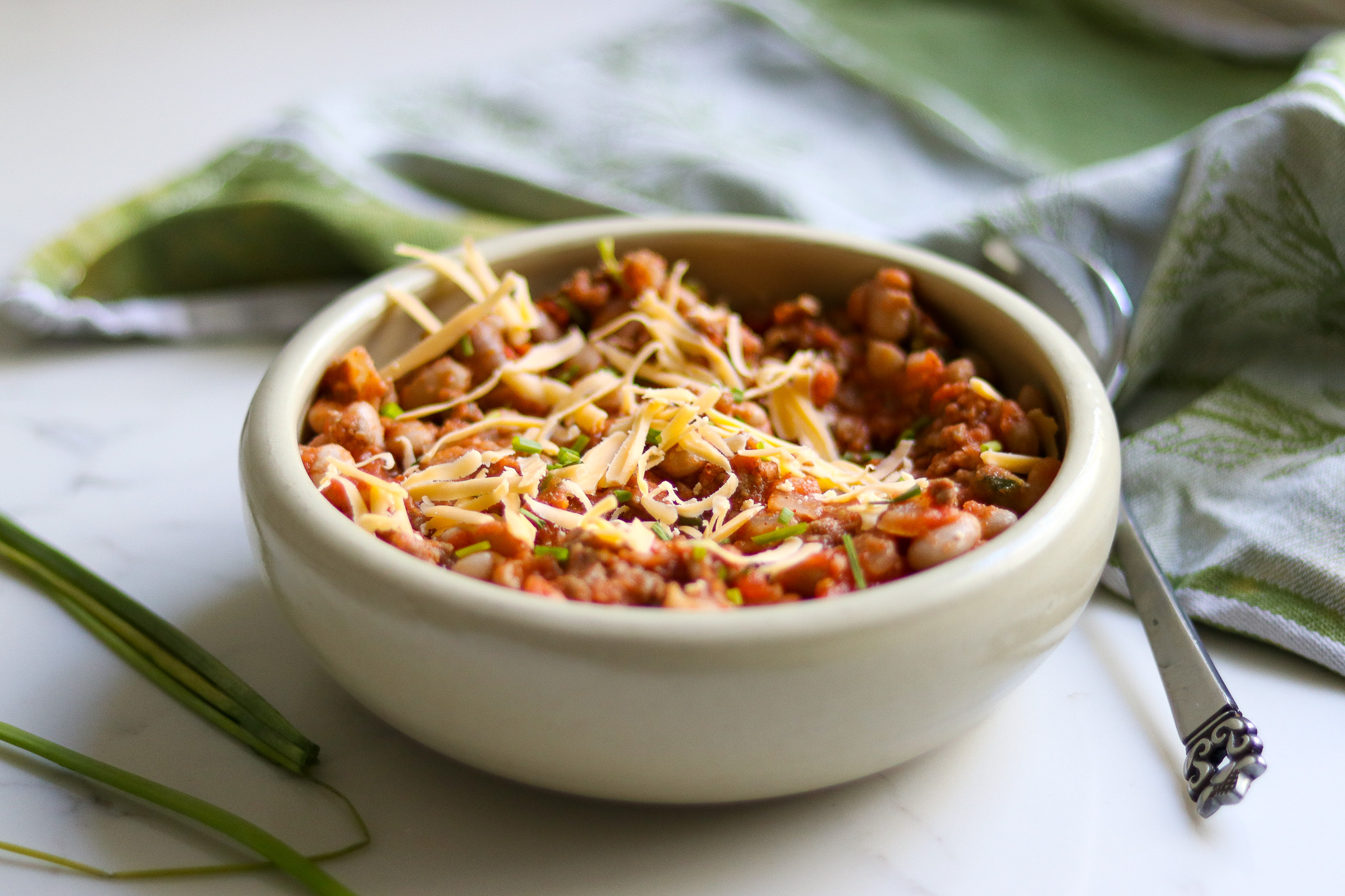
If your jar came out thinner than you like, thicken it in the pot. A spoonful of masa harina or cornmeal stirred in and simmered a few minutes is the traditional fix, and it adds flavor. Cornstarch slurry works too.
Past a bowl of chili, a jar covers a lot of ground. Spoon it over rice, baked potatoes, or corn chips for nachos, fold it into a burrito, or ladle it over a hot dog. It also makes a fast chili mac stirred into cooked pasta.
More dinners that open this easily are in my meal in a jar canning recipes and my bean canning recipes.
Storage and Shelf Life
Once the jars are cool, press the center of each lid. A sealed lid curves down and doesn’t move or click. Take the rings off before you store them, since a ring left on can hold a failed lid in place and hide a jar that never sealed.
Label them and store them somewhere cool, dark, and dry. Sealed jars hold their quality for 12 to 18 months, and they stay safe past that as long as the seal holds and they were processed correctly in the first place.
Some liquid loss during processing is normal on a jar this thick, and it isn’t a safety problem as long as the jar sealed. The NCHFP treats siphoning as a cosmetic issue. A jar that didn’t seal goes in the fridge and gets eaten within a week, or gets reprocessed with a new lid for the full time if you catch it within 24 hours.
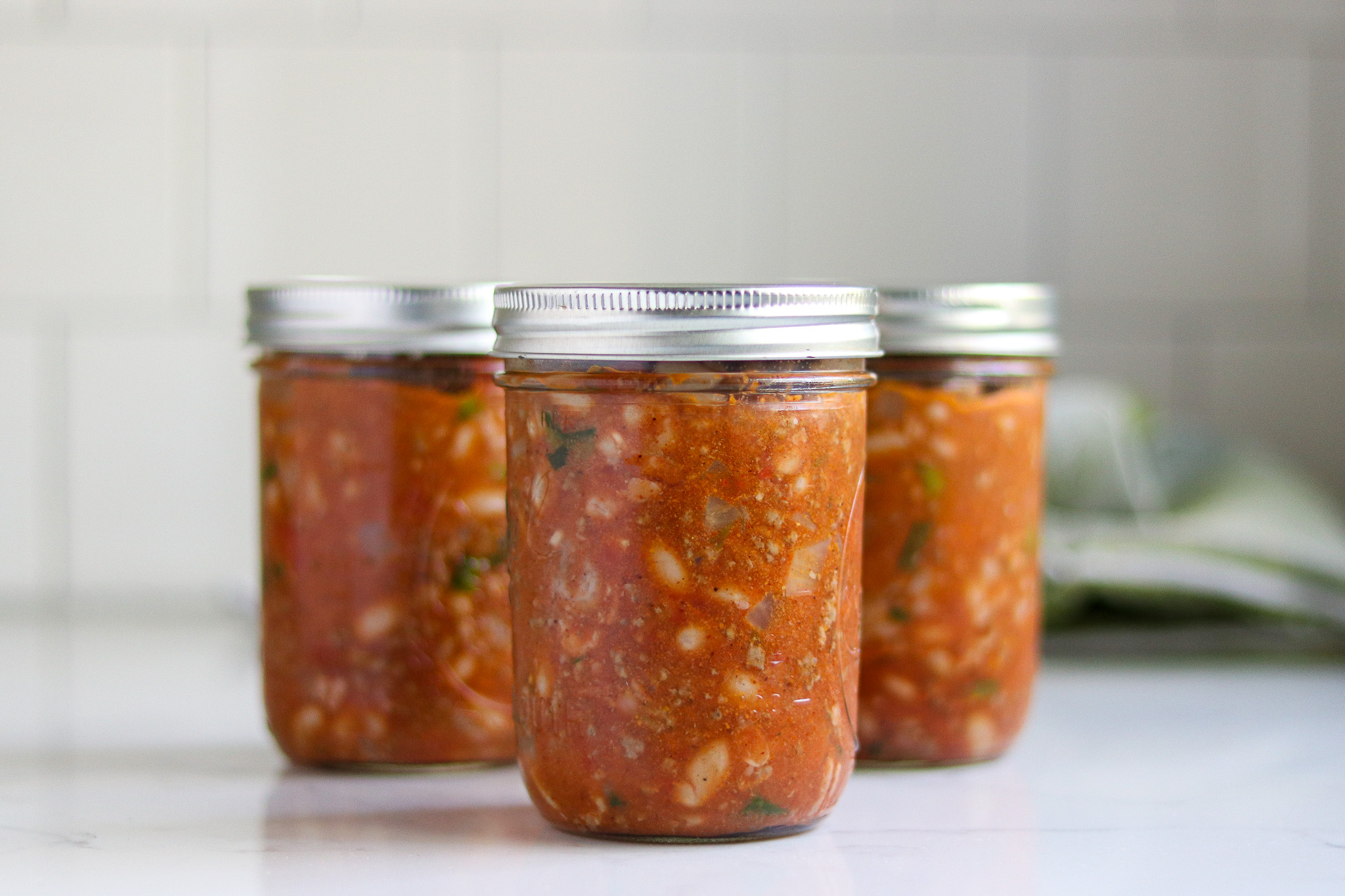
Yield Notes
The batch is 9 pints and the jar count matters. Filling 8 jars instead of 9 packs each one denser than the process was tested for. If you come up short of liquid, top the jars with boiling water rather than using fewer jars.
Check your canner before you start. Nine pints is standard, but smaller canners won’t take that many. Halve the recipe for a small canner, or double it to 18 pints if yours is big enough.
Three cups of dried beans is about 1 1/2 pounds. That’s most of a 2-pound bag, and it roughly triples on the way to the jar.
Canning Chili Con Carne FAQs
These are the ones readers ask most in the comments.
No. Chili con carne is low acid, and a water bath canner doesn’t get hot enough to make meat and beans safe on the shelf. Boiling a jar for a long time doesn’t substitute for pressure, and there’s no tested water bath process for this at any jar size. It needs a pressure canner.
No. The USDA tested this recipe in pints and never published a quart process, so there isn’t a time to give you. It isn’t that quarts are known to be unsafe, it’s that nobody has run the heat penetration study, and a jar packed with beans and ground meat is exactly where that matters. Wide mouth or regular pints both work, and half pints are fine at the full pint time.
Yes, and it saves the longest part of the recipe. Canned beans are already cooked, so you skip the overnight soak and the 30 minute pre-cook and start at the browning step. Use about 8 to 9 cups of drained canned beans in place of the 3 cups dried, which works out to roughly five 15-ounce cans. Measure the cups rather than counting cans, since a drained can runs between 1 1/2 and 1 3/4 cups. You can keep the canning liquid or rinse it off.
Any ground meat works pound for pound, so venison, pork, lamb, turkey, or chicken all substitute. Loose Italian sausage is good here as long as it isn’t cased. Chunks of meat work in place of ground. You can also leave the meat out entirely for a vegetarian chili, which is a safe change since it only removes a solid rather than adding one.
Sealed jars in a cool, dark cupboard hold their quality for 12 to 18 months, and they stay safe past that as long as the seal holds and they were processed correctly. The beans soften over time. Once you open a jar, refrigerate it and use it within three or four days.
Meal in a Jar Canning Recipes
More whole dinners you can open and heat:
If you tried this Canning Chili Con Carne recipe, or any other recipe on Creative Canning, leave a ⭐ star rating and let me know what you think in the 📝 comments below!
And make sure you stay in touch with me by following on social media!
Canning Chili Con Carne
Equipment
- Canning Jars, Lids and Bands
Ingredients
- 3 cups dried kidney beans, or pinto, see notes
- 5 1/2 cups water, for the bean pre-cook
- 2 tsp canning salt, for the bean pre-cook water
- 3 lbs ground beef
- 1 1/2 cups onion, chopped
- 1 cup peppers, chopped, sweet or hot, optional
- 2 quarts tomatoes, whole or crushed
- 3 tsp canning salt, for the chili
- 1 tsp black pepper, ground
- 3-6 Tbsp chili powder, to taste
Instructions
- Wash the beans and put them in a large saucepan. Add cold water to a level 2 to 3 inches above the beans and soak them 12 to 18 hours, then drain and discard the water.
- To quick soak instead, cover the beans with water, bring them to a boil, boil 1 minute, then take the pot off the heat and let them stand 1 hour before draining.
- Combine the drained beans with 5 1/2 cups fresh water and 2 tsp of the salt. Bring to a boil, reduce the heat, and simmer 30 minutes. Drain again and discard that water.
- Prepare the pressure canner, 9 pint jars, lids and bands. Put the trivet in, add 2 to 3 inches of water following your manufacturer’s directions, and bring the canner to a gentle simmer with the jars warming inside it.
- Brown the ground beef in a large pan, then add the onions and peppers. Drain off the fat.
- Add the remaining 3 tsp salt, the black pepper, the chili powder, the tomatoes, and the drained beans. Simmer 5 minutes. The mixture will look thin, which is correct. Do not thicken it.
- Divide the solids evenly among all 9 hot jars with a slotted spoon, then ladle the liquid over them, leaving 1 inch headspace. Top up with boiling water if you run short of liquid.
- Release trapped air bubbles, then check the headspace again and adjust to a full 1 inch.
- Wipe the rims and threads clean, set the lids on, and apply the bands fingertip tight.
- Load the jars into the pressure canner, fasten the lid, and vent a steady stream of steam for 10 minutes before adding the weight or closing the petcock.
- Process pints for 75 minutes at 10 pounds pressure in a weighted gauge canner or 11 pounds in a dial gauge canner, adjusting for altitude (see notes).
- Turn off the heat and let the canner depressurize on its own, then wait 5 minutes before removing the lid, opening it away from your face.
- Leave the jars in the canner another 10 minutes, then remove them to a towel lined counter and let them cool undisturbed for 12 hours.
- Check the seals, remove the rings, label the jars, and store them in a cool, dark place.
Notes
- 0 to 2,000 feet: 11 lbs
- 2,001 to 4,000 feet: 12 lbs
- 4,001 to 6,000 feet: 13 lbs
- 6,001 to 8,000 feet: 14 lbs
- 0 to 1,000 feet: 10 lbs
- Above 1,000 feet: 15 lbs
Nutrition
Nutrition information is automatically calculated, so should only be used as an approximation.
Bean Canning Recipes
Chili beans aren’t the only beans you can put in a jar:
Find the perfect recipe
Searching for something else? Enter keywords to find the perfect recipe!

Hi! Can I use canned beans instead of dried?
Thanks, Sue
Yes. I just updated the post to include instructions for already-canned beans. Enjoy!
Hi! I was wondering if Italian Sausage could be subbed for the ground beef in this recipe?
Yes, Italian sausage will work wonderfully in this recipe. Just make sure it’s loose pack (not cased). Enjoy!
I will make this but add cumin. I think that makes it chili.
I usually add cumin to my chili too. I left the recipe as they had it, but you can always adjust the dry spices in canning recipes to suit your tastes (and I do too). Enjoy!
Hi there, I really appreciate your information sharing. I’m learning a lot from you!
Can you please clarify ‘canned tomatoes’ – can I use commercially canned tomatoes from the grocery store? Or are you referring to fresh tomatoes you previously canned yourself?
Thanks!
You can use tomatoes that are commercially canned or tomatoes that you canned yourself, either way.
I don’t eat red meat , can I use chicken or tofu instead?
You cannot use tofu, but you can substitute chicken.
The taste was just amazing & directions brilliant.
So glad you enjoyed it!
I would like to add Hatch green chilis to this recipe. I get roasted green chilis every year, de-seed them, peel them and freeze in recipe-ready portions. Can I use these or would I need to use fresh chilis to include them in canning the chili con carne? Thanks.
You can use frozen hatch chilis in this recipe in place of the 1 cup peppers. Any type of peppers is allowed here, and from the freezer works just fine. Enjoy!
Hi Ashley,
Thank is for this recipe! I make a batch yesterday and tho a that the jars have cooled, they look a bit “dry” ? Not as much liquid I would expect. It looks like a little bit did seep out while canning. Do I need to be concerned about this?
This recipe does come out looking a bit dry, especially with the beans in there soaking up liquid. So long as the jars are sealed and were processed the proper time, you’re good safety wise. (Siphoning or liquid loss during pressure canning isn’t a safety issue, it’s a cosmetic issue, as odd as that sounds. At least according to the NCHFP.)
Everything is good
Lovely, glad you enjoyed it!
Hi there. I love your recipe for chili and would like to know if I could add other vegetables like zucchini
Thanks Heather
Recipes that are bean heavy are hard to modify safely, or at least, safe modifications haven’t been tested. If you’re looking to create your own recipes, I’d suggest taking a look at my article on creating your own meal in a jar recipes here: https://creativecanning.com/choice-meal-in-a-jar-canning-recipe/
Zucchini in particular is problematic since it tends to get really pasty when canned, so it’s not an approved ingredient.
Hi Ashley, Is it possible to substitute sweet potatoes for the beans? Would that affect the canning process?
This recipe is from the NCHFP, but it uses the processing times for “hearty soups” from the University of Alaska Extension (Publication FNH-00065). Their guidance allows you to make quite a few changes to recipes, but sweet potatoes are one of the things that’s explicitly not allowed. You can substitute in lots of veggies or meats, but not “greens, cream-style corn, winter squash, or sweet potatoes in Hearty Soup recipes.”
Regular potatoes, however, are fine according to their logic.
I have a different recipe I use and would like to can. How do I safely pressure can it? I am very particular in what I eat and what my food contains and once I find a recipe I like, I prefer not to deviate from it. What do I need to take into account?
If you look up the University of Alaska Hearty Soups canning instructions (publication FNH-00065) it will walk you through the allowed changes to a recipe like this. For the most part, the only things not allowed are things without canning instructions (cabbage, etc) or things not allowed for canning in general (flour, butter, etc). Beyond that, you’re not allowed to use “greens, cream-style corn, winter squash, or sweet potatoes in Hearty Soup recipes.” But, provided your recipe has plenty of liquid in it, and none of the “not allowed” ingredients, it may be able to be canned as you wish.
Oh, and my method, which may have a madness to it, but worked fine for me: did the one-minute boil and one-hour soak on the beans, browned grounds beef&pork in the airfryer (took 3-4 batches), meanwhile chopping/mandolining and sauteing the veggies. Added the tomatoes and spices (3T oregano, 2T basil, 6T homemade chili powder (ground up dried ancho, guajillo, and chilis d’arbol, and 3T cocoa powder), BTW, a slow cooker is great for keeping things at proper heat for canning if you have to batch stuff. The recipe came up short WRT the jars, (I am in Canada, so we have 500 ml jars, whereas pints are 473 ml) so I back-filled w more canned diced tomatoes. Worried that I was on the edge of poisoning my family, but hey, we’re olds so it doesn’t matter so much …
Anyway, we ate a test jar, it was magnificent. A thousand thanks.
Filling the extra space with tomatoes is a great idea, and that’s a perfectly fine addition. You’re definitely allowed to add extra tomatoes to this recipe without issue. You can also fill the extra space with water, but less flavorful that way. So glad you enjoyed it!
Hi
Instead of canned tomatoes., would tomatoe juice also work?
Thanks
Yes, you could use the same volume of tomato juice in place of canned tomatoes. That’d make the mix less thick, which is fine for pressure canning.
Hi Ashley, Because of you and your breezy and clear instructions I have been canning stuff for about two months (spring 2024), although I have had my pressure canner for (cough) some time. Um, since Covid lockdowns, actually. But I was terrified of it and the more I read, the more terrified I got. The recipes seemed so arcane, inconsistent, and totally lacking in theory. The USDA stuff in particular is totally unscientific and cannot be made sense of, it is more like a religious ritual. There must be a General Theory of Canning, but don’t look to the USDA for it. Also, I have to wonder about what they decided to test and what not to test. And no, can’t use celery since not in canning quide, but they put it in their spaghetti sauce. What would we have to do to get them to test quarts of chili? Or celery, for that matter? I like to put fennel (bulb) in my spaghetti sauce, fennel not in list of can-ables. Nor rapini, leeks, raw garlic, shallots, and a whole lot of ‘modern’ vegs and fruits. Did their budget get cut? Sigh, But I digress….
I want tom thank you for your calm and engaging directions, from the chatty articles to your comforting comments and answers to anxious canners. So, reporting: Canned 18 pints of chili con carne two weeks ago, splendid!. Have done some other stuff, too, will pop by those recipes and gush a bit.
Thank you so much Dawn, and I’m so glad you’re getting into canning. It’s a lot of fun once you take the leap =)
Would it be possible to use this recipe and sub ground turkey for beef? I have been scouring and cant find anything. I got a great deal on turkey today and i usually sub turkey as a lower fat alternative for the family and they dont even realize it 🙂 Thanks!
Yup, you can use any ground meat in this recipe. Enjoy!
This looks great! Just wondering if it would be okay to leave out the meat to make it for a vegetarian meal? And would adding a bit of garlic and ginger be okay? Thanks for the help!
Yup, leaving out the meat is perfectly fine in this recipe. And yes, you can add any dry spices you like, so ginger and garlic are great. Enjoy!
how long will this recipe be good for? It sounds delicios! Can’t wait to try it!
Home canned recipes generally maintain peak quality for 12-18 months. After that, quality goes down, but they’re still safe to eat as long as the jars are sealed (and they were properly canned in the first place).
Can dry lentils be safely swapped for the dry beans (as long as you follow the same soaking process)? Thank you in advance.
Probably? But you’ll have to work out exactly how to adjust the recipe there, and realize that it’s not a specifically tested recipe so you’re at your own risk for that one. The University of Oregon says that canning lentils are equivalent to canning beans, but in my experience, they tend to fall apart more than beans and may result in a thicker product. I would add more liquid to the recipe to make sure it’s not too thick in the jars.
Hi! I’m so excited to get started as I have always canned soups but no meats.
How long is the shelf life in Canning meaty recipes? I have soups good for years.
Thanks, Deborah
They maintain peak quality for 12-18 months, but they’re good indefinitely provided the jars are still sealed and they were processed correctly.
Are purchased, canned, kidney beans safe to use in canned chili? Do you have to drain the sauce or would you use the whole can as is? I am just feeling my way along since you say a lot of things aren’t tested yet and are unsafe.
I intend to prepare my own dried beans but have a few cans of canned beans that I need to use up first.
You are such an inspiration to me and I refer to your information often. I purchased a pressure canner a couple of months ago and love it. I was always afraid to try pressure canning as lots of people seemed to have them blow up. If you follow the instructions, that is not happening. I am 81.
Thanks so much for all of your hard work and information, Ashley!
Kathryn
Hi Kathryn, I’m so glad you’re canning at 81, that really makes me smile. For the canned beans, yes, you can use store bought canned beans in place of the dry beans, but the process would be a bit different. You don’t soak them or pre-cook them.
In this particular recipe, the beans are soaked and then pre-cooked for 30 minutes. If you’re using canned beans, you’d just pick up at that point. You can keep the bean liquid from the can, or strain it and rinse the beans, either way is fine.
Using canned beans in this recipe actually makes it a lot simpler and quicker to get it in the canner, and it’s perfectly fine from a canning safety perspective.
Enjoy!
I made the chili as my first canning project with meat!!! This was delicious and a wonderful experience!!! I have a Nesco electric pressure cooker. I love it but have only used it for jams and jellies. Likewise, this is a big game changer now that I can meat/poultry /soup/ I love if more as we lose power regularly here in Mi and now knowing how and the simple instructions I can make sure my pantry is well stocked. Thanks so much.
So glad you enjoyed it!
Hello,
Just a quick question. Can this be pressure canned in a wide mouth quart jar also? Or is there a reason to use only pints? What would be the timing and pressure for a for quarts if they are safe to use?
Thank you again!!
Colleen
You can use wide mouth or narrow mouth jars for this recipe, so long as they’re pints. For some reason, the USDA didn’t test this one in quarts (yet) and there is not an established time. I do believe there are other chili recipes that have been tested in quarts, I’ll see if I can find any of them in my canning books and let you know if I do.
Can you use fresh tomatoes not canned?
Yes, fresh or canned both work in this recipe.
I’m new to the pressure canning world and I have a few questions.
Would I use the 75 mins of canning time for your chili recipe in my NESCO pressure canner for the 0 to 1,000 feet in elevation – 10 lbs pressure canner?
I would like to make your chili recipe but I am not sure of the proper time to pressure can.
Split pea, Chili, pot pie, etc… I would love to have some directions of time so that my soups, and meats won’t spoil in their jars.
Thanks.
Yes, the canning time is 75 for pints. The Nesco canner is considered a “Weighted Gauge” canner and you would use the 10 pound weight if you’re under 1000 feet in elevation.
Would it be ok to sauté the onions before cooking the beef, and then cook them together? Or do the onions need to be added after the beef is cooked?
Yes, you can definitely sautee the vegetables first. In the pre-cooking phase, you can do whatever you’d like here, but the important parts are to make sure the meat is browned first (so it doesn’t clump when canned) and to make sure everything simmers together for 5 minutes so everything goes into the jars hot. Beyond that, however you cook things before they go into the jars is fine.