
This post may contain affiliate links. Please see our disclosure policy.
The Ball Blue Book of Preserving was originally written in 1909. The first edition was called “The Correct Method for Preserving Fruits.” The title changed several times in the last century, but we now know it as The Ball Blue Book of Preserving.
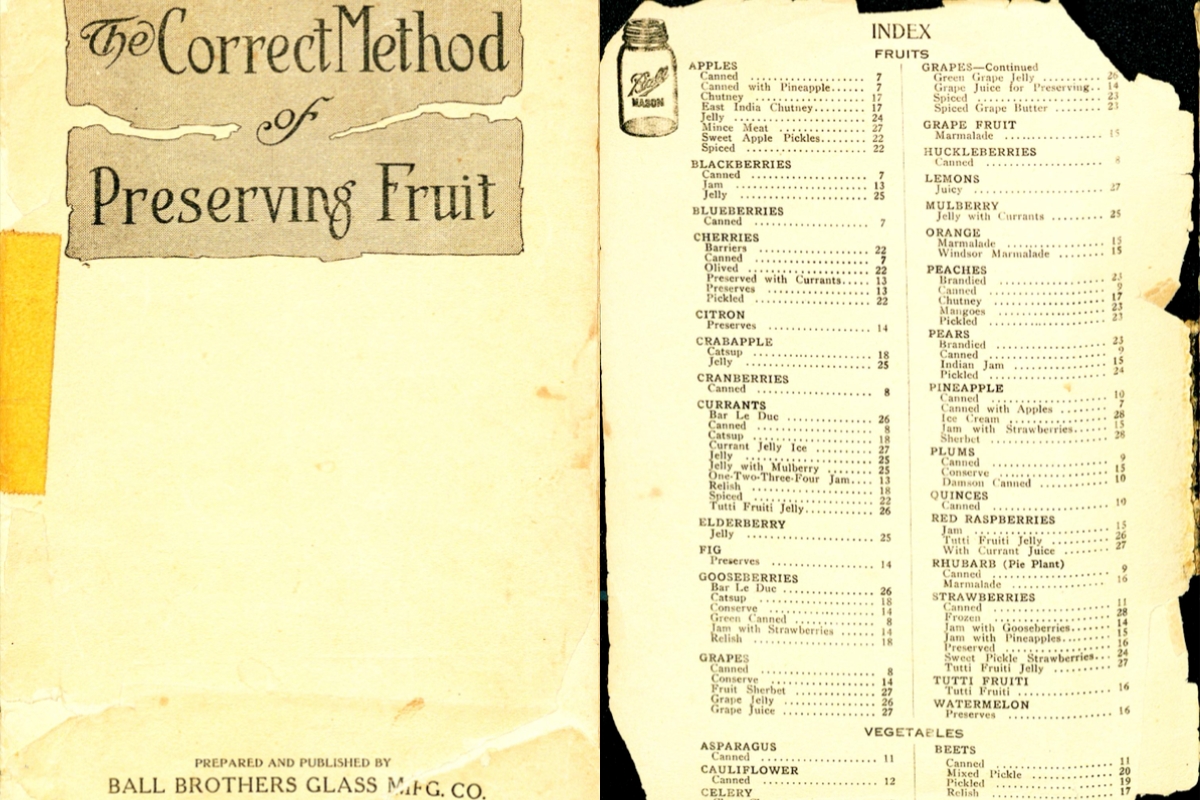
Table of Contents
Most people think of home canning as an old-time food preservation technique, but it’s really only been around for the last 100 years or so.
Arguably, a hundred years is “a long time,” but centuries of food preservation (salting, curing, potting, etc.) led up to this “new method,” which was a huge revolution for home food preservation at the time.
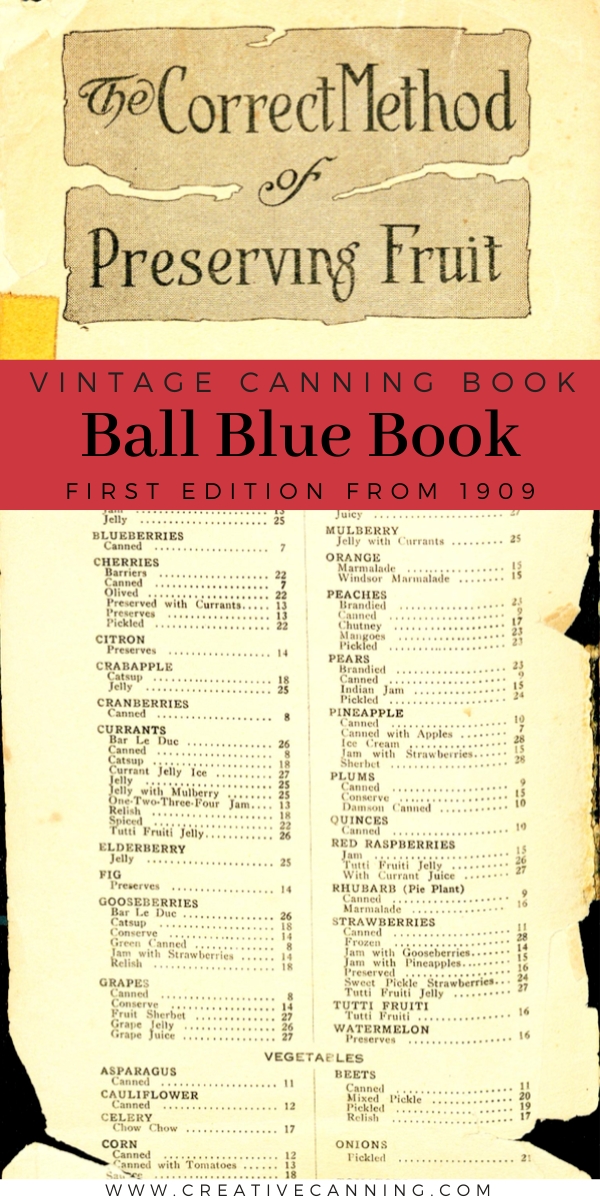
One of the first books written for home canners was “The Correct Method of Preserving Fruits,” written in 1909.
At that point, it was only a 30-page pamphlet, but it went on to become one of the most respected home canning books on the market today.
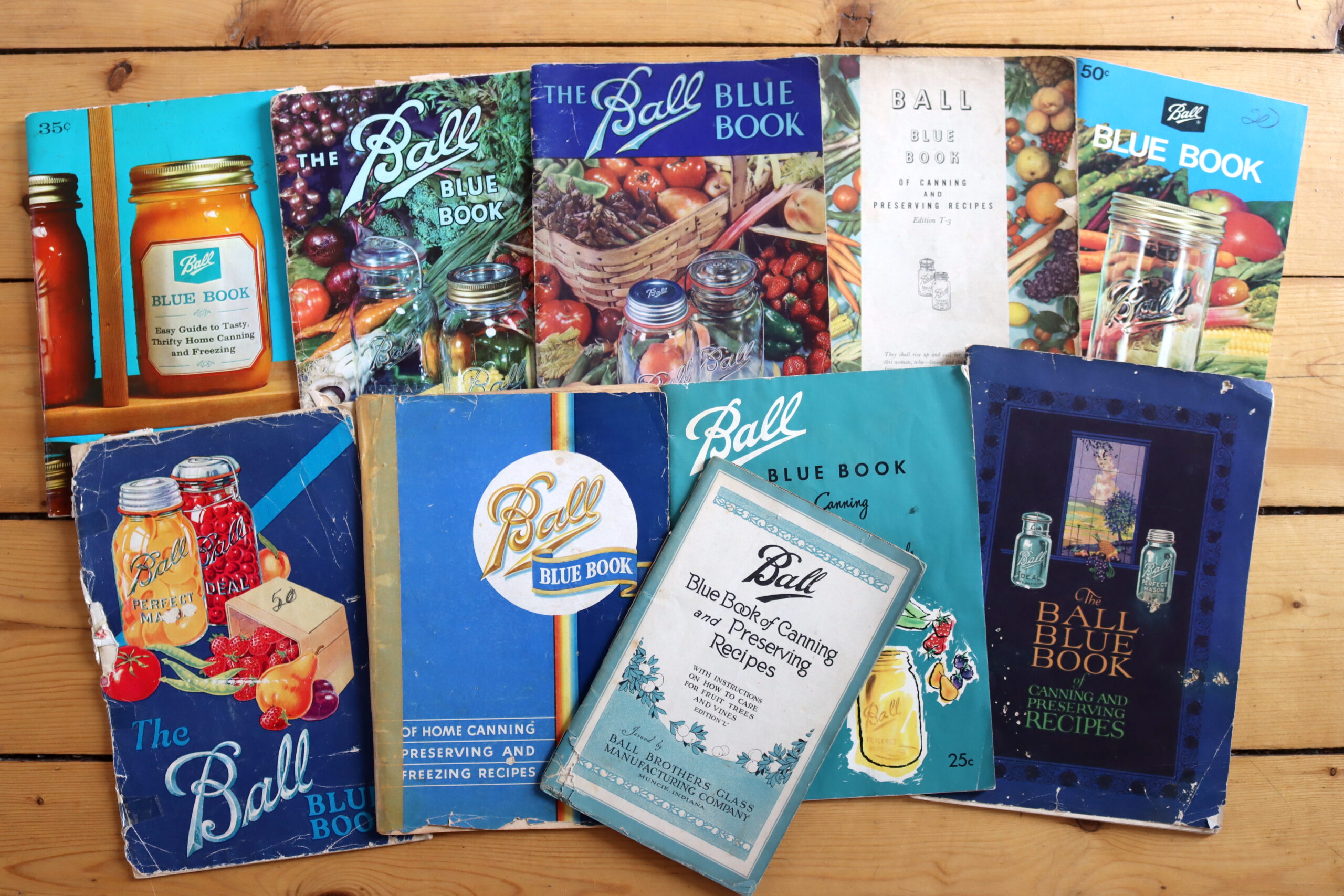
In 1916, the title changed to “The Ball Blue Book of Preserving,” and at that point, it contained quite a few more recipes…but it was still only around 50 pages long. Modern editions are more than 200 pages long, so they’ve come a long way in compiling guidance on canning for home canners.
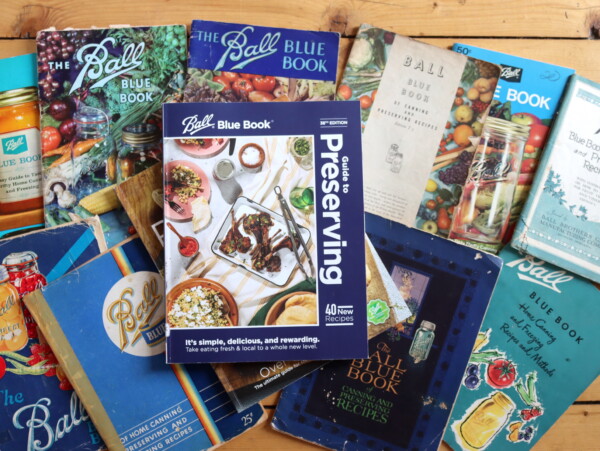
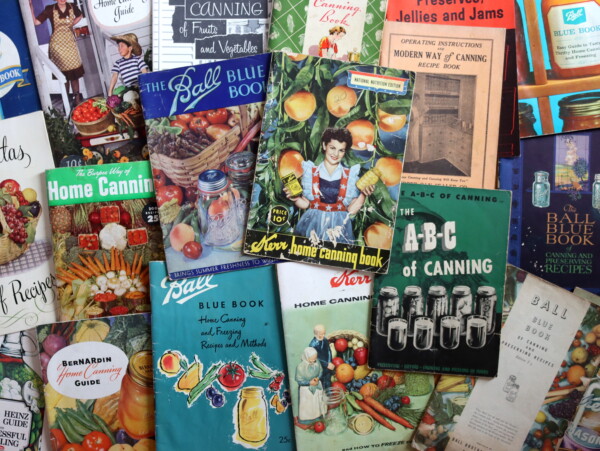
I have about a dozen different copies from various years in hard copy simply because I love paging through the old copies. Old versions are often available on Etsy, but copies of the first edition are almost impossible to find.
Until recently, most sources said that all versions of this original were lost…but I was able to find an original copy with the help of the reference librarians at the University of Iowa.
This is a very old vintage copy of “The Correct Method of Preserving Fruit” that is out of copyright, and I’m posting it here for historical reference.
According to Penn State University Extension, “Canning books published prior to 1994 will not have safe processing times and/or methods.” That applies to the Ball Book, given that new information about canning safety was developed at that time.
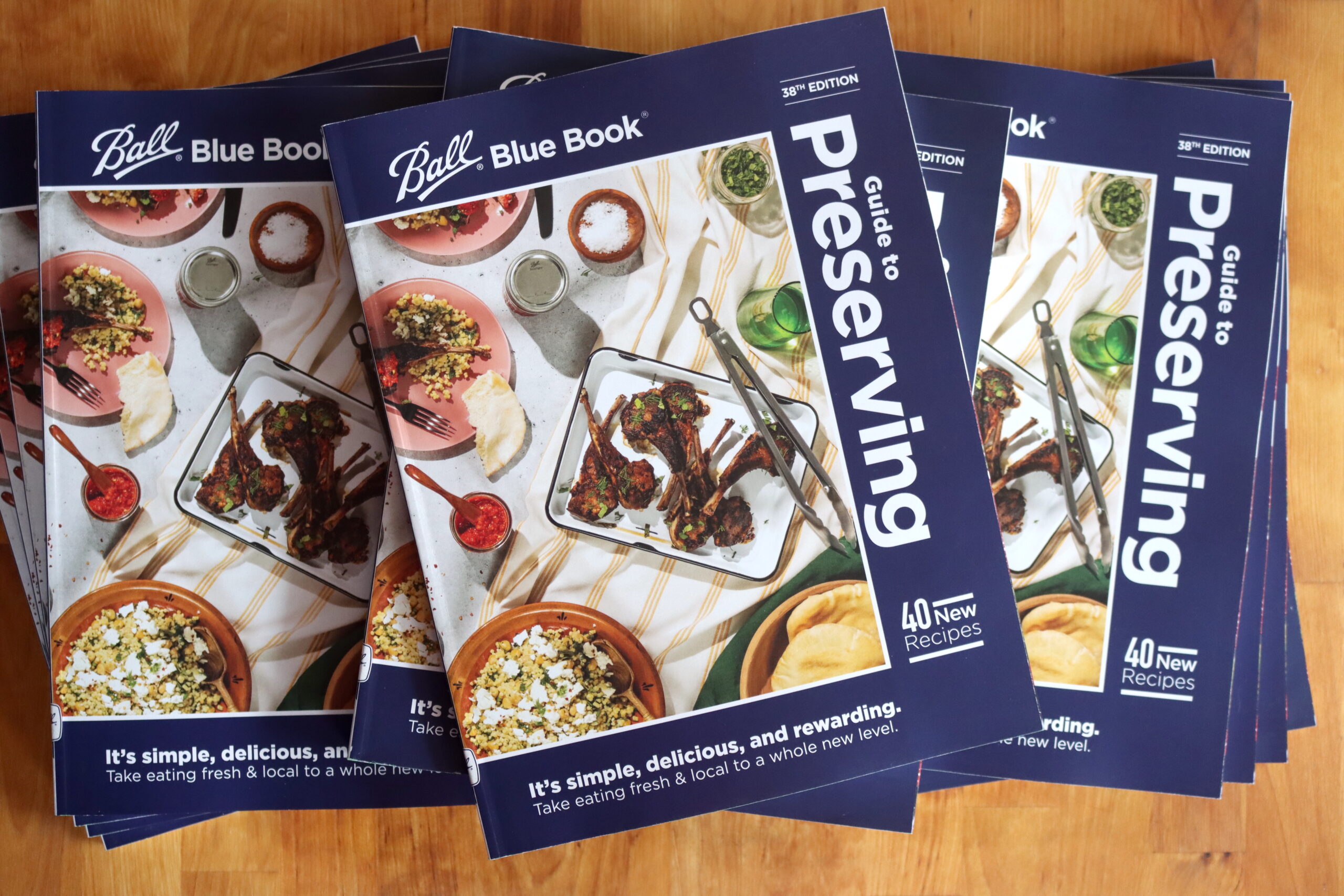
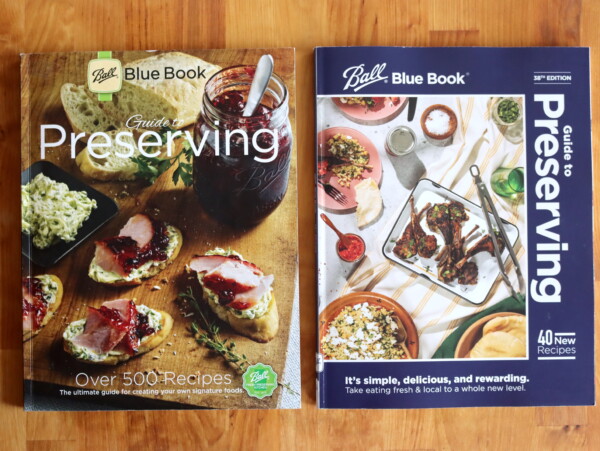
All new editions of the Ball Blue Book supersede earlier editions, and this edition is obviously not up to date for modern safety standards. The most recent edition of the Ball Blue Book of Preserving is the 38th Edition, released on February 1st, 2024. In honor of its release with updated safety standards (again updated since the 37th edition in 2020), I thought it’d be nice to see how it all started.
I’m posting it here for historical reference only, and I don’t endorse or use these vintage canning methods. I do, however, love reading about canning methods, and this first edition is basically the holy grail for a canning nerd like me.
When I had it in hand, I couldn’t keep this edition to myself. I hope you enjoy this little trip back in time to peek at early canning history.
(The most up-to-date version is available wherever books are sold, and it’s only a few bucks online.)
Ball Blue Book of Preserving First Edition
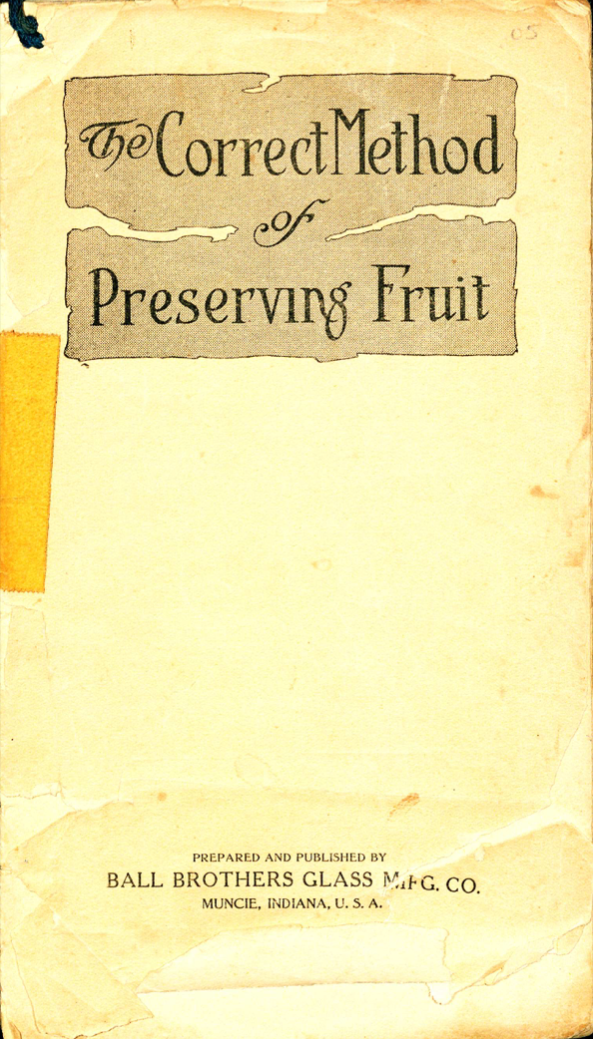
Below, you’ll find all 30 pages of the first edition of the Ball Blue Book of Preserving, or The Correct Method of Preserving Fruit, as it was called when it was originally published in 1909. One of the interesting historical tidbits here is that the cover shows “Ball Brothers Glass Mfg. Co.”, which was only used prior to 1922. They were renamed the Ball Brothers Company in 1922 and then again the Ball Corporation in 1969.
That’s just one way you can help date old Ball Canning ephemera.
If you’re looking for a slightly newer version, but still obviously a vintage copy, you can view the full text of a version published between the end of WWI in 1919 and 1922, as it has references to the recent war victory and still has the pre-1922 name on the cover. It’s called “Edition M” of the Ball Blue Book, and a scanned copy of all 52 pages is available online through the University of Iowa Library Archives.
Beyond that, I have a list with links to the full text of more than 100 vintage canning books, either old enough to be out of copyright or produced as educational material by the federal government, so copyright protections do not cover them.
Here is the full 30 pages of the first edition of the Ball Blue Book of Canning:
The Correct Method of Preserving Fruit
Prepared and Published by
BALL BROTHERS GLASS MFG. CO.
Muncie, Indiana, U. S. A.
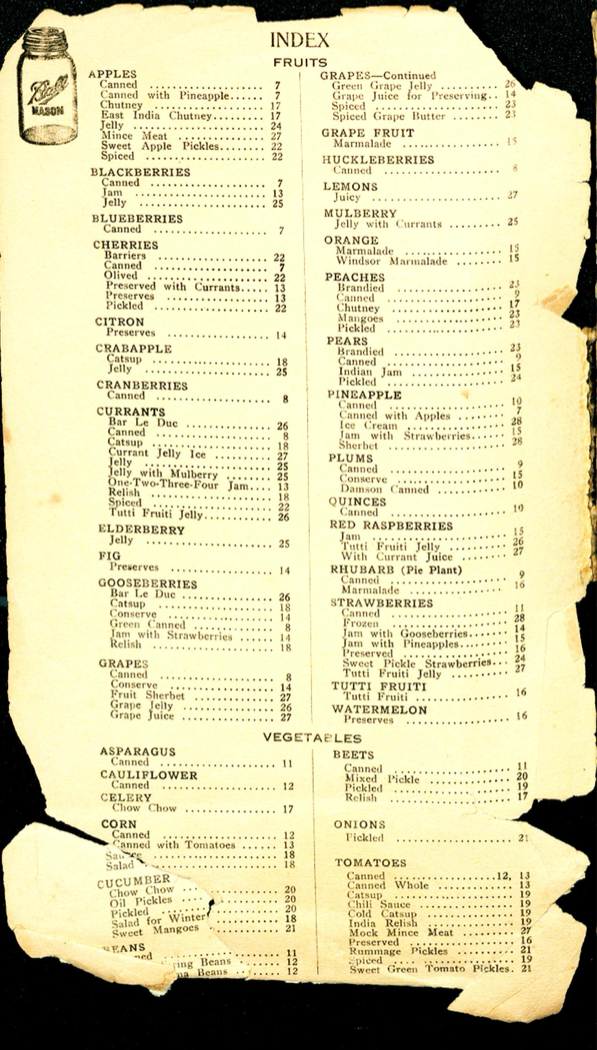
Index
Fruits
APPLES
Canned … 7
Canned with Pineapple … 7
Chutney … 17
East India Chutney … 17
Jelly … 24
Mince Meat … 27
Sweet Apple Pickles … 22
Spiced … 22
BLACKBERRIES
Canned … 7
Jam … 13
Jelly … 25
BLUEBERRIES
Canned … 7
CHERRIES
Barriers … 22
Canned … 7
Olived … 22
Preserved with Currants … 13
Preserves … 13
Pickled … 22
CITRON
Preserves … 14
CRABAPPLE
Catsup … 18
Jelly … 25
CRANBERRIES
Canned … 8
CURRANTS
Bar Le Duc … 26
Canned … 8
Catsup … 18
Currant Jelly Ice … 27
Jelly … 25
Jelly with Mulberry … 25
One-Two-Three-Four Jam … 13
Relish … 18
Spiced … 22
Tutti Fruiti Jelly … 26
ELDERBERRY
Jelly … 25
FIG
Preserves … 14
GOOSEBERRIES
Bar Le Duc … 26
Catsup … 18
Conserve … 14
Green Canned … 8
Jam with Strawberries … 14
Relish … 18
GRAPES
Canned … 8
Conserve … 14
Fruit Sherbet … 27
Grape Jelly … 26
Grape Juice … 27
Green Grape Jelly … 26
Grape Juice for Preserving … 14
Spiced … 23
Spiced Grape Butter … 23
GRAPE FRUIT
Marmalade … 15
HUCKLEBERRIES
Canned … 8
LEMONS
Juicy … 27
MULBERRY
Jelly with Currants … 25
ORANGE
Marmalade … 15
Windsor Marmalade … 15
PEACHES
Brandied … 23
Canned … 9
Chutney … 17
Mangoes … 23
Pickled … 23
PEARS
Brandied … 23
Canned … 9
Indian Jam … 15
Pickled … 24
PINEAPPLE
Canned … 10
Canned with Apples … 7
Ice Cream … 28
Jam with Strawberries … 15
Sherbet … 28
PLUMS
Canned … 9
Conserve … 15
Damson Canned … 10
QUINCES
Canned … 10
RED RASPBERRIES
Jam … 15
Tutti Fruiti Jelly … 26
With Currant Juice … 27
RHUBARB (Pie Plant)
Canned … 9
Marmalade … 16
STRAWBERRIES
Canned … 11
Frozen … 28
Jam with Gooseberries … 14
Jam with Pineapples … 15
Preserved … 16
Sweet Pickle Strawberries … 24
Tutti Fruiti Jelly … 27
TUTTI FRUITI
Tutti Fruiti … 16
WATERMELON
Preserves … 16
Vegetables
ASPARAGUS
Canned … 11
CAULIFLOWER
Canned … 12
CELERY
Chow Chow … 17
CORN
Canned … 12
Canned with Tomatoes … 13
Sauce … 18
Salad … 18
CUCUMBER
Chow Chow … 20
Oil Pickles … 20
Pickled … 20
Salad for Winter … 18
Sweet Mangoes … 21
BEANS
Canned … 11
String Beans … 12
Lima Beans … 12
BEETS
Canned … 11
Mixed Pickle … 20
Pickled … 19
Relish … 17
ONIONS
Pickled … 21
TOMATOES
Canned … 12, 13
Canned Whole … 13
Catsup … 19
Chili Sauce … 19
Cold Catsup … 19
India Relish … 19
Mock Mince Meat … 27
Preserved … 16
Rummage Pickles … 21
Spiced … 19
Sweet Green Tomato Pickles … 21
In this book of correct methods for preserving fruits and vegetables, we have collected the best of tried and proven recipes in actual use by experienced housewives.
For some fruits more than one recipe is given to better cover a variety of tastes.
Every recipe can be successfully prepared by following the directions given.
We urge the careful reading of the general instructions and not the individual recipe alone even if you intend to can only the one item.
It is our intention to add new recipes in future editions of this book and we will appreciate any suggestions from you that will tend to improve or enlarge its scope or usefulness.
BALL BROS. GLASS MFG. CO.,
Muncie, Indiana.
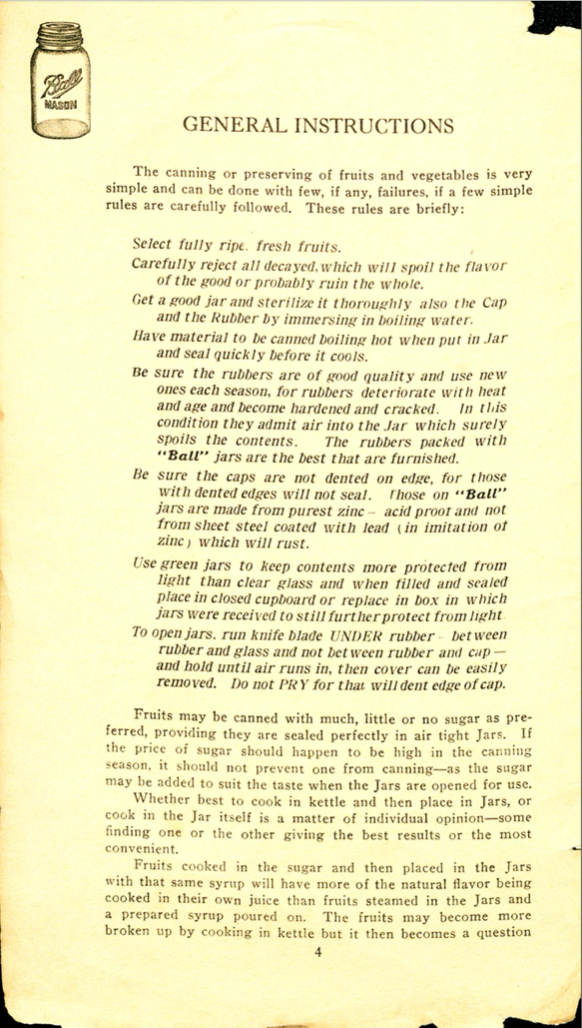
General Instructions
The canning or preserving of fruits and vegetables is very simple and can be done with few, if any, failures, if a few simple rules are carefully followed. These rules are briefly:
Select fully ripe, fresh fruits.
Carefully reject all decayed, which will spoil the flavor of the good or probably ruin the whole.
Get a good jar and sterilize it thoroughly also the Cap and the Rubber by immersing in boiling water.
Have material to be canned boiling hot when put in Jar and seal quickly before it cools.
Be sure the rubbers are of good quality and use new ones each season, for rubbers deteriorate with heat and age and become hardened and cracked. In this condition they admit air into the Jar which surely spoils the contents. The rubbers packed with “Ball” jars are the best that are furnished.
Be sure the caps are not dented on edge, for those with dented edges will not seal. Those on “Ball” jars are made from purest zinc, acid proof and not from sheet steel coated with lead (in imitation of zinc) which will rust.
Use green jars to keep contents more protected from light than clear glass and when filled and sealed place in closed cupboard or replace in box in which jars were received to still further protect from light.
To open jars, run knife blade UNDER rubber, between rubber and glass and not between rubber and cap, and hold until air runs in, then cover can be easily removed. Do not PRY for that will dent edge of cap.
Fruits may be canned with much, little or no sugar as preferred, providing they are sealed perfectly in air tight Jars. If the price of sugar should happen to be high in the canning season, it should not prevent one from canning, as the sugar may be added to suit the taste when the Jars are opened for use.
Whether best to cook in kettle and then place in Jars, or cook in the Jar itself is a matter of individual opinion, some finding one or the other giving the best results or the most convenient.
Fruits cooked in the sugar and then placed in the Jars with that same syrup will have more of the natural flavor being cooked in their own juice than fruits steamed in the Jars and a prepared syrup poured on. The fruits may become more broken up by cooking in kettle but it then becomes a question
of one’s personal preference for either the better natural flavor of cooking in kettle or the appearance if cooked in the Jar.
When canning, take a Jar from the boiling water in which it has been submerged for sterilizing and stand it on a towel wrung from hot water. Take out from the boiling water where it has also been sterilizing, a rubber ring and put on neck or shoulder of Jar. Put in the Jar a long silver fork or spoon or knife. This will help to keep Jar from breaking if there should be too much difference in temperature of Jar and fruit. Fill the Jar with fruit and then pour in boiling syrup until the Jar is filled to the brim. With the fork or spoon press fruit away from side of Jar to allow air bubbles to escape. Pour in more syrup until jar overflows. Take cap from the boiling water in which it has been sterilizing and screw on tight, taking care that the rubber is on flat and that there is no fruit or seeds or peeling on or on the rubber ring which might prevent sealing. After sealing, stand the Jars in the kitchen out of a draft over night. A draught of cold air coming in contact with hot glass may cause some of the Jars to break. In the morning the covers should again be tightened as the glass will contract after cooling.
Fill one Jar at a time and put on cover securely before filling second Jar. Do not fill several Jars and let them stand before putting on covers. This is particularly important with vegetables.
When filling Jars put some syrup in Jars first, for the fruit by submerging itself lifts all air to the top.
Use a funnel for filling Jars so as to keep the lip or rubber seat of Jar as free from fruit and syrup as possible. Be careful to wipe off this rubber seat before putting rubber on as you will more surely get a perfect seal.
There is no hard and fast rule as to the time necessary to cook various fruits or vegetables as it depends so much on the character of the articles and degree of ripeness.
“Soft Fruits,” such as strawberries or raspberries, require less time than plums, apples, pears, peaches, etc. Quinces and pears being hard fruits require much steaming and cooking to become tender. The location or altitude also has some bearing on the time, for at high altitude, in Colorado, for example, it takes much longer to boil water than it does at sea level. The time for boiling ranges between a quarter of an hour and an hour and a quarter. It should all, however, be at boiling point before put into Jars.
Fruits at different stages of ripeness should not be cooked together as the time required for one is not sufficient for the other. Fruit mixed as to ripeness should be sorted and the ripest canned first. In testing large fruits they may be pricked with a silver fork or broom corn to see if tender. Use a silver knife in peeling all fruits to prevent the fruit from becoming discolored. Immersing fruit in cold water immediately and canning promptly after being peeled, instead of allowing to stand, will also preserve the color.
If the fruits or vegetables are to be cooked in the Jar, take any flat bottomed vessel, a wash boiler, preserving kettle, or
bucket, deep enough to permit being covered after the Jars are placed inside. Whatever kind of vessel is used, you must surely provide a false bottom on which to set the Jars while cooking to prevent breakage. Narrow strips of wood may be used or a layer of excelsior. The vessel should have a tight cover to be kept in place while cooking. As a general rule when canning fruits let the water start to boil and continue boiling for ten minutes. At the end of this time, seal the Jar tight by screwing down the top or pushing down the spring and continue boiling for twenty minutes. After boiling the contents will shrink and some prefer before sealing to fill Jars to overflowing with boiling water and then seal.
In canning vegetables boil fifteen minutes before sealing tight and after that continue boiling forty-five minutes. If mixed vegetables, say corn and beans, boil fifteen minutes before sealing tight and after that boil seventy-five minutes.
All goods “canned” or “preserved” in glass will keep their color better if kept from strong light and should therefore be stored in a dark closet or cellar. The original cases in which Jars are received make excellent storage.
The notion is quite common that vegetables can be preserved only by using tin cans. This is an incorrect idea for there is no fruit or vegetable that cannot be successfully preserved in glass Jars with porcelain-lined tops and this too without adding any preservative. The material to be canned must be perfectly fresh and sound. With glass Jars there is not the danger to health that there is in the use of metal cans. The salts of metals formed in tin cans are injurious to health.
A thin mould on top of fruit in the Jar does not mean that the whole contents of Jar has spoiled. It is caused by the oxygen in the air not excluded from the Jar and if carefully removed the remainder of fruit in Jar will probably be unspoiled.
A mouldy taste through contents of a Jar is caused by air imprisoned between the lumps of fruit.
If fruit after being canned seems to be spoiling or souring which will be indicated by syrup rising to top, it may generally be saved by opening and recooking.
MIXING FRUIT IN PRESERVES. There are many which mix with admirable results, for example, apples with blackberries; raspberries with rhubarb or currants or cherries or gooseberries; strawberries with red currants or gooseberries; grapes with plums; bananas with pineapple or nectarines; mulberries or loganberries with red currants; oranges with lemons or honey; apples with pears or red plums.
Before preserving, the sweetness of the boiling syrup to be added to the fruit, if any is desired, can be made to suit the taste and will also vary with different fruits according to the sweetness of those fruits. Here, however, is a table found to be quite generally acceptable.
Strawberries, 1 lb. sugar to 1 pint water.
Blackberries, 1/2 lb. sugar to 1 pint water.
Red Raspberries, 1/2 lb. sugar to 1 pint water.
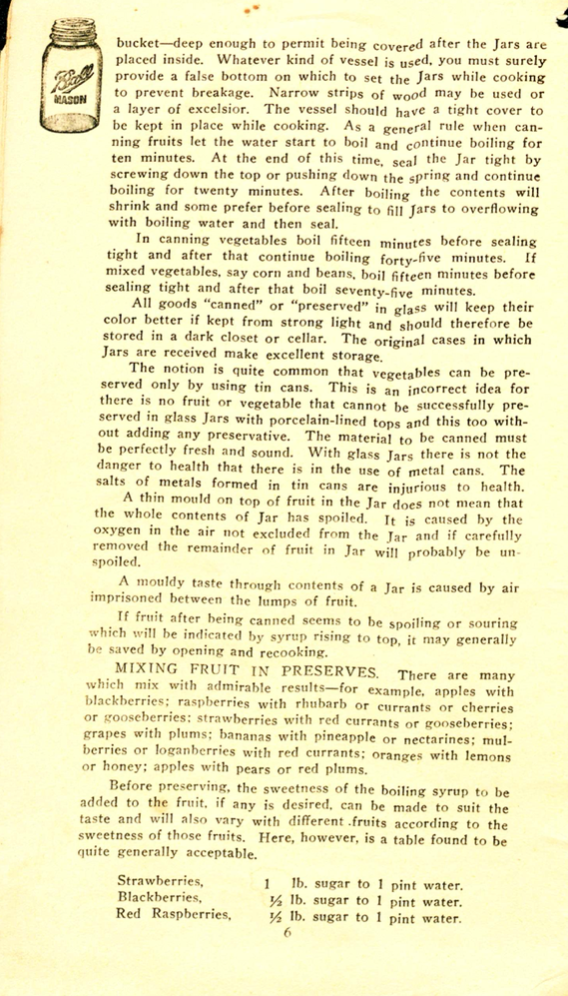
Blueberries, 1/2 lb. sugar to 1 pint water.
Sweet Plums, 1/2 lb. sugar to 1 pint water.
Sour Plums, 3/4 lb. sugar to 1 pint water.
Cherries, 1/2 lb. sugar to 1 pint water.
Pineapple, 1 lb. sugar to 1 pint water.
Peaches, 1/2 lb. sugar to 1 pint water.
Quinces, 1/2 lb. sugar to 1 pint water.
Pears, 1/2 lb. sugar to 1 pint water.
Canned Fruits
Read “General Instructions” as well as the Individual Recipes
CANNED APPLES Three pounds of apples, one pound of sugar, one quart of water, the grated yellow rind of one lemon. Put the sugar and water over in kettle and bring to the boiling point. When boiling drop in the apples which have been peeled, halved and cored. Let cook until they seem quite tender when pricked with a fork. Lastly add the grated lemon rind and boil three minutes. Seal in Ball jars.
CANNED APPLES AND PINEAPPLE For every four pounds of apple take about one pound of shredded pineapple. Make a syrup of 1 1/2 pounds of sugar to one quart of water. Put the apples in a kettle with a little boiling water and let them cook five minutes after they have come to a boil. At the same time put the pineapple into the syrup and bring to the boiling point. After the apples have boiled in the water, lift them out with a wire spoon and put into the syrup with the pineapple and let cook until tender. Place in jars and seal.
CANNED BLACKBERRIES To every pound of blackberries add a quarter of a pound of sugar. Put into kettle with a cup of water and bring to the boiling point. Let boil gently three minutes. Skim and seal in Ball jars.
CANNED BLUEBERRIES One and one-half cups water, one cup sugar. Bring water and sugar to a boil. Add blueberries, let boil up and seal in Ball jars. This will fill one jar.
CANNED CHERRIES Stone the cherries and if sour, allow 1/2 pound of sugar to every pound of cherries. If sweet, 1/4 pound to each pound of fruit. Put the cherries in a preserving kettle and cover them with sugar. Let them stand two or three hours or over night if more convenient. When ready place over the fire and bring to a boiling point. Skim and place in jars and seal. The large kettle belonging to a fireless cooker is most convenient to keep the fruit and sugar in over night.
CANNED CRANBERRIES (For Summer Use). Heat fruit jars gradually, then rinse jars and covers in boiling water. Put as many cranberries as possible into each jar. Then pour in cold water to fill jars to overflowing. Adjust the rubbers and covers. Seal and set in a cool place.
CANNED CURRANTS Look them over carefully. Stem and weigh. Put in a kettle, cover and leave to heat slowly. Stew gently for twenty minutes, then add a pound of sugar for every pound of fruit. Shake the kettle occasionally to make it mix with the fruit. Do not allow it to boil, but keep as hot as possible until the sugar is dissolved. Pour into Ball jars and seal at once. White currants are beautiful preserved in this way.
CANNED GRAPES Select the grapes not too ripe. Pick from stems and pack in jars as closely as may be without breaking the skins. Make a syrup of half a cup of sugar and a cup of water and pour over each jar of fruit. If this amount of syrup does not flush the jars, add more water until it does. Then put the top on without screwing down. Set the jars in a boiler upon folded towels or pieces of lath, anything to keep them from touching the bottom of the boiler. Pour in hot water to come up on the jars some two or three inches from the top. Cover the boiler and place over the fire. Let the water boil for an hour, then remove the jars. Put on the rubbers and screw down tight. Grapes put up in this way retain their fresh delicious taste and are so easy to preserve that the veriest novice cannot fail.
GREEN GOOSEBERRIES Cook the berries in water until white, but not enough to break them. Fill the jars three-quarters full with berries. Fill up with boiling water and seal. When opened pour off the water and cook like fresh berries.
GREEN GOOSEBERRIES (For Pies). Since these are to be used for pies it is best to can without sugar. Wash and stem and put in a kettle with just as little water as will prevent the fruit from sticking to the bottom of kettle. Bring quickly to the boiling point and seal immediately in Ball jars.
HUCKLEBERRIES Pour them into a jar. Shake until you have put in all the jar will hold. Pour molasses over, filling jar until not an air bubble can be seen. Set away in dark cool place. When they are required, pour contents of jar into strainer. When all molasses is drained off, wash the berries and use as fresh berries. Molasses can be used again.
CANNED PEACHES Have a porcelain kettle with boiling water and another with a syrup made sweet enough with white sugar for the peaches. Pare, halve and drop them into the boiling water. Let them remain until a silver fork will pierce them. Lift them out with a wire spoon. Fill jars with peaches. Cover with boiling syrup until the jar overflows and seal immediately. Continue in this way, preparing and sealing only one at a time until done.
CANNED PEACHES STEAMED To peel, place in a wire basket, to the handle of which a cord has been tied. Let down into boiling water for a moment, then into cold water. Strip off the skin. (This saves both fruit and labor). The fruit must be at a certain stage to be prepared in this way. If too green it will not peel, and if too ripe, it will be too much softened by the hot water. After peeling, stone and place in a steamer over a kettle of boiling water, first laying a cloth at the bottom of the steamer. Fill about half full of fruit and cover tightly. Make a syrup in a porcelain kettle, allowing three pounds of sugar to one quart of water. Let the fruit steam until it can be easily pierced with a silver fork. Drop gently for a moment into the hot syrup. Then place in jars. Cover with syrup and seal. This recipe may be used as well for pears.
PLAIN CANNED PEACHES Make a syrup of 1 pound of sugar to 1 quart of water. When this is hot, drop the peaches into it and bring quickly to a boil. Then set back on the stove and let simmer until tender. When done place in jars as closely as possible, then fill the jar to overflowing with the hot syrup and seal. Fruit cooked in the syrup in this way will have a better flavor than that steamed in the jars. The peaches should be pared and halved to can in this manner. Stems may be left on if desired.
CANNED PIEPLANT Cut the pieplant in pieces two inches long. Add equal weight in sugar and put over a slow fire. When sugar is dissolved, let it boil slowly until clear, but do not let it cook long enough to become dark colored. Put up in Ball jars.
CANNED PEARS Pare and halve the pears and take out the core. Leave the stem on as it adds to appearance. As soon as pared drop into cold water to prevent discoloration. Make a syrup of 1 pound of sugar to 1 quart of water. Put this into a kettle and bring to a boil. Skim, then drop in the pears and cook slowly until tender. Take out with a silver fork and place in Ball jars. Fill the jars to overflowing with hot syrup and seal. Bartlett pears are best for canning. Pears may also be steamed in the manner described for peaches.
CANNED PLUMS Wash and put whole into a syrup made in the proportion of: A pint of water and a pound of sugar to every two pounds of fruit. Boil for eight minutes. Can and seal immediately. If pricked with a fork before placing in syrup, they will be less liable to burst. Cherries can be canned in the same way.
DAMSON PLUMS The Damson is a small blue plum but it makes a very rich, fine flavored sauce. After washing and stemming the plums, put in a kettle with 1/2 pound of sugar to every one pound of fruit and let stand over night. In the morning let them heat up slowly and then simmer until soft and tender. Seal in Ball jars. They will be less liable to cook to pieces if a few are cooked at a time.
CANNED PINEAPPLE Peel and slice. Make a syrup of 2 1/2 pounds of sugar to three pints of water. Boil the syrup five minutes and skim. Add fruit and let it come to a boil. Have jars hot. Fill and seal up as soon as possible.
CANNED PINEAPPLE Pack glass jars with pineapple cut into dice with a silver knife. Cover each layer quickly with granulated sugar. The packing should be as close as possible as the fruit shrinks when heated. When you have crowded all that the jars will hold, pour in enough cold water to fill to overflowing. Set these jars upon a board in the bottom in a large wash boiler. Put the tops on with one turn of the screw and pour luke warm water around them. Bring slowly to a boil. Tighten the covers when boiling is reached and again when it has gone on for five minutes. At this point screw them on tight and remove the boiler from the fire. Throw a cloth over it and leave the jars in until the water is perfectly cool. Wrap each in dark paper to exclude the light and keep in a cool, dark place.
CANNED PINEAPPLE Pineapple may be prepared in different ways, the best way depending on what you wish to use it for. When you have pared it and have taken out the eyes, it can be sliced around the entire fruit leaving a whole in the middle where the core is, or it may be picked to pieces with a fork. It may also be grated if preferred. To each pound of fruit add three-quarters of a pound of sugar. Cook the two ingredients over a moderate fire fifteen minutes. Then remove and while still boiling seal in Ball jars.
CANNED QUINCES Weigh the fruit after peeling, coring and quartering. Allow six ounces of sugar and nearly a pint of water to each pound of fruit. Steam fruit until tender, then place in heated Ball jars. Have the syrup boiling and pour over the fruit and seal.
CANNED QUINCES If quinces are not ripe when purchased, put in a dark closet until they color up before canning. Pare, core and cut into rings or quarters. When you have enough pared to fill two or three jars, put them in a kettle, cover with boiling water and bring quickly to a boil. Then cook slowly until they are quite tender. Make a syrup in another kettle, allowing 1 pound of sugar to 1 pint of water. Let this boil up, skim, then drop in the quinces and cook ten minutes. Seal like pears.
CANNED STRAWBERRIES Fill glass jars with fresh whole strawberries. Sprinkle with sugar in the proportion of half a pint of sugar to each pound of berries. Lay covers on lightly. Stand them in a wash boiler filled with water within an inch of the tops of the jars, but the water must not be more than milk warm when the jars are placed in it. When they have boiled fifteen minutes, draw to the back of the stove. Let steam pass off. Roll the hand in a towel. Lift out jars and place on a table. If the berries are well covered with their own juice, fill up with the first to the very top of the lid of the second. Wipe the neck groove dry and screw the top down firmly. Fill another from the second and so on until all are finished. Great care must be taken to keep the berries whole and round. As the jars cool, invert them occasionally to prevent the fruit from forming a mass in one end.
Canned Vegetables
Read “General Instructions” as well as the Individual Recipes.
BEETS FOR WINTER USE Put beets in water and let them boil until tender. Put them in glass jars. Heat equal parts of good cider vinegar and water with a little sugar and salt. Pour over the beets and seal.
CANNED ASPARAGUS Cut the asparagus just the length of the jar you are going to use and stand it closely together as possible in the jar with the heads up. Then fill the jar full of cold water and stand in a boiler on a rack. Fill the boiler with cold water until it stands about half way up in the jars. Set boiler over fire and put cover on tight and let boil for one and a half hours. When done remove jars, fill to overflowing with boiling water and seal tight.
CANNED YOUNG BEETS Sugar is not used to help preserve beets. A little may be added to make up for that lost in the cooking. Rub the young beets without bruising the skin, first cutting off the leaves. Save at least an inch of stem. Cook until tender enough for the table. Drain and cover with cold water. Push off the skin from the beets one at a time and put them into jars on a rack in a steam kettle or boiler and add a teaspoon of salt in luke warm water to fill the jars, also water to come up half way to the tops of the jars. Let cook an hour. If contents of jar has shrunk in cooking, fill to overflowing with boiling water, adjust the covers and rubbers and cook fifteen minutes more. Screw down tight and remove from the fire.
CANNED BEANS String and break beans not too ripe. Measure by the quart and boil twenty minutes. Take off the stove and to each quart of beans add one tablespoon of cider vinegar. Seal in Ball jars and keep in the dark. When preparing for the table, pour off the water, parboil with a little soda, then prepare as usual.
CANNED STRING BEANS String the beans. Put them in Ball jars. Add one teaspoon of salt to each jar, then fill up with cold water. Place in a boiler of cold water in which there is some excelsior or wood strips on bottom to keep from breaking the jars. Boil three hours. Fill up the jars to overflowing with boiling water. Then screw down the tops tight before putting away. Corn may be canned in the same way after it has been cut off the cob.
GREEN STRING BEANS Cook in salted water, fill jars, then add one tablespoonful of hot vinegar. Seal in Ball jars.
CANNED LIMA BEANS Fill Ball Fruit Jars with lima beans, quite young ones preferred, then fill with cold water and put on rubbers and tops. Do not screw. Place the jars in a wash boiler on a rack and pour in enough cold water to almost half cover them. Cover the boiler and place over the fire and let boil steadily for three hours. Take out the jars and see that they are filled to overflowing with boiling water. Screw on tops tight and set out of a draft to cool. When cold, screw down the tops again. Peas may be canned in exactly the same manner.
CANNED CAULIFLOWER Have a head of cauliflower separated into flowerets. Stand heads downward in pan of cold salted water for an hour or more. Examine carefully that no insects be left concealed. Then arrange in the jars. Put in as many pieces as possible without breaking, then set the jars on a folded towel in a steam kettle containing hot water. Put the covers inside also. Cover the kettle and let cook forty-five minutes after boiling begins. Add salt to boiling water in the proportion of a teaspoon for a quart and use to fill the jars to overflowing. Adjust the rubbers and covers. Cover the kettle and let cook twenty minutes. Tighten the covers and if convenient let cool in the kettle.
CANNED CORN To eight pints of cut corn add three pints of water. Boil twenty minutes. Add one pint of salt. Boil three minutes. Can in glass jars. When wanted for use, pour off the water. Wash and place over a fire in cold water and let come to boiling point. Pour off the water and season with butter, cream and one teaspoon of sugar.
CANNED CORN Select fresh, sweet corn. Cut it from the cob carefully and pack it into jars, pressing it down firmly. Fill the jars to overflowing and screw on the lids. Place the jars on a rack in a wash boiler and half cover with cold water. Cover the boiler tightly and boil steadily for four hours, keeping enough water in boiler to make a continuous steam. When done screw down the tops still tighter if possible and set away to cool.
CANNED TOMATOES (Whole). Select small, smooth tomatoes, cut out all green and hard parts and after the jars have been packed with them, proceed just the same as with asparagus. (See page 11).
CANNED TOMATOES AND CORN Take tomatoes not too ripe in the proportion of one-third corn to two-thirds tomatoes. Scald, peel, and slice and cut out all green or hard parts. Put all in a porcelain kettle. Let boil fifteen minutes and seal immediately in Ball glass jars. Some prefer equal parts of corn and tomatoes. You may, after cutting off the corn, cook it fifteen minutes. Add a little water and stir often, then prepare the tomatoes as above. Cook in separate kettles five minutes. Add them to the corn mixing well until they boil up once, then can immediately. Be sure to keep in the dark.
CANNED TOMATOES Select good ripe tomatoes, peel, cut out all green and hard parts and cook with a little salt. Pour in glass jars, fill jars full to the top of lid, seal carefully and then turn the jar upside down till next day to better test and determine that they are safely sealed.
Preserved Fruits and Jams
Read “General Instructions” as well as the Individual Recipes.
PRESERVES. Fruit should not be over ripe when made into jam. When over ripe it begins immediately to ferment; and this is fatal to the success of preserves.
BLACKBERRY JAM Take equal weight of blackberries and currants and pound for pound of sugar. Add no water. Cook slowly together until sugar is dissolved, then boil fast for thirty minutes.
PRESERVED CHERRIES WITH CURRANTS To every 4 pounds of cherries, add one pound of stemmed currants and sugar equal in weight to the fruit. After the sugar has dissolved, cook together slowly thirty minutes. Put in jelly glasses or small Ball jars.
PRESERVED CHERRIES To every three pounds of tart fruit allow the rind of one and a half lemons. Cook the latter thirty minutes, then strain off the water. Cut the lemon pulp fine, free it from seeds and heavy membrane around the seeds. Make a syrup of one and a half pounds of sugar to half a pint of water. The water may be used in which the lemon peel was cooked. Boil, skim and add cherries and boil five minutes. Add the lemon pulp and boil a little longer. Put fruit in jars, pouring over it the hot syrup and seal tight.
ONE-TWO-THREE-FOUR JAM One pint of currant juice, two pounds of seeded raisins, three pounds of currants, four pounds of sugar. Cook altogether to the consistency of jam.
CITRON PRESERVES Pare off rind, seed and cut in thin slices. Weight the fruit and then put in a preserving kettle with water enough to cover. Boil one hour, take out the melon and to the water in the kettle add as much sugar as there was melon by weight. Boil until quite thick. Replace the melon and add two sliced lemons to each pound of fruit. Boil twenty minutes and seal in small Ball jars.
FIG PRESERVES Three and a half quarts of pieplant. Cut up without peeling. One pint of chopped figs. Grated rind and juice of one lemon and two quarts of sugar. Let sugar stand on pieplant over night. Boil down thick before putting in the figs and lemons. This may be put away in jelly glasses.
GOOSEBERRY CONSERVE (Old English Recipe). Five pounds of gooseberries, large English preferred. Four pounds of sugar. One and one-half pounds of seedless raisins. Juice and chopped rind of four oranges. Boil about forty-five minutes or until it is of the consistency of jam. Seal in Ball jars to prevent mold.
GOOSEBERRY AND STRAWBERRY JAMS Take equal weight of gooseberries and strawberries. Cook until tender. Remove all seeds and skin by pressing through a sieve. Weigh and for every pound of fruit add three-quarters of a pound of sugar. Let come to a boil, then seal in Ball jars. If the gooseberries are not perfectly ripe, cook them alone for half an hour before adding the strawberries.
FRUITS PRESERVED IN GRAPE JUICE No sugar is needed when fruits are put up in grape juice. Heat grape juice until reduced one-third then place in it the fruits as prepared for other preserves. Have it well covered with juice. Boil slowly until the fruit is tender, then place in heated Ball jars and seal.
GRAPE CONSERVE Five pounds grapes, three pounds granulated sugar, two pounds seedless raisins, one pound English walnut meats. Cover grapes with water and cook until seeds can be removed by pressing through a sieve. Add sugar and raisins which have been chopped. Cook until thick. Just before removing from fire add the walnuts. Seal while hot.
GRAPE CONSERVE Pulp the grapes and take out the seeds, add the skins chopped. To every three pints of grapes add three pounds of sugar, one pound of stoneless raisins, one pound of walnuts. Cook all but the walnuts until thick like jam. Add walnuts about five minutes before rest is done. Put in jelly glasses.
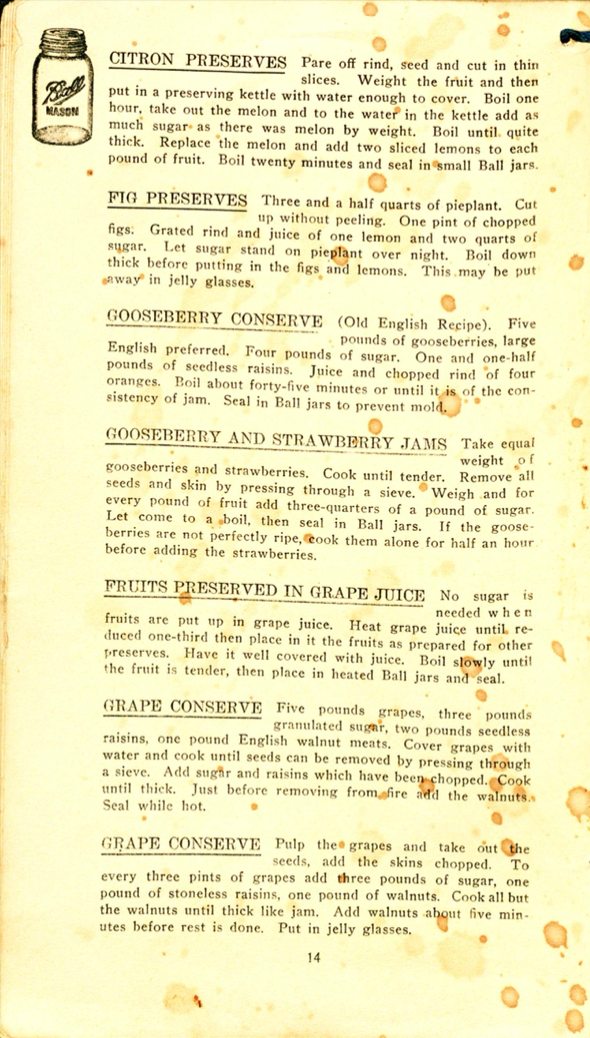
GRAPE FRUIT MARMALADE One grape fruit, one orange, one lemon. Cut the fruit up small, removing all seeds. Soak over night in three times the same amount of water. Next day measure the fruit and add same quantity of sugar as fruit. Boil two hours over a slow fire.
INDIAN JAM Eight pounds chopped pears, 8 pounds sugar, 3/4 pound crystallized ginger, 4 lemons. Use hard green pears. Core and chop. Weigh after chopping. Chop the lemons after removing the white part of the rind. Mix all together, and let stand over night. Then cook slowly until a good reddish color. Some like more lemon.
ORANGE MARMALADE Six oranges, three lemons. Slice very thin and remove seeds. Three pints of water to each pound of fruit. Let it stand twenty-four hours, then boil one hour. Let cool and for every pound of this mixture add one quart of sugar. Boil one hour. This quantity will make about twenty glasses. To keep for a long time, it is best to seal.
ORANGE MARMALADE Six large naval oranges, two lemons. Wash and slice fruit thin. Cover with three quarts of water and let stand over night. Boil in same water until fruit is tender, then add two quarts of sugar and boil until it is the proper consistency. This will keep for years in Ball glass jars.
WINDSOR MARMALADE One dozen oranges, twelve pints of water, four lemons, twelve pounds of sugar. Slice oranges and lemons very thin, soak in water forty-eight hours. Boil the mixture down to nine quarts and add the sugar. Boil again until it jellies. Use an orange saw for slicing and a porcelain kettle for boiling. Heat the sugar in a slow oven before adding it to the oranges.
PINEAPPLE AND STRAWBERRY JAM Prepare the pineapple by cutting into fine small cubes or shred with a fork. Take equal parts of pineapple and firm dark red strawberries. Cook together gently for fifteen minutes, then add sugar, allowing three-quarters of a pound for each pound of fruit. Cook with fruit until the sugar is thoroughly dissolved. Seal in glass jars.
PLUM CONSERVE One peck blue plums, five pounds sugar, juice and rind of three oranges and two lemons, two pounds raisins. Remove the stems and halve plums. Put all together and cook until consistency of jelly. Seal in Ball jars.
RED RASPBERRY JAM To every pound of raspberries allow a pound of sugar and to each pound of berries one-quarter pound of currants. Prepare the currant juice as for jelly. Cook the currant juice and sugar for twenty minutes. Add the raspberries whole and simmer together half an hour. Seal at once.
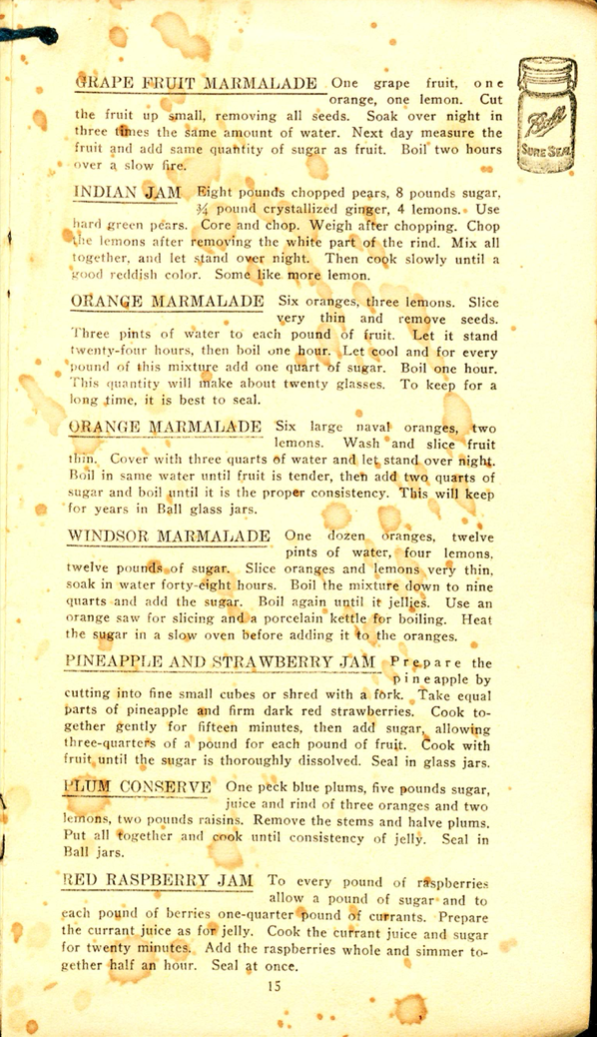
RHUBARB MARMALADE Five pounds of rhubarb, five pounds of granulated sugar, two whole lemons. Cut up the rhubarb into small cubes without removing the skin. Place in the preserving kettle and cover with the sugar. Then cut up the two lemons, rind and all, removing only the seeds. Almost half a cup of water may be added before putting on fire to prevent the sugar sticking to bottom of kettle. This mixture should be cooked from two to three hours and stirred to avoid burning at the bottom. Seal air tight. This marmalade is delicious to the taste, like some fine Turkish relish.
STRAWBERRIES PRESERVED Secure large ripe berries and for each pound of fruit allow a pound of sifted sugar. Put some of the sugar on a large dish. As berries are hulled, lay them on the sugar until dish is covered. Then scatter more sugar over them. Hull more fruit and so on until all are ready. By the time all the fruit is hulled, there will be juice enough to preserve it in without any water. Water spoils strawberries. Cook ten minutes in porcelain kettle. Seal while hot.
TUTTI FRUITI Take a large glass jar, gallon size, put into it a pint of alcohol or brandy. Begin with strawberries, the first fruit of the season. Add in succession the various fruits as they appear in the market, taking care to use only those which are ripe and fresh. Add one pound of sugar to each pound of fruit until the jar is almost half full. Then use three-quarters of a pound of sugar to each pound of fruit. Stir mixture thoroughly for several mornings after each addition of fruit and sugar to dissolve sugar. Use wooden spoon. Be careful not to crush. Keep in a cool, dry place in the cellar. If this proportion of brandy is too strong for the taste, half of that amount may be used.
TOMATO PRESERVES To every pound of small yellow tomatoes allow one pound of sugar. Put the tomatoes and sugar together and to every seven pounds of sugar allow the juice of three lemons. Let stand together all night and in the morning drain off the syrup and boil, skimming frequently. Put in the tomatoes and simmer for twenty minutes after they boil. Remove the tomatoes and allow the syrup to boil until thick. Just before taking from the fire add the lemon juice. Put the fruit in the jars and fill to overflowing with boiling syrup. Seal immediately.
PRESERVED WATERMELON Peel and cut into dice the rind of one ordinary size melon, leaving part of the pink of melon, add two lemons and five cups sugar, boil until tender and can.
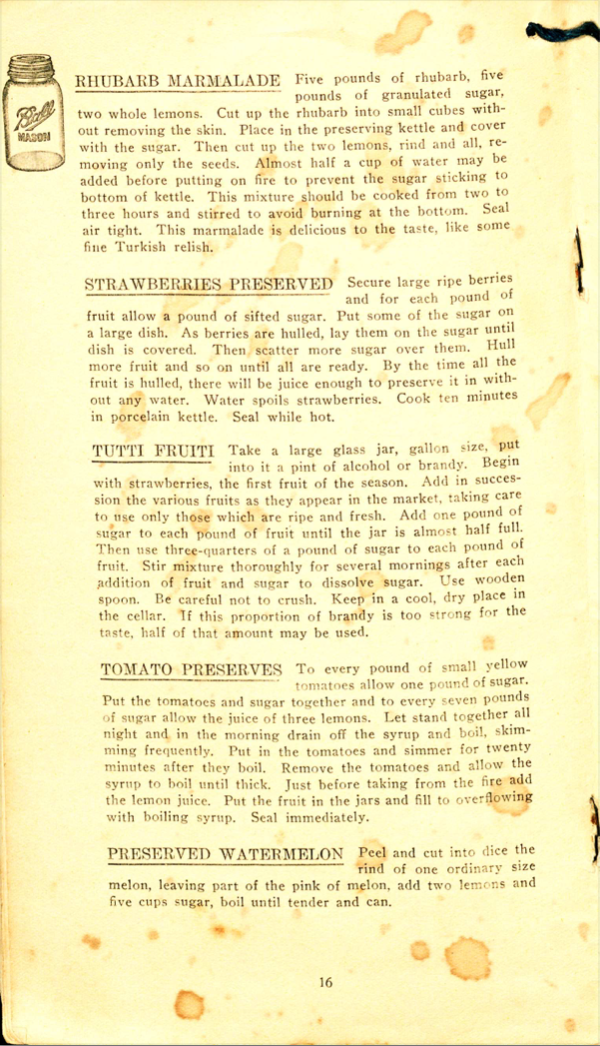
Sauces and Relishes
CHUTNEY is an East India dish and takes the place of our many catsups.
APPLE CHUTNEY Take five pounds of tart apples. Peel, core and cook smooth with two pounds of brown sugar and two quarts of cider vinegar. When thick, place in a crock and add two pounds of chopped raisins, a small mild onion, an ounce each of white and black mustard seed ground, two ounces of ground ginger, one tablespoon of salt, two or three red peppers chopped fine. Mix thoroughly and let stand over night. In the morning place in small jars without cooking and seal well. This will keep for years.
EAST INDIA CHUTNEY Pare and core twelve sour apples. Peel one mild onion. Remove the seeds and stems from three peppers, one of which should be red. Seed a cup of raisins and extract the juice of four lemons. Chop the apples, peppers, raisins and onions very fine. Add one pint of cider vinegar and half a cup of currant jelly and let simmer very gently one hour. Add one pint of cider vinegar, two cups of sugar, one tablespoon each of salt and ground ginger and one-quarter teaspoon of cayenne. Cook another hour, stirring constantly. Store in Ball glass jar.
PEACH CHUTNEY To two pounds of peaches which have been peeled and pits removed, add a half pint of vinegar, cook together until soft. Mix a quarter of a pound each of white mustard seed, chopped onions, raisins and sugar, two ounces of scraped ginger root and one ounce of garlic and red pepper. When well mixed, add to the peaches another half pint of vinegar. Cook all together fifteen minutes. Place in pint Ball jars and seal.
BEET RELISH One quart cooked beets chopped, 1 quart raw cabbage chopped, 1 cup grated horse radish, 2 cups granulated sugar, 1 tablespoon salt, 1 teaspoon black pepper, 1/4 teaspoon cayenne pepper. Cover with cold vinegar and seal.
CELERY CHOW CHOW One head of cabbage, one pound of brown sugar, one ounce celery seed, half a teaspoon red pepper, a dozen cucumbers, half a dozen large onions, one ounce mustard seed. Salt the cabbage, cucumbers and onions separate over night, then drain the water off and put in a kettle and cover with cider vinegar. Put in the sugar and seeds and let come to a boil, then put in air tight jars. The cabbage, cucumbers and onions should be chopped fine before salting.
CORN SAUCE One large head of cabbage cut fine. Salt and let remain over night. Drain water off in morning. Boil one dozen large ears of corn on cob. Cut off. Chop three green and three red peppers fine. Dissolve two tablespoons mustard in vinegar. Mix all ingredients together. Cover with the vinegar. Add two tablespoons salt, a pint of sugar and boil half an hour. Seal while hot in glass jars.
CORN SALAD One head of cabbage chopped fine, one dozen ears green corn or four cans, half dozen sweet peppers, take out seeds and chop fine; two tablespoons of mustard, half teaspoon tumeric powder, two tablespoons salt, two tablespoons flour, one pound brown sugar, one tablespoon or more of celery seed, two quarts of mild vinegar. Mix the flour and mustard together. Scald altogether a few minutes and can in Ball jars.
CRAB APPLE CATSUP Six pounds crab apples cooked soft and pressed through a coarse sieve; 3 pounds of sugar, 2 quarts of vinegar, 2 teaspoons cinnamon, 1 tablespoon cloves, 1 tablespoon pepper, 2 tablespoons salt. Cook until thick and seal in glass jars.
CUCUMBER SALAD FOR WINTER One hundred cucumbers peeled and sliced as for the table. Three pints of onions sliced very thin, half a small sack of table salt. Mix and let stand three hours. Drain and if too salty, rinse and drain. Then add one ounce of celery seed, three ounces of white mustard seed ground, three ounces white mustard seed, one pint olive oil, and vinegar enough to cover (probably about 3 1/2 quarts). Mix well and seal in glass jars.
CURRANT CATSUP Five pounds currants, 3 pounds brown sugar, 2 tablespoons cinnamon, 1 tablespoon cloves, 1 pint good cider vinegar. Boil all together for two hours and seal while hot in Ball jars.
CURRANT RELISH Three quarts currants, three quarts sugar, one quart raisins chopped very fine, two oranges, two lemons cut fine. Use yellow rind and pulp. Cook this mixture until solid. This may be kept in jelly glasses.
GOOSEBERRY RELISH To one quart of gooseberries add one cup sugar and boil for twenty minutes. Add two tablespoons of vinegar, stick cinnamon and cloves to taste. Put in jars while hot.
GOOSEBERRY CATSUP Nine pounds gooseberries, six pounds granulated sugar, one ounce nutmeg, allspice, cloves and cinnamon, one quart vinegar. Stem and clean gooseberries, washing in several waters to remove all spraying poisons. Put all ingredients in preserving kettle at once and let cook, stirring until quite thick and dark. Seal in air tight jars while boiling hot.
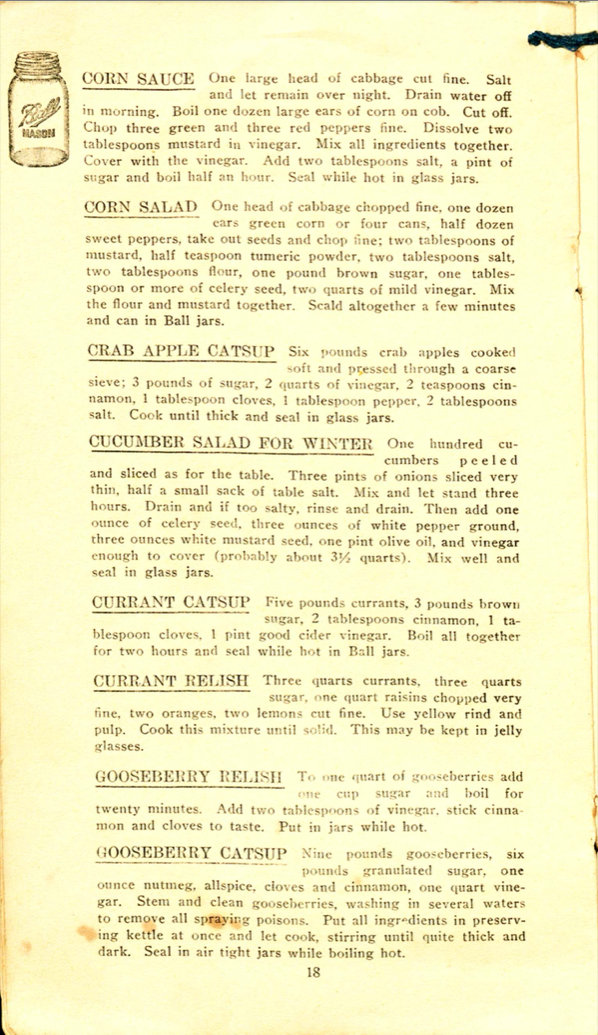
CHILI SAUCE One peck ripe tomatoes, six green peppers, six onions, two teaspoons of cinnamon, two teaspoons cloves, one tablespoon salt, two cups of brown sugar, five cups of vinegar. Scald, skin and slice tomatoes. Chop onions and peppers fine. Boil together two hours, then seal in small Ball jars.
COLD CATSUP One peck of ripe tomatoes chopped fine and drain without salt. One quart of chopped celery, one-quarter peck of onions chopped fine and drain without salt. Four green peppers and four red peppers chopped fine, a cupful white mustard seed. Mix well and add sugar and salt to taste. Place in glass jars. Cover with cold vinegar and seal.
INDIA RELISH One peck of ripe tomatoes chopped fine, three cups of chopped celery, two cups of chopped onions. Drain tomatoes, then add celery and onions and half a cup of salt and let stand two hours. Then drain well again and add two pints of vinegar, three cups of brown sugar, half a cup of white mustard seed, two red peppers chopped fine, one tablespoon of ground cinnamon, one tablespoon of spices and half a tablespoon cloves. Mix together and seal tight without cooking.
SPICED TOMATOES One peck of green tomatoes, six large onions, one cup of salt. Let stand over night. Drain and cook fifteen minutes in two quarts of water and one of vinegar. Drain again and cook fifteen minutes in the following: Two quarts of vinegar, two pounds brown sugar, two tablespoons each cloves, allspice, ginger, mustard, cinnamon and one teaspoon cayenne pepper. Use ground spices in a bag. This must be put in jars when hot and sealed tight.
TOMATO CATSUP One peck ripe tomatoes, one ounce salt, one tablespoon black pepper, one and one-half teaspoons cayenne pepper, one tablespoon mustard. Cut up the tomatoes and boil till very watery, strain juice through collander or sieve, then boil tomatoes about five hours slowly, adding seasoning about an hour before taking from stove. When cold add one pint vinegar. Seal in Ball jars.
Pickles
PICKLED BEETS Boil young beets in salted water until tender, drain and put in jars. Cover with a mustard dressing made of two quarts of vinegar, one-quarter pound best mustard, two cups of golden brown sugar, one teaspoon tumeric and mixed spices. Mix the mustard and tumeric to a paste with a little cold vinegar and beat until smooth, then add the rest of the vinegar, sugar and all-spices and boil slowly until thick enough, stirring all the time. Pour the dressing over the beets while boiling. Place the mixture in jars and seal while hot.
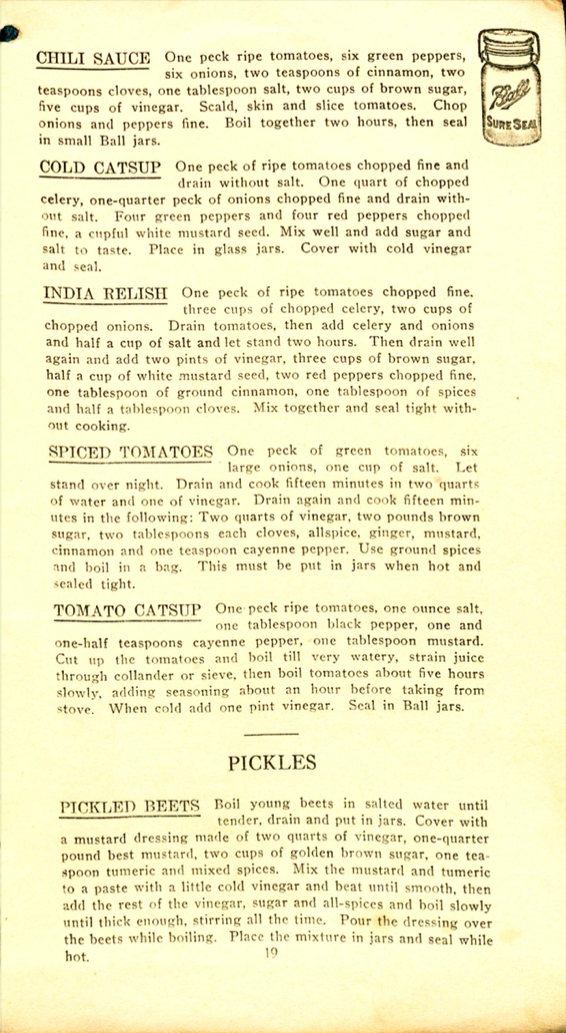
MIXED PICKLE One quart raw cabbage, chopped fine, 1 quart boiled beets chopped fine, 2 cups sugar, 1 tablespoon salt, 1 teaspoon black pepper, 1/4 teaspoon red pepper, 1 teacup grated horse radish. Cover with cold vinegar and seal air tight.
CHOW-CHOW OR MIXED PICKLES One hundred small cucumbers, two heads cauliflower, 1 quart small white onions, 1 quart string beans, 1 quart green tomatoes, 1 pint radish pods, 1 pint nasturtium seeds, 25 martynias. (If some of these items are not easily obtainable they may be omitted with nearly as good results). Put all in a brine strong enough to bear up an egg. Let remain in for twenty-four hours, then take out and drain in a collander. Put all together in large pan to mix well. Sprinkle over them a quarter of a pound of white mustard seed. Scald three quarts of vinegar, a pinch of red pepper, a quarter of an ounce of tumeric powder, three tablespoons black pepper and a little brown sugar. When cold add three green peppers, some root horse radish and a quarter of a pint of mixed mustard. Seal in glass jars.
OIL PICKLES Take one peck or fifteen medium sized cucumbers. Slice quite thin without paring. Place in layers in large jar with layers of course salt (not too much salt). Let stand over night in as cool a place as possible, (ice box is good). One cup olive oil. One and a quarter pounds black mustard seed (whole), eighth of a pound white mustard seed, one and half teaspoons celery seed, one quarter teaspoon pulverized alum. Dissolve alum in a little vinegar and add to oil. Mix oil and seeds and pour over cucumbers after they have been nicely rinsed and drained in collander. Then place in glass jars and cover with cold vinegar. A few sliced onions may be used if the flavor is liked. Slice and place onions in ice water for three hours before mixing with cucumbers.
PICKLED CUCUMBERS Take 200 small cucumbers and scrub clean with a small brush. Place in a stone jar and cover with a scalding hot brine strong enough to hold up an egg. Let the pickles stand over night in this brine. In the morning rinse them off with cold water and pack in Ball fruit jars. Have on the stove a kettle with a gallon of the best cider vinegar, a small lump of alum and 1/2 pint of brown sugar. On the table have spices prepared as follows: Green and red peppers sliced in rings, horse radish root, washed and scraped and cut in small pieces, black and white mustard seed and cloves. Before placing the pickles in jars place a slice of each of the seasonings in bottom of jar. On the top scatter the cloves and mustard seed. When the jars are packed as full as possible, pour into them the boiling hot vinegar, filling to overflowing. It is well to go over them the second time and fill up the second time to supply shrinkage. Seal the jars at once. Pickles done in this way in Ball jars will keep several years.
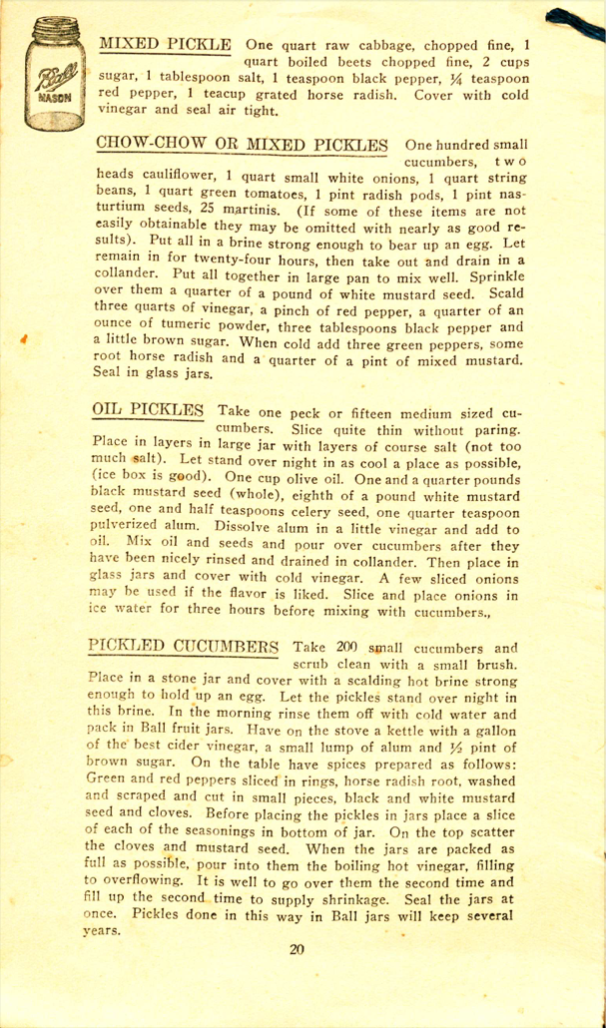
SWEET MANGOES Take twelve large cucumbers, all uniform size. Put in salt water that will bear up an egg and let remain in this for nine days. Remove from brine and soak in fresh water for twenty-four hours. Split cucumbers lengthwise and remove the seeds. Place these pickles in large kettle with alternate layers of grape leaves. Over each layer sprinkle a little pulverized alum. Cover with equal parts of good cider vinegar and water and let come to a boil. Remove pickles from vinegar and stuff with seeded raisins and cubes of lemons, one lemon to a pound of raisins. Do not remove rind of lemon. Tie each cucumber together and place in a large jar. Sprinkle whole cloves and cinnamon bark over each layer. Make a syrup of one pound of sugar to one pint of vinegar and pour over. Pour off and reheat for nine mornings. These will be kept best in half gallon Ball jars.
PICKLED ONIONS Take the small silver skinned onions, remove with a knife all the outer skins so that each onion will be white and clean. Put them into a brine strong enough to bear up an egg and let stand twenty-four hours. Drain and place in glass jars, first a layer of onions, then a sprinkling of horse radish, cinnamon bark, cloves and a little cayenne pepper, repeat until the jar is full. Have a gallon of vinegar and one quart of brown sugar boiling hot and pour this over the onions until the jars overflow. Seal immediately. The seasoning should be used in the following proportion to a gallon of pickles: 1/2 teaspoon cayenne, 2 teaspoons chopped horse radish, 2 teaspoons cloves, 4 teaspoons cinnamon bark.
RUMMAGE PICKLES Two quarts green tomatoes, 1 quart red tomatoes, 3 bunches celery, 3 large onions, 3 large red peppers, 3 green peppers, small head cabbage, 1 large ripe cucumber. Chop vegetables and sprinkle with one cup of salt and let stand over night. Drain well and add 3 pints of vinegar, 2 pounds dark brown sugar, 1 teaspoon mustard, 1 teaspoon black pepper. Cook until clear, almost one hour and then seal while hot in Ball glass jars.
SWEET GREEN TOMATO PICKLE One peck of green tomatoes sliced, 6 large onions sliced. Sprinkle through them 1 teacup salt and let stand over night. Drain off all the liquid in the morning. Take two quarts water and one quart vinegar, boil the tomatoes and onions in this for five minutes. Drain. Take 3 quarts vinegar, 4 cups sugar, 1 tsp. mustard, 1 Tbsp. cloves and 1 tsp. cinnamon (several quantities in this line are obscured by handwriting in the original). Boil this fifteen minutes and pour over the onions and tomatoes which have been placed in glass jars.
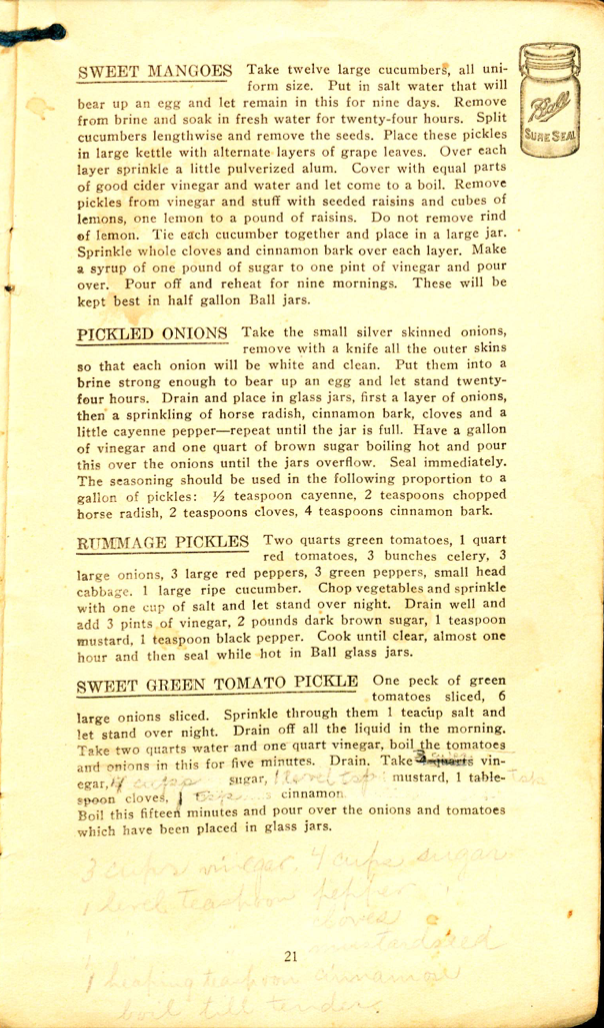
Pickled Fruits
SPICED APPLES Six pounds of apples cored and chopped. 2 oranges, rind and pulp chopped fine, 2 pounds seedless raisins chopped fine, 5 pounds sugar, 2 teaspoons cinnamon, 1/2 teaspoon cloves. Heat oranges and spices hot. Add all the other ingredients. Boil twenty-five minutes and seal while hot in Ball jars.
SWEET APPLE PICKLES (Delicious). Take two quarts of vinegar and six pounds of light brown sugar and place in kettle with spice bag containing one tablespoon of whole cloves and one-quarter pound stick cinnamon. Pare and cut in half one peck ripe sweet apples and cook in vinegar until almost transparent. Place the apples in Ball jars and cover with the vinegar which should be like syrup. If there is too much of the syrup, a few more apples can be used. The above is nicely served with meats.
BARRIERS CHERRIES Take fine large cherries and seed them. Place in stone jars and cover with vinegar. Let stand twelve hours. Drain and add equal amount of granulated sugar pint for pint. Let stand until all the sugar is dissolved. Put in glass jars and screw on the tops. These will keep indefinitely and are fine served with cold meats.
OLIVED CHERRIES Fill one-quart jars with cherries, only the perfect ones with the stems. Boil together nearly a cup of vinegar with two level tablespoons of salt just long enough to dissolve the salt. Allow this to cool. Pour over the cherries and fill the jars with cold water. Seal well. A delicious appetizer.
PICKLED CHERRIES Leave an inch of stem on all fruit. Place in jars in layers, alternating with thick layers of powder sugar. Fill the jars three-quarters full. Fill up with cold spiced vinegar and seal.
SPICED CURRANTS Make a syrup of three pounds of white sugar and one pint of vinegar. Skim and add five pounds of currants and one pound of seedless raisins. Boil about half an hour and add half a tablespoon of sugar and one-half tablespoon each of cloves, all-spice and nutmeg.
SPICED CURRANTS Four pounds of sugar, six pounds of currants, one pint of vinegar, a bag of spices, one teaspoon of salt. Cook slowly from two to three hours. Seal in Ball jars.
SPICED GRAPES Weigh out seven pounds of grapes and slip the pulps from the skins. Put the pulps over the fire in white-lined sauce pan and let simmer until softened. Then pass through a sieve fine enough to keep back the seeds. Add the sieved pulp to the skins with four pounds of sugar, one pint of vinegar, one nutmeg grated, one-half tablespoon ground cinnamon and scant tablespoon ground cloves. Let the whole simmer very gently for two hours. Store as canned fruit.
SPICED GRAPE BUTTER Pulp the grapes and let stand over night. Put the pulps in a porcelain kettle and let them come to a boil and press through the collender fine enough to exclude the seeds. Put skins and pulps together and for five pints of fruit put in four pints of brown sugar, two tablespoons each of cloves and let boil one hour, then add a coffee cup of vinegar and boil until it thickens. Place in jelly glasses.
PEACH MANGOES Rub the fuzz off Freestone peaches. Cut in half and stone. Make a mixture of equal parts of white mustard, nutmeg, ginger and celery seed and fill the peach cavities. Tie the halves together and fill with them jars three-quarters full. Whole cloves may be added to the spice if desired. Pour cold strong vinegar over the fruit or if to be kept in a warm climate, boil the vinegar. In either case seal the jars at once.
BRANDIED PEACHES Five pounds fruit, 5 pounds sugar, 1 pint white brandy. Make a syrup of the sugar and water enough to dissolve, put over the fire and let come to a boil, then add fruit and let boil for five minutes. Take out fruit carefully, leaving the syrup to boil for twenty minutes, or until it thickens; add brandy and remove kettle at once from the fire. Pour hot syrup over the fruit and seal tight in Ball jars.
PICKLED PEACHES Make a syrup of two quarts of best cider vinegar and 6 pounds of granulated sugar. Place this in a kettle with a spice bag containing one tablespoon of whole cloves and 1/4 pound stick cinnamon. Pare and halve the peaches, leaving in an occasional stone for flavor. Cook the peaches in the syrup until tender, then place in glass jars and cover with the vinegar syrup which should be in consistency of maple syrup. The peaches may be left whole if preferred.
BRANDIED PEARS To two pounds each of peeled fruit and sugar take half a pint of brandy. Cook the sugar and a pint of water two minutes after coming to a boil. Place the fruit in this and let boil five minutes. Remove the pears and put in heated jars. Let syrup boil until it thickens, add the brandy and remove at once from the fire. Pour syrup over the fruit and seal jars immediately.
PICKLED PEARS To each three pounds of pears allow a half pint of cider and wine vinegar, one and a half pounds of sugar and spices to taste. Tie up in a thin bag. Let the sugar, vinegar and spices boil up, then put in the pears a few at a time. Cook until tender. Place the pears in a crock. Pour over them the syrup and let stand three days. Pour off the syrup. Boil it down. Then pour it again over the pears, having placed them in a small Ball jar. The pears may be sealed or not as preferred.
SWEET PICKLE STRAWBERRIES Two quarts berries, 1 1/2 pounds sugar, 1/2 pint vinegar. Put the berries and sugar on the fire and heat slowly, then add vinegar. Boil 10 minutes (not hard). Set them on the back of range to keep hot for 1 hour (not boiling). Then take out into a skimmer and let cool. Boil the syrup until it thickens. Put the cool fruit in a jar and pour the boiling syrup over it. Seal in Ball jars.
Jellies
Fruit for jelly should be under ripe rather than over ripe. One must use judgment and test jellies in making by putting a spoonful on a plate. If it jellies quickly, it is done. If still watery, it must be boiled longer. If Jelly is not as hard as it should be the day after it is made, it can be set in the sun for several hours which will help it greatly.
APPLE JELLY Wash and cut into pieces without peeling or removing the cores and seeds. Put into a kettle and just cover with cold water. Cook until the apples are soft and tender. Put into a jelly bag and let drain. Do not squeeze or the jelly will be cloudy. Measure the juice, bring it to a boil then add one pound of granulated sugar for every pint of juice, stir until sugar is dissolved. Let this boil twenty minutes and then begin to test. It may jelly at once and it may take half an hour. If a teaspoonful placed in a cold saucer shows a partly solid surface, then jelly is done. Have the jelly glasses standing in hot water. Drain and fill with hot jelly. Let stand without covers for twenty-four hours in order to harden.
APPLE JELLY Quarter and core; leave on the skins, pour in water to just cover apples; cook soft, don’t stir; when very soft (but not in pieces), pour carefully into cheese cloth; drain over night; in morning measure the juice; add one pint of sugar to one pint of juice. Boil ten to fifteen minutes; try on ice to see if it jellies; if cooked too long, turns to jack-wax. Cover jelly glasses with paper, pour paraffin or wax over the papers, or dip them in liquor. Same method for crab apple or currant jelly. Astrakan or Maiden Blush or any juicy apple should be used in making jelly.
BLACKBERRY JELLY Under-ripe berries are best for this jelly. Put the fruit in the kettle with half a cup of cold water to keep it from sticking. Heat slowly until the berries are quite soft. Put a small quantity at a time into a jelly bag and squeeze out all the juice. Measure the juice, and for every pint add a pound of granulated sugar. Put the juice back into the kettle and boil continuously for twenty minutes. Then for every pint of juice, add a pound of granulated sugar, stirring until it is all dissolved. When it has come to a boil begin to test. As soon as done place into glasses which are taken out of hot water. If your fruit is over ripe it will never be firm.
CRAB APPLE JELLY Wash the apples. Cut in half and place in a crock on the back of the stove or in the oven, setting in another vessel of hot water if there is danger of too great heat. When the apples are soft, place in jelly bag to drain over night. Measure this juice and boil ten minutes, then add one pint of sugar for each pint of juice. After which stir until sugar is dissolved, then boil eight or ten minutes. A little mint or rose geranium leaves may be added as a flavor to this jelly.
CURRANT JELLY Take sixteen quarts of ripe currants, being particular to get fresh ones, and four quarts of red raspberries. Wash the fruit and crush and put over a moderate fire. Boil for twenty minutes. When done, squeeze the juice out in a bag made of fresh muslin which has been thoroughly scalded. If a quart is squeezed out at a time, it will be easier. When the juice is ready, weigh it, put it on the fire and let it boil five minutes, then add a pound of granulated sugar for every pound of juice, and let it boil one minute more. Skim off the scum and put in jelly glasses. To test jelly drop a little in a glass of ice water. If it goes to the bottom at once, the jelly is ready.
CURRANT AND MULBERRY JELLY Use only red, immature berries for this jelly. To each three-quarters pound berries add one quart of water. Cook slowly for about an hour, mashing well the berries. Add a second quart of cold water and cook another hour. Strain the juice in jelly bag and for each pint of juice allow a pint of sugar. Boil about three minutes, then test. If not quite ready, boil two minutes longer. Place in jelly glasses and let stand in the sun until firm. One-quarter as much currant juice as mulberry may be added if desired.
ELDERBERRY JELLY This may be made with elderberries alone or an equal quantity of lemon juice or green grapes or gooseberries or currants. Proceed as with other fruits for making jelly and to each pint of juice allow one pint of sugar. Boil and test. Remove from the fire and let stand until solid.
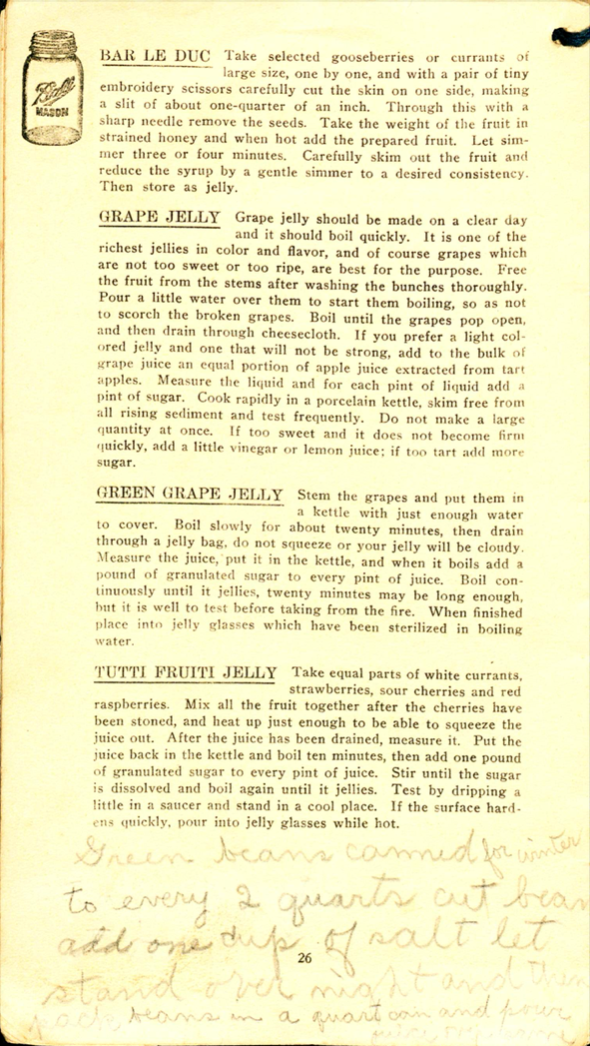
BAR LE DUC Take selected gooseberries or currants of large size, one by one, and with a pair of tiny embroidery scissors carefully cut the skin on one side, making a slit of about one-quarter of an inch. Through this with a sharp needle remove the seeds. Take the weight of the fruit in strained honey and when hot add the prepared fruit. Let simmer three or four minutes. Carefully skim out the fruit and reduce the syrup by a gentle simmer to a desired consistency. Then store as jelly.
GRAPE JELLY Grape jelly should be made on a clear day and it should boil quickly. It is one of the richest jellies in color and flavor, and of course grapes which are not too sweet or too ripe, are best for the purpose. Free the fruit from the stems after washing the bunches thoroughly. Pour a little water over them to start them boiling, so as not to scorch the broken grapes. Boil until the grapes pop open, and then drain through cheesecloth. If you prefer a light colored jelly and one that will not be strong, add to the bulk of grape juice an equal portion of apple juice extracted from tart apples. Measure the liquid and for each pint of liquid add a pint of sugar. Cook rapidly in a porcelain kettle, skim free from all rising sediment and test frequently. Do not make a large quantity at once. If too sweet and it does not become firm quickly, add a little vinegar or lemon juice; if too tart add more sugar.
GREEN GRAPE JELLY Stem the grapes and put them in a kettle with just enough water to cover. Boil slowly for about twenty minutes, then drain through a jelly bag, do not squeeze or your jelly will be cloudy. Measure the juice, put it in the kettle, and when it boils add a pound of granulated sugar to every pint of juice. Boil continuously until it jellies, twenty minutes may be long enough, but it is well to test before taking from the fire. When finished place into jelly glasses which have been sterilized in boiling water.
TUTTI FRUITI JELLY Take equal parts of white currants, strawberries, sour cherries and red raspberries. Mix all the fruit together after the cherries have been stoned, and heat up just enough to be able to squeeze the juice out. After the juice has been drained, measure it. Put the juice back in the kettle and boil ten minutes, then add one pound of granulated sugar to every pint of juice. Stir until the sugar is dissolved and boil again until it jellies. Test by dripping a little in a saucer and stand in a cool place. If the surface hardens quickly, pour into jelly glasses while hot.
Miscellaneous
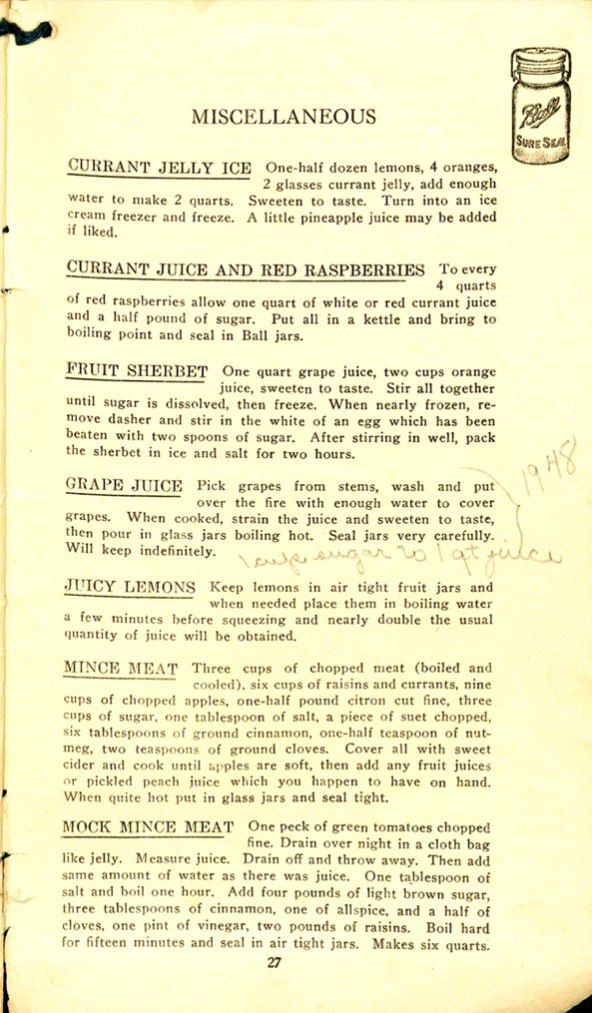
CURRANT JELLY ICE One-half dozen lemons, 4 oranges, 2 glasses currant jelly, add enough water to make 2 quarts. Sweeten to taste. Turn into an ice cream freezer and freeze. A little pineapple juice may be added if liked.
CURRANT JUICE AND RED RASPBERRIES To every 4 quarts of red raspberries allow one quart of white or red currant juice and a half pound of sugar. Put all in a kettle and bring to boiling point and seal in Ball jars.
FRUIT SHERBET One quart grape juice, two cups orange juice, sweeten to taste. Stir all together until sugar is dissolved, then freeze. When nearly frozen, remove dasher and stir in the white of an egg which has been beaten with two spoons of sugar. After stirring in well, pack the sherbet in ice and salt for two hours.
GRAPE JUICE Pick grapes from stems, wash and put over the fire with enough water to cover grapes. When cooked, strain the juice and pour in glass jars boiling hot. Seal jars very carefully. Will keep indefinitely.
JUICY LEMONS Keep lemons in air tight fruit jars and when needed place them in boiling water a few minutes before squeezing and nearly double the usual quantity of juice will be obtained.
MINCE MEAT Three cups of chopped meat (boiled and cooled), six cups of raisins and currants, nine cups of chopped apples, one-half pound citron cut fine, three cups of sugar, one tablespoon of salt, a piece of suet chopped, six tablespoons of ground cinnamon, one-half teaspoon of nutmeg, two teaspoons of ground cloves. Cover all with sweet cider and cook until apples are soft, then add any fruit juices or pickled peach juice which you happen to have on hand. When quite hot put in glass jars and seal tight.
MOCK MINCE MEAT One peck of green tomatoes chopped fine. Drain over night in a cloth bag like jelly. Measure juice. Drain off and throw away. Then add same amount of water as there was juice. One tablespoon of salt and boil one hour. Add four pounds of light brown sugar, three tablespoons of cinnamon, one of allspice, and a half of cloves, one pint of vinegar, two pounds of raisins. Boil hard for fifteen minutes and seal in air tight jars. Makes six quarts.
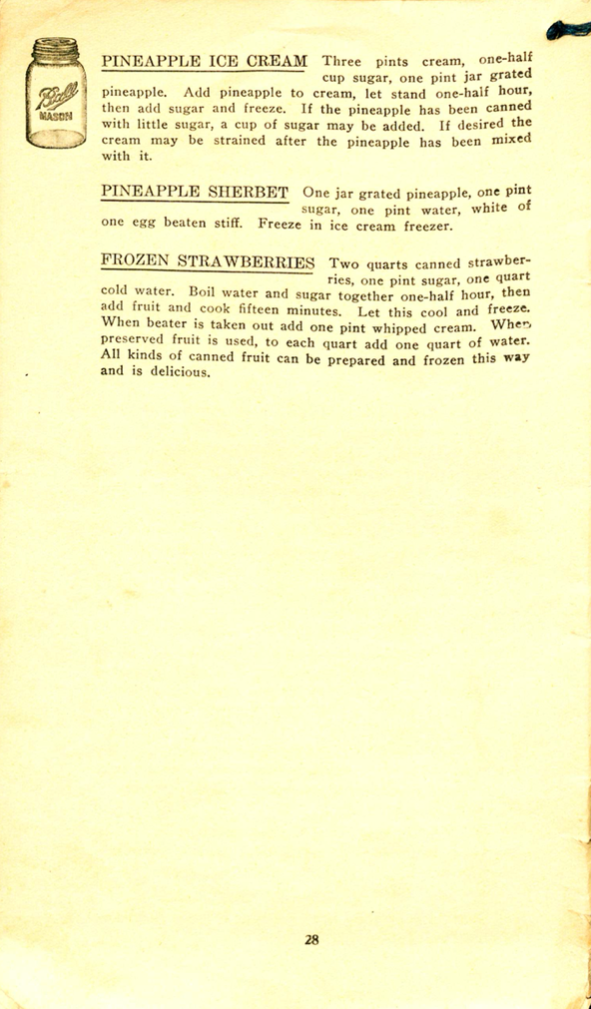
PINEAPPLE ICE CREAM Three pints cream, one-half cup sugar, one pint jar grated pineapple. Add pineapple to cream, let stand one-half hour, then add sugar and freeze. If the pineapple has been canned with little sugar, a cup of sugar may be added. If desired the cream may be strained after the pineapple has been mixed with it.
PINEAPPLE SHERBET One jar grated pineapple, one pint sugar, one pint water, white of one egg beaten stiff. Freeze in ice cream freezer.
FROZEN STRAWBERRIES Two quarts canned strawberries, one pint sugar, one quart cold water. Boil water and sugar together one-half hour, then add fruit and cook fifteen minutes. Let this cool and freeze. When beater is taken out add one pint whipped cream. When preserved fruit is used, to each quart add one quart of water. All kinds of canned fruit can be prepared and frozen this way and is delicious.
About “The Best” of Jars, The Ball
It hardly pays to risk the results of your preserving to just “any” jar.
Much fine fruit has been spoiled through some little imperfection in the sealing, or some weakness of the jar.
If when buying your JARS you will always insist on having the BALL brand, you will secure the best results in your canning and preserving. WHY?
Because these jars are now made by recently invented and patented machinery, which produces more perfect jars than it is possible to make by any other process.
Because this machinery makes the glass of even thickness, and that evenness of distribution makes it possible to anneal or temper or toughen the glass perfectly, which is not possible if the jar is thick and thin in spots.
Because they are made of GREEN glass which color keeps contents better than clear glass.
Because every jar produced passes thru close inspection and if the slightest imperfection is found, the jar is discarded and broken up. No “seconds” in BALL brand are ever packed.
Because with the BALL brand are packed rubbers of very superior quality, better than those generally furnished and of higher cost, made carefully and of the right ingredients to adapt them for this use. Only the immense output of the BALL factories allows them to furnish this high quality of rubbers.
Because in the BALL factories every part of the jar is made complete, the metal cap, the porcelain lining for the cap, the wire levers and the boxes in which the goods are packed. This insures more perfect fitting jars and trimmings than can be had or expected where the glass is produced by one maker and the metal caps by another, neither being able to keep track of just what is necessary to make his part fit the product of the other.
Because even the zinc metal for the caps is rolled in the BALL factories own rolling mills, from superior raw materials producing softer, more pliable metal, expressly adapted for the requirements of a Fruit Jar.
Insist on having the BALL brand in either the Screw Top or Wire Top styles.
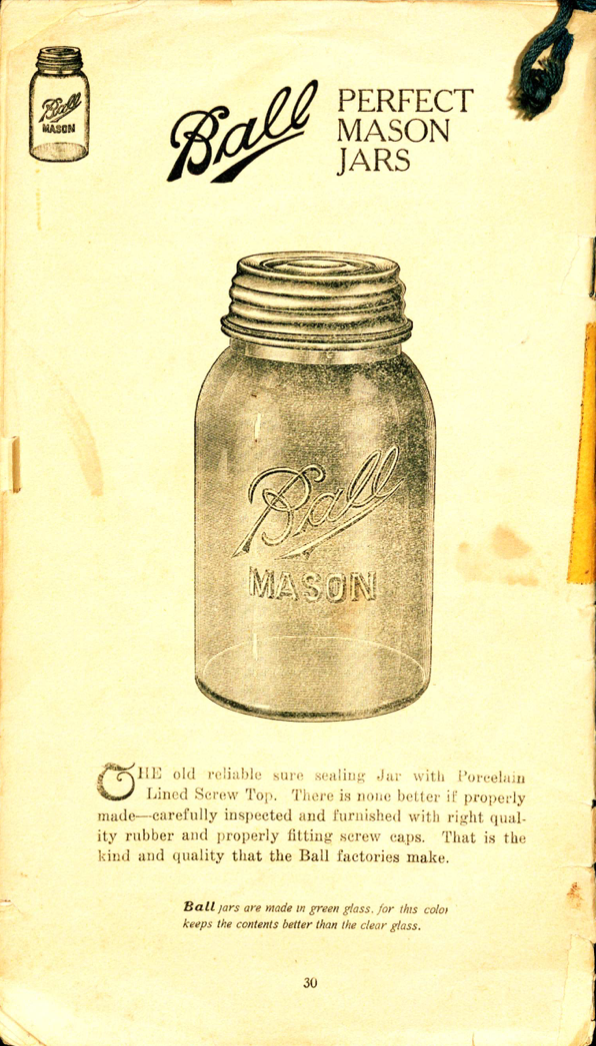
Ball Perfect Mason Jars
The old reliable sure sealing Jar with Porcelain Lined Screw Top. There is none better if properly made, carefully inspected and furnished with right quality rubber and properly fitting screw caps. That is the kind and quality that the Ball factories make.
Ball jars are made in green glass, for this color keeps the contents better than the clear glass.
Vintage Canning Books
Looking for more canning history?

Thank you so much for these copies. Such precious information!
Bless you
You’re quite welcome!