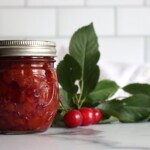
Old Fashioned Cherry Preserves
Whole cherries suspended in a thick syrup, made with no added pectin. The batch cooks in two sessions with an overnight rest in between, which is what keeps the cherries intact instead of breaking down into jam.
Servings: 64 servings, makes 4 to 5 half pints
Equipment
- Canning Jars, Lids and Bands
Ingredients
- 2 pounds cherries sweet or tart
- 4 cups granulated sugar
- 1/4 to 1/2 cup water only if needed to dissolve the sugar if your cherries didn't give up much juice
Instructions
- Pit the Cherries: Rinse the cherries under cold running water and drain. Remove the stems and pits, working over a bowl so all of the juice is retained. Set the pitted cherries aside separately from the juice.
- Make the Syrup: Combine the reserved cherry juice and the sugar in a large stainless steel or enameled saucepan. Bring to a boil, stirring until the sugar dissolves. If there is not enough juice to dissolve the sugar, add a small amount of water.
- First Cook: Add the cherries. Boil over high heat until the cherries turn glossy. Remove from heat.
- Rest Overnight: Cover the pan and let it stand in the refrigerator for 12 to 18 hours. Do not shorten this step.
- Cook to the Set Point: Bring the mixture to a rolling boil that cannot be stirred down. Cook rapidly over high heat, stirring constantly, until it reaches 220°F, adjusting for altitude. Remove from heat and skim the foam.
- Fill the Jars: Ladle the hot preserves into hot half pint jars, leaving 1/4 inch headspace. Remove air bubbles, wipe the rims, center the lids, and apply the bands to fingertip tight.
- Process: Process in a boiling water bath canner for 10 minutes, adjusting for altitude. Turn off the heat, remove the canner lid, and let the jars stand 5 minutes before removing them to cool undisturbed for 12 to 24 hours.
Do Not Double: Make two separate batches rather than one large one.
Notes
This recipe is adapted from Ball Canning Back to Basics, where it appears as Traditional Cherry Preserves.
Yield: This recipe makes about 4 half-pint jars. That figure comes from Ball and already accounts for pitting loss. Two pounds of cherries as purchased is roughly 5 to 6 cups once you pull the stems and pits, and the 4 jar count is measured from there, not from the starting weight.
Expect the exact number to move a little, because the second cook is a reduction to the set point rather than a fixed volume. Juicier cherries and a narrow pan cook down further and can stretch into a partial fifth jar, while drier fruit in a wide pan can leave the fourth jar shy of full. Have a spare quarter pint clean and ready so you have somewhere to put the overflow or the short jar, since hot preserves should go straight into a jar rather than wait.
Quarter pint jars work well here and process on the same 10 minute schedule, which is handy if you would rather have several small jars for gifting than a few larger ones. Do not scale up to pints or double the batch. A larger volume takes so long to reach the set point that the cherries break down and the syrup darkens.
Set Point: The gel point is 220°F at sea level, and it drops about 1°F for every 500 feet of elevation. Cook to that temperature and no further. Preserves are meant to be slightly jellied rather than firmly set, and cherries are low in natural pectin, so a syrup that pours slowly around whole cherries is the correct result.
Overnight Rest: The 12 to 18 hour refrigerated rest between the two cooks is what firms the cherries so they stay whole. Cherries that go straight from the first boil to the second one fall apart.
Sugar: Do not reduce the sugar in a batch you plan to store on the shelf. In a thick syrup preserve, the sugar is part of the preservation, paired with the short 10 minute process time. Reduced sugar batches belong in the refrigerator or the freezer.
Yield: Two pounds of cherries comes to roughly 5 to 6 cups pitted and yields about 4 half-pint jars. Juicier fruit gives a fuller fourth jar.
Doubling: Do not double this recipe. A larger batch takes so long to reach the set point that the cherries break down and the syrup darkens. Halving works fine.
Storage: Sealed jars keep 12 to 18 months in a cool, dark place. Once opened, refrigerate and use within 1 to 2 weeks. Discard any jar with an unsealed lid, mold, or an off smell.
Altitude Adjustments: For water bath canning, processing times increase at higher elevations. 0 to 6,000 feet: 10 minutes. Above 6,000 feet: 15 minutes.
Nutrition
Calories: 57kcal | Carbohydrates: 15g | Protein: 0.2g | Fat: 0.1g | Saturated Fat: 0.01g | Polyunsaturated Fat: 0.01g | Monounsaturated Fat: 0.01g | Sodium: 0.2mg | Potassium: 32mg | Fiber: 0.3g | Sugar: 14g | Vitamin A: 9IU | Vitamin C: 1mg | Calcium: 2mg | Iron: 0.1mg