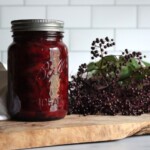
Elderberry Marmalade
Elderberry marmalade is an old-fashioned preserve made from elderberry juice, with whole slices of lemon and orange suspended in it. It sets on the citrus peel's own pectin with nothing added.
Servings: 24 servings, makes 3 half pint jars
Equipment
- Canning Jars, Lids and Bands
- Bubble remover
- Large glass or stainless steel bowl
- Sharp knife or mandoline
Ingredients
For the Elderberry Juice
- 1 lb elderberries as picked, see notes
- 3/4 cup water
For the Marmalade
- 1 cup elderberry juice measured, see notes
- 2 lemons quartered and thinly sliced, peel on
- 1 orange quartered and thinly sliced, peel on
- 2 cups water for simmering the citrus
- 1/2 cup bottled lemon juice
- 3 cups granulated sugar
Instructions
- Trim the ends off the lemons and the orange, quarter them lengthwise, and pull out the seeds.
- Slice the citrus quarters as thin as you can, peel and all, into small quarter moons.
- Put the citrus in a bowl, cover it with cold water, and leave it overnight. An hour is the minimum.
- De-stem the elderberries completely, so no stem or leaf material goes in the pot.
- Simmer the de-stemmed elderberries with water for at least 10 minutes, crushing the berries against the side of the pan as they soften.
- Strain the cooked berries through a jelly bag and measure the juice (see notes).
- Prepare a water bath canner, jars, and lids, and keep the jars hot until you fill them.
- Drain the soaking water off the citrus and put the slices in a wide, heavy-bottomed pot with fresh water.
- Simmer until the peel is tender and most of the water has cooked away, about 10 to 15 minutes, adding more water if the peel is still firm.
- Test the peel by pressing a slice against the side of the pot with a spatula. A spatula cuts through tender peel easily, and the peel will not soften further once the sugar goes in.
- Add the elderberry juice, bottled lemon juice, and sugar to the tender citrus.
- Return to a hard boil and cook until it reaches the gel stage, about 10 minutes.
- Test for the gel stage at 220 degrees F, or take the pot off the heat and check whether a spoonful wrinkles on a frozen plate.
- Remove the pot from the heat and skim off any foam.
- Ladle the hot marmalade into hot jars, leaving 1/4 inch headspace. Remove air bubbles, adjust the headspace, and wipe the rims clean.
- Center the lids on the jars and screw the bands down to fingertip tight.
- Process quarter pints and half pints in a boiling water bath canner for 10 minutes, adjusting for altitude (see notes).
- Turn off the heat, remove the canner lid, and wait 5 minutes before lifting the jars out onto a towel.
- Cool 12 to 24 hours, check the seals, take the bands off, and store in a cool, dark place.
Notes
Yield and measuring: 1 pound of elderberries as picked is about 3 cups de-stemmed and gives about 1 cup of juice. Save any extra for another use. Finishes at 3 half pints, so wash a fourth jar.
Recipe source: Follows NCHFP guidance for jams and jellies, with more sugar than the University of Wisconsin Extension's minimum for the elderberry juice. Neither the NCHFP nor the USDA has an elderberry marmalade.
Elderberries: Never use them raw. Freezing the clusters first makes de-stemming easier.
Slicing and peeling: Never peel the citrus. Slice it as thin as you can, since thin slices make the peel tender instead of chewy.
Citrus and sugar: Use at least three whole citrus fruits per cup of elderberry juice. The count can go up but never down, and the bottled lemon juice isn't optional. Elderberries aren't acidic enough on their own, so the sugar also keeps the jars safe. Don't cut it or swap in honey or a low-sugar pectin.
Pectin and set: No added pectin. Cook to 220 degrees F at sea level, or until a spoonful wrinkles on a frozen plate. The set point drops about 1 degree per 500 feet of elevation.
Batch size: Halves and doubles cleanly. Don't go past double, because a deep pot takes so long to reach the gel stage that the peel overcooks.
Canning optional: Keeps a few weeks in the fridge, or 6 months in the freezer. Use straight-sided, freezer-safe jars and leave 1 inch of headspace.
Altitude adjustments: Processing time for quarter pints and half pints in a water bath canner.
- 0 to 6,000 feet: 10 minutes
- Above 6,000 feet: 15 minutes
Nutrition
Serving: 2Tbsp | Calories: 108kcal | Carbohydrates: 28g | Protein: 0.2g | Fat: 0.1g | Saturated Fat: 0.01g | Polyunsaturated Fat: 0.01g | Monounsaturated Fat: 0.003g | Sodium: 1mg | Potassium: 45mg | Fiber: 0.4g | Sugar: 27g | Vitamin A: 15IU | Vitamin C: 10mg | Calcium: 6mg | Iron: 0.1mg