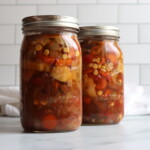
Canning Vegetable Beef Stew
This pressure canned vegetable beef stew is packed with tender stew beef, potatoes, carrots, celery, corn, green beans, and tomatoes in a rich, Italian-seasoned broth. Adapted from the Ball Complete Book of Home Preserving and the University of Alaska Hearty Soups Protocol, it yields 4 hearty quart jars that are ready to heat and serve any night of the week.
Servings: 8 servings (makes 4 quarts)
Equipment
Ingredients
- 2.5 lbs beef stew meat cut into 1 to 1.5 inch pieces
- 2 tbsp olive oil
- 1 cup onion chopped
- 2 cups carrots peeled, halved and sliced
- 1 cup celery sliced
- 3 cloves garlic minced
- 28 oz canned diced tomatoes do not drain
- 5 cups beef broth unsalted — see notes if using salted broth
- 3 cups Potatoes peeled and cut into 1-inch pieces
- 1 cup corn fresh from 1 large cob, or frozen
- 1 cup green beans trimmed and cut into 1-inch pieces
- 1 tsp dried parsley
- 2 tsp Italian seasoning or equal parts basil, oregano, rosemary, thyme, and marjoram
- 4 to 5 whole bay leaves
- 1 tbsp salt see notes — reduce significantly if using salted broth
Instructions
- Prepare your pressure canner, jars, lids, and bands according to the manufacturer's instructions. Keep jars hot until needed. Peel and cube the potatoes, slice the carrots, chop the celery and onion, mince the garlic, and cut the beef into 1 to 1.5 inch pieces. Cut corn from the cob and trim the green beans if using fresh.
- Heat the olive oil in a large heavy-bottomed pot over medium-high heat. Brown the beef in batches, adding more oil as needed. Do not crowd the pan — browning in batches builds much better flavor. Set the browned beef aside.
- In the same pot, add the onion, carrots, celery, and garlic. Return the browned beef to the pot. Add the diced tomatoes with their liquid, beef broth, potatoes, corn, green beans, Italian seasoning, parsley, bay leaf, and salt. Stir well and bring to a boil. Reduce heat and simmer for 5 minutes until everything is heated through.
- Add one bay leaf to each quart jar. Use a slotted spoon to distribute the solids evenly between the hot jars, then ladle the broth over the top to 1 inch headspace. If you run short on broth, add a bit of boiling water or extra stock. Remove air bubbles, wipe rims, and apply lids and bands to fingertip tight.
- Load jars into the preheated pressure canner. Lock the lid, vent for 10 minutes, then bring to pressure. Process pints for 75 minutes and quarts for 90 minutes, adjusting pressure for altitude. Allow the canner to depressurize naturally. Remove jars and cool on a towel-lined counter for 12 to 24 hours. Check seals, label, and store in a cool dark place.
Notes
Salt: This recipe calls for 1 tablespoon of salt, which works out to about 3/4 teaspoon per quart jar using unsalted homemade broth. If using full-salt commercial beef broth, reduce added salt to just 1 teaspoon, as salted broth typically already contains 2 to 3 teaspoons of salt equivalent per 5 cups.
Yield: As written, this recipe yields 4 hearty quart jars packed with meat and vegetables. For a brothier stew, add an extra 4 cups of beef stock and distribute the ingredients across 5 quart jars instead of 4.
Thickening: Do not add flour, cornstarch, or any thickener before canning. If you prefer a thicker stew, stir in a flour or cornstarch slurry after opening the jar when reheating. A tablespoon of tomato paste can be stirred into the pot before canning for a slightly richer broth without affecting safety.
Vegetables: Per the University of Alaska Cooperative Extension Hearty Soups Protocol, you can swap in other firm vegetables such as peas or bell peppers. You cannot add pureed vegetables, sweet potatoes, winter squash, dry beans, pasta, rice, dairy, or cured meats before canning.
Meat: Any stewing cut of beef works well. Chuck roast is the most flavorful. Venison, bison, or other game meats can also be used.
Storage: Store sealed jars in a cool, dark pantry. Use within 12 to 18 months for best quality. Refrigerate after opening.
Altitude Adjustments
For dial gauge pressure canners:- 0 to 2,000 feet in elevation: 11 lbs pressure
- 2,001 to 4,000 feet in elevation: 12 lbs pressure
- 4,001 to 6,000 feet in elevation: 13 lbs pressure
- 6,001 to 8,000 feet in elevation: 14 lbs pressure
- 0 to 1,000 feet in elevation: 10 lbs pressure
- Above 1,000 feet: 15 lbs pressure
Nutrition
Serving: 2cups | Calories: 350kcal | Carbohydrates: 25g | Protein: 37g | Fat: 11g | Saturated Fat: 3g | Polyunsaturated Fat: 1g | Monounsaturated Fat: 6g | Cholesterol: 88mg | Sodium: 1686mg | Potassium: 1224mg | Fiber: 4g | Sugar: 7g | Vitamin A: 5668IU | Vitamin C: 19mg | Calcium: 108mg | Iron: 5mg