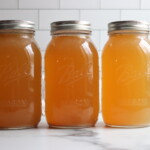
Canning Turkey Broth
Rich, roasted turkey broth made from leftover bones, vegetables, and herbs, then pressure canned for shelf-stable jars you can use all year for soups, gravy, and easy weeknight meals.
Servings: 20 servings, or 4 to 5 quarts
Equipment
Ingredients
- 8 quarts water enough to cover all ingredients
- 1 large Leftover turkey bones and carcass legs, wings, and any skin
- 2 large carrots washed, unpeeled
- 2 large celery stalks or celery tops
- 1 large onion or onion skins and ends
- 1 bulb garlic sliced in half
- 2 whole bay leaves
- 4 sprigs fresh thyme or 1 tsp dried
- 4 sprigs fresh parsley or 1 tsp dried
- 10 whole black peppercorns
Instructions
- Preheat the oven to 400 F. Roast turkey bones and carcass in a roasting pan for 30–45 minutes, until browned.
- Transfer the roasted bones to a large stockpot. Add onion, garlic, celery, carrots, bay leaves, thyme, parsley, and peppercorns.
- Add 6–8 quarts of water (or enough to cover the bones and vegetables). Bring just to a simmer over low heat.
- Simmer gently for 4–8 hours, adding a bit more water as needed to keep the bones covered.
- Strain the broth and let it cool enough to handle safely. Skim off as much fat as you can.
- Reheat the broth to a full boil.
- Ladle boiling broth into hot jars, leaving 1-inch headspace. Remove bubbles, adjust headspace if needed, wipe rims, and apply lids and rings fingertip-tight.
- Place jars in a pressure canner with the amount of water recommended by the canner manufacturer. Lock the lid, vent steam for 10 minutes, then bring the canner up to pressure.
- Process pints for 20 minutes, quarts for 25 minutes (adjust pressure as needed for your canner type and elevation, see notes).
- Turn off heat and allow the canner to depressurize naturally. Once at zero pressure, wait 10 minutes, then remove the lid carefully.
- Remove jars and cool undisturbed for 12–24 hours. Check seals, label, and store sealed jars in a cool, dark place. Refrigerate any unsealed jars and use within a few days.
Notes
Yield: Start with 6–8 quarts water (just enough to cover the bones and vegetables). After simmering and straining, expect about 4–5 quarts, depending on how tightly the pot is covered and how much evaporation occurs. Keep the pot tightly covered and the heat at a low simmer for the best yield.
Roasting step: Roasting the carcass deepens the color and gives the broth a richer, more savory flavor. If you’re short on time, you can skip it, but the finished broth will be lighter and more mild.
Keep it at a gentle simmer: A low simmer (not a hard boil) helps keep the broth clearer and prevents the fat from emulsifying into the liquid.
Skimming fat: Fat can interfere with sealing and shorten shelf quality. Turkey is usually easier to skim than beef stock, and you can often ladle most of it off while the broth is still warm if you’re careful. Chilling makes skimming even easier if you have time.
Salt is optional: I usually leave the broth unsalted so it’s more flexible in recipes later, then season when I use it. If you want to add salt, my personal preference is 1/4 tsp per quart.
Strain well before canning: This recipe is written for strained liquid broth/stock. If you want jars with meat pieces, you’ll need a separate canning method meant for poultry.
Do not thicken before canning: Don’t add flour, cornstarch, cream, dairy, rice, or noodles before canning. Thicken after opening when you make gravy or soup.
Altitude Adjustments
Canning time remains the same regardless of altitude. However, the processing pressure increases as altitude increases. For dial gauge pressure canners:- 0 to 2,000 feet in elevation – 11 lbs pressure
- 2,001 to 4,000 feet in elevation – 12 lbs pressure
- 4,001 to 6,000 feet in elevation – 13 lbs pressure
- 6,001 to 8,000 feet in elevation – 14 lbs pressure
- Above 1,000 feet – 15 lbs pressure
- 0 to 1,000 feet in elevation – 10 lbs pressure
Nutrition
Serving: 1cup | Calories: 2kcal | Carbohydrates: 0.1g | Protein: 0.2g | Fat: 0.1g | Saturated Fat: 0.02g | Polyunsaturated Fat: 0.01g | Monounsaturated Fat: 0.03g | Sodium: 4mg | Potassium: 10mg | Sugar: 0.02g | Calcium: 0.5mg | Iron: 0.03mg