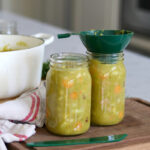
Canning Split Pea Soup
Home-canned split pea soup is a hearty meal in a jar, ready to heat and eat. This tested Ball Blue Book recipe is pressure canned for safe pantry storage.
Servings: 10 servings (Makes 5 pints, or a bit over 2 quarts, see note)
Equipment
- Canning Jars, Lids and Bands
Ingredients
- 1 lb split peas dry
- 2 qt water or broth
- 1 1/2 cup carrots sliced
- 1 cup onion chopped
- 1 cup cooked ham diced (optional)
- 1 whole bay leaf
- 1/4 tsp allspice
- 1/2 tsp black pepper
- 2 tsp salt or adjust to taste
Instructions
- Rinse the split peas and pick out any debris. Combine them with the water or broth in a heavy-bottomed pot. Bring to a boil, then reduce to a low simmer, covered, for about 1 hour until the peas are soft. Add water as needed to keep it from getting too thick or scorching.
- (Optional) For a smooth soup, puree with an immersion blender or in a blender, then return it to the pot. Keep it thin enough to pour.
- Peel and slice the carrots, and peel and chop the onion. Add them to the pot along with the ham, bay leaf, and allspice.
- Prepare and preheat your pressure canner for hot pack canning.
- Simmer the soup for 30 more minutes until the vegetables are cooked, adding water as needed to keep it pourable.
- Adjust the seasonings and salt to taste, then remove the bay leaf.
- Ladle the hot soup into prepared jars, leaving 1 inch of headspace. Remove air bubbles, wipe the rims, and apply lids and bands to fingertip tight.
- Load the jars into the canner, lock the lid, and vent steam for 10 minutes. Bring to 10 lbs pressure for a weighted gauge canner or 11 lbs for a dial gauge, adjusting for altitude.
- Process pints for 75 minutes or quarts for 90 minutes.
- Turn off the heat and let the canner return to zero pressure naturally. Cool the jars 12 hours, then check the seals before storing.
Notes
This is a hearty (full-packed) soup from the Ball Blue Book of Canning, also called Habitant Soup. Because it contains low-acid ingredients, it must be pressure canned and cannot be water bath canned. Do not shorten the time or lower the pressure.
Density: split peas cook down dense, and the 1 lb peas to 2 qt liquid ratio was tested together with the 75 and 90 minute times to handle that. Keep the ratio as written, do not pack in extra peas, and keep the soup thin enough to pour and ladle freely. If nessisary, add extra water to the recipe to ensure that it pours freely into the jars. You can puree it smooth, but it still needs to stay pourable, not pasty, and it thickens further in the jar.
This recipe makes a soup that's VERY thick, and for modern tastes, you'll likely want to thin it at serving. (Often, back in the day, this was a "stick to your ribs" hearty soup that was stand a spoon in it thick, and this is an older style recipe.)
You can also add more broth or water and thin it before it goes into the jars. You're always allowed to make canning recipes thinner before canning (it's thicker than the tested recipe that's not allowed). Personally, I like to add at least an extra quart of broth to the recipe when I make it, but I've written the recipe as Ball Canning tested it.
Whole-vegetable starting amounts: about 3 medium carrots and 1 medium onion, measured before peeling and cutting. You can leave out the carrots, onion, or ham, since split peas can be canned on their own, but do not add more vegetables than listed.
Use vegetable broth and skip the ham for a vegetarian version.
Adjust seasonings to taste, including small amounts of Worcestershire, cider vinegar, or lemon juice. Do not add thickeners, flour, pasta, rice, or dairy before canning.
Altitude Adjustments
The canning time is always the same, 75 minutes for pints and 90 minutes of quarts, regardless of altitude.
Pressure changes at higher altitudes. Altitude adjustments for pressure are as follows:
For dial gauge pressure canners:
- 0 to 2,000 feet in elevation – 11 lbs pressure
- 2,001 to 4,000 feet in elevation – 12 lbs pressure
- 4,001 to 6,000 feet in elevation – 13 lbs pressure
- 6,001 to 8,000 feet in elevation – 14 lbs pressure
- 0 to 1,000 feet in elevation – 10 lbs pressure
- Above 1,000 feet – 15 lbs pressure
Nutrition
Serving: 1cup | Calories: 186kcal | Carbohydrates: 31g | Protein: 14g | Fat: 1g | Saturated Fat: 0.3g | Polyunsaturated Fat: 0.3g | Monounsaturated Fat: 0.4g | Cholesterol: 8mg | Sodium: 733mg | Potassium: 563mg | Fiber: 12g | Sugar: 5g | Vitamin A: 3282IU | Vitamin C: 6mg | Calcium: 37mg | Iron: 2mg