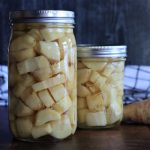
Canning Parsnips
Canning parsnips is a simple pressure canning project that turns a fall harvest into shelf stable jars. Hot packed in their own cooking liquid with optional salt, they keep for a year and go straight into soups, stews, pot pie, and mashes.
Servings: 56 servings, 7 quarts or 9 pints
Equipment
- Canning Jars, Lids and Bands
Ingredients
- 18 lbs parsnips as purchased, see notes
- Boiling water to fill each jar
- Salt optional, 1 tsp per quart or 1/2 tsp per pint
Instructions
- Peel the parsnips and trim off the crown and the thin spindly tips.
- Cut the parsnips into evenly sized chunks so they heat through at the same rate.
- Bring a large pot of water to a hard boil, add the parsnips, wait for the water to return to a boil, and then boil for 5 minutes. Work in batches if the pot is small.
- Pack the hot parsnips into warm, clean jars, leaving 1 inch headspace.
- Add salt to each jar if you are using it, then cover the parsnips with the boiling cooking liquid, keeping 1 inch headspace.
- Release trapped air bubbles, top up the liquid if the level dropped, wipe the rims and threads clean, and apply two piece lids until fingertip tight.
- Load the jars into the pressure canner, fasten the lid, and vent a steady stream of steam for 10 minutes before adding the weight or closing the petcock.
- Process pints for 30 minutes or quarts for 35 minutes at 10 pounds pressure in a weighted gauge canner or 11 pounds in a dial gauge canner, adjusting for altitude (see notes).
- Turn off the heat and let the canner depressurize on its own, then slowly remove the weight or open the petcock.
- Wait 2 minutes, then unfasten the lid and open it away from your face.
- Remove the jars to a towel lined counter, leaving space between them, and let them cool undisturbed for 12 to 24 hours.
- Check the seals, remove the rings, label the jars, and store them in a cool, dark place.
Notes
Recipe source: The root vegetable directions in the Ball Complete Book of Home Preserving, matched against Michigan State University Extension, Michigan Fresh bulletin HNI44. Parsnips are not in the USDA guide or NCHFP.
Yield: 16 to 18 pounds as purchased fills 7 quarts; 10 to 12 pounds fills 9 pints. Roughly 2 to 2 1/2 pounds per quart. Peeling loss varies with root size and shape.
Salt: Optional, for flavor only, and it does nothing for safety. Use 1/2 teaspoon per pint or 1 teaspoon per quart, added before the liquid. This is a per jar amount and does not scale with the serving buttons. Canning and pickling salt keeps the liquid clear.
Pressure canning only: Parsnips are low acid and there is no tested water bath process for them at any jar size. Dry canning without liquid is untested and unsafe.
Peel the parsnips: A safety step, not a texture preference. Garden soil carries microbes you do not want sealed into a jar.
Hot pack: The 5 minute boil drives air out so the pieces do not float. Pack hot and cover with the boiling cooking liquid.
Quality note: Parsnips, turnips and rutabaga come out sweeter, stronger and slightly duller in color. Young roots in larger pieces come out mildest.
Altitude adjustments: Times stay the same at every altitude. Only the pressure changes.
- Dial gauge: 11 lbs to 2,000 feet, 12 lbs to 4,000, 13 lbs to 6,000, 14 lbs to 8,000
- Weighted gauge: 10 lbs to 1,000 feet, 15 lbs above that
Nutrition
Calories: 109kcal | Carbohydrates: 26g | Protein: 2g | Fat: 0.4g | Saturated Fat: 0.1g | Polyunsaturated Fat: 0.1g | Monounsaturated Fat: 0.2g | Sodium: 15mg | Potassium: 547mg | Fiber: 7g | Sugar: 7g | Vitamin C: 25mg | Calcium: 52mg | Iron: 1mg