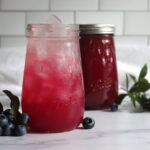
Canning Blueberry Lemonade Concentrate
This blueberry lemonade concentrate is a simple way to preserve summer’s freshest flavors for year-round sipping. Made with real blueberries and freshly squeezed lemon juice, it’s perfect for canning and mixing up quick, refreshing drinks whenever you need them. Just add water to serve—still or sparkling!
Servings: 40 servings, Makes 5 Pints
Equipment
- Blender or immersion blender
- Canning Jars, Lids and Bands
Ingredients
- 6 cups blueberries
- 6 cups sugar
- 4 cups lemon juice preferably fresh, but bottled works too
Instructions
- Prepare a water bath canner, jars, rings and lids before beginning. The canner should be pre-heated to around 180 degrees F (barely simmering) for hot pack.
- Juice the lemons and strain to remove any pulp and seeds.
- Puree the blueberries. (Straining the puree to remove skins and seeds is optional, and only affects texture, not safety. I don't strain for with blueberries, as the seeds are so small they're not noticeable and the skins puree completely.)
- Mix the blueberry puree, strained lemon juice, and sugar in a saucepan.
- Gently heat the mixture on the stove to around 190 degrees F, but do not boil.
- Ladle the blueberry lemonade concentrate into prepared jars, leaving 1/4 inch headspace. Seal with 2 part canning lids.
- Process the jars in a water bath canner for 15 minutes, adjusting to the altitude (see notes).
- Turn off the heat and leave the jars in the canner for an additional 5 minutes to cool slightly before removing them with a canning jar lifter to cool completely on a towel on the counter.
- Wait 12 to 24 hours, then check seals. Store any unsealed jars in the refrigerator for immediate use. Properly canned and sealed jars may be stored in the pantry. Refrigerate after opening.
To reconstitute, mix 1 part concentrate with 3 parts water. For a 1 pint jar, you'd add 3 pints water. For simplicity, you can just add a pint to a half-gallon mason jar, which holds 4 pints, and then fill it up the rest of the way with cold water. That should give you a "basic lemonade" flavor that's strong, but not too strong. You can adjust to your own tastes.
Notes
Yield: When I make this recipe it yields about 5 pints, though it varies a little with how juicy your berries are and how much puree you get out of them. Both the blueberries and the lemon juice are safe to can on their own, so the ratio is not fixed for safety. Lean toward more blueberry or more lemon to suit your taste, and raise or lower the sugar however you like, since the sugar is here for flavor rather than preservation.
Lemon Juice: Fresh or bottled lemon juice both work. Fresh juice, strained well, gives the fullest flavor, while bottled is convenient and has a steady acidity. Either way, use plain lemon juice with nothing else added.
Straining: Straining is optional and only changes the texture of the finished drink. The canning time is the same whether the blueberries go in as puree or strained juice, so leave the puree in for more body and color, or strain it down to juice for a smoother, lighter lemonade. Straining does lower the yield a bit, since you are removing the fiber.
Reconstituting: One pint of concentrate makes a half gallon of blueberry lemonade. Mix 1 part concentrate with 3 parts cold water, or pour a pint into a half gallon mason jar and fill the rest with water, then serve over ice. Mix it stronger or weaker to taste, or stir it into sparkling water for a fizzy version.
Storage: Sealed, processed jars keep on the pantry shelf for up to a year. If you are not canning, the concentrate keeps in the refrigerator for a few weeks or in the freezer for up to 6 months. Leave 1 inch of headspace if you are freezing so it has room to expand, and refrigerate after opening.
Altitude Adjustments: Process half pints, pints, and quarts for 15 minutes below 1,000 feet. Between 1,000 and 6,000 feet, process for 20 minutes, and above 6,000 feet, process for 25 minutes. This follows the NCHFP fruit puree times, which are the same across all three jar sizes. Do not can this in half gallon jars, since quart is the largest size.
Nutrition
Calories: 134kcal | Carbohydrates: 35g | Protein: 0.2g | Fat: 0.2g | Saturated Fat: 0.02g | Polyunsaturated Fat: 0.04g | Monounsaturated Fat: 0.01g | Sodium: 1mg | Potassium: 43mg | Fiber: 1g | Sugar: 33g | Vitamin A: 13IU | Vitamin C: 12mg | Calcium: 3mg | Iron: 0.1mg