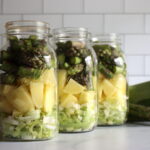
Canning Asparagus Potato & Leek Soup
Asparagus, Potato, and Leek soup is a cross between two wonderful hearty soups. Potato leek is a classic, and asparagus soup is a refined treat. Together they’re wonderfully delicious, and this canning recipe means you can enjoy them year-round.
Servings: 4 servings, 2 Quarts, see notes
Equipment
- Canning Jars, Lids and Bands
Ingredients
- 2 cup leeks sliced
- 3 cups potatoes diced
- 3 cups asparagus chopped
- 2 tsp salt
- 4 cups vegetable broth plus more to fill as needed
Instructions
- Prepare a pressure canner, jars, and lids. Wash and slice the leeks, peel and dice the potatoes, and trim and chop the asparagus.
- Combine the leeks, potatoes, asparagus, and salt in a large pot. Add vegetable broth to cover and bring to a boil, then reduce to a simmer for 5 minutes.
- Using a slotted spoon, pack the hot vegetables into the jars to the hearty guideline, leaving 1 inch headspace. Ladle hot broth over the top to fill the gaps, keeping 1 inch headspace.
- Run a bubble remover around the inside of each jar to release trapped air, adjust the headspace if needed, then wipe the rims and set the lids and bands to fingertip tight.
- Place the jars in the pressure canner and vent the steam for 10 minutes before adding the weight. Process pints for 75 minutes or quarts for 90 minutes at 10 lbs pressure in a weighted gauge canner or 11 lbs in a dial gauge canner, adjusting for altitude.
- Allow a natural pressure release. Remove the jars and cool undisturbed for 12 to 24 hours, then check the seals.
Notes
Safe canning source: This recipe follows the University of Alaska hearty soup guidelines (publication FNH-00065), where the jars are packed mostly full of vegetables with broth filling the gaps. The processing time and pressure are the safety control and cannot be reduced, and because this is a low acid soup it cannot be water bath canned.
Do not add before canning: Cream, milk, cheese, butter, flour, cornstarch, and other thickeners are never added before canning, and the soup is not pureed before canning either, since a thick puree blocks heat from moving through the jar. Stir any of those in at serving when you reheat a jar.
Minimum batch: The smallest safe load is 2 quarts or 4 pints, which is what the recipe as written makes. It scales up cleanly to fill the canner, so multiply the vegetables and broth as needed and process by jar size rather than by batch size.
Storage: Properly sealed jars keep for 12 to 18 months in a cool, dark place and stay safe well beyond that. Refrigerate after opening and use within 3 to 4 days.
Altitude Adjustments
With pressure canning, the processing times stay the same at higher altitudes, but the pressures change. Here are the altitude adjustments for pressure canning soup:
For dial gauge pressure canners:
- 0 to 2,000 feet in elevation – 11 lbs pressure
- 2,001 to 4,000 feet in elevation – 12 lbs pressure
- 4,001 to 6,000 feet in elevation – 13 lbs pressure
- 6,001 to 8,000 feet in elevation – 14 lbs pressure
- 0 to 1,000 feet in elevation – 10 lbs pressure
- Above 1,000 feet – 15 lbs pressure
Nutrition
Serving: 2cups | Calories: 253kcal | Carbohydrates: 57g | Protein: 9g | Fat: 1g | Saturated Fat: 0.1g | Polyunsaturated Fat: 0.3g | Monounsaturated Fat: 0.01g | Sodium: 1775mg | Potassium: 1420mg | Fiber: 10g | Sugar: 7g | Vitamin A: 2257IU | Vitamin C: 63mg | Calcium: 105mg | Iron: 6mg