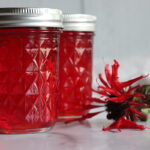
Bee Balm Jelly
Savory bee balm jelly is a unique herbal treat with gorgeous color right from your perennial patch.
Servings: 48 servings (makes 5 to 6 half pint jars)
Equipment
- Canning Jars, Lids and Bands
Ingredients
For the Bee Balm Tea
- 2 cups fresh bee balm blossoms de-stemmed (or 1 cup dried)
- 4 cups water or 2 cups water and 2 cups dry white wine
For the Jelly
- 4 cups bee balm tea strained
- 1 cup vinegar wine, white, cider, or rice
- 1/4 cup bottled lemon juice
- 1 Box Low Sugar Powdered Pectin 1.75 oz low-sugar pectin, such as Sure-Jell No Sugar
- 1 to 2 cups granulated sugar See Notes for Sweet Jelly Option
Instructions
- Bring the water (or water and wine) to a boil. Pour over the bee balm blossoms in a heat-safe container, pushing them down to submerge. Cover and steep 10 to 15 minutes.
- Strain the tea through a fine mesh strainer or cheesecloth, pressing gently on the petals. Measure, adding water if needed to reach the full amount.
- Pour the tea into a large pot and add the vinegar and lemon juice. Whisk in the pectin until dissolved. Bring to a full rolling boil over medium-high heat, stirring, and boil hard for 1 minute.
- Add the sugar and stir to dissolve. Return to a full rolling boil and boil 1 more minute. Remove from heat and skim off any foam.
- Ladle hot jelly into prepared jars, leaving 1/4 inch headspace. Wipe rims, center lids, apply bands fingertip-tight.
- Process in a boiling water bath for 10 minutes, adjusting for altitude. Let jars rest 5 minutes, then cool undisturbed 12 to 24 hours before checking seals.
Notes
Bee Balm Varieties: Monarda didyma (red) and Monarda fistulosa (lavender wild bergamot) are both edible and work interchangeably here, with the red blossoms giving the deepest color.
Harvest Safely: Use only blossoms you've correctly identified as edible bee balm, gathered away from pesticides, road spray, and pet traffic. Use the petals only, discard the green bits, and rinse for insects before steeping.
Use Bottled Lemon Juice: Bottled lemon juice has the consistent acidity that makes this jelly safe to can. Use the full amount along with the vinegar, and don't substitute fresh lemon juice or cut it back.
Keep It Savory or Take It Sweet: As written, 1 to 2 cups of sugar keeps this on the savory side. You can add up to 4 cups for a sweeter spread, but keep the vinegar and lemon juice unchanged for safety.
Don't Double the Batch: Pectin sets on a precise ratio of liquid, sugar, and pectin, and doubling often keeps it from gelling. If you want more, make the batches one at a time rather than in one large pot.
Give It Time to Set: Pectin jelly can take 24 to 48 hours to firm up completely. If it still looks loose the next day, use it as a savory syrup or glaze before you think about re-cooking it.
Storage: Sealed, processed jars keep on the pantry shelf for 12 to 18 months. If you're not canning, store the jelly in the refrigerator for up to 4 weeks or the freezer for up to 6 months. Refrigerate after opening.
Altitude Adjustments: 0 to 6,000 feet: 10 minutes. Above 6,000 feet: 15 minutes.
Nutrition
Serving: 1Tbsp | Calories: 17kcal | Carbohydrates: 4g | Protein: 0.004g | Fat: 0.02g | Sodium: 1mg | Potassium: 1mg | Fiber: 0.004g | Sugar: 4g | Vitamin A: 0.1IU | Vitamin C: 0.5mg | Calcium: 1mg | Iron: 0.005mg