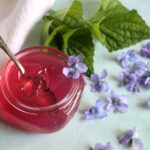
Violet Jelly
Wild violet jelly tastes like spring in a jar, with the flavor of fresh berries and it turns a beautiful shade of pink in the jar.
Servings: 48 servings (5 to 6 half pint jars)
Equipment
- Canning Jars, Lids and Bands
Ingredients
For the Violet Tea
- 2 cups wild violet flowers loosely packed
- 4 cups water
For the Violet Jelly
- 1/4 cup bottled lemon juice or 1 teaspoon citric acid
- 1 Box powdered pectin 1.75 oz, Sure-Jell or similar brand
- 5 cups sugar or less, see notes
Instructions
- Harvest the violet flowers, choosing only blossoms free from pesticides. If using a mason jar, harvest directly into the jar, about halfway full.
- Pour the boiling water over the violet flowers. Let steep for 15 to 20 minutes. The tea will likely be greenish or turquoise at first.
- Strain out the flowers and pour the tea into a large pot. Stir in the lemon juice (or citric acid); the color will shift from turquoise to pink.
- Whisk in the powdered pectin until dissolved. Bring to a full rolling boil over high heat, stirring constantly, and boil for 1 minute.
- Add all the sugar at once and stir. Return to a full rolling boil and boil hard for exactly 1 minute. Remove from heat and skim off any foam.
- Ladle hot jelly into prepared jars, leaving 1/4 inch headspace. Wipe rims clean, center lids, and apply bands fingertip-tight.
- Process in a boiling water bath for 10 minutes, adjusting for altitude. Turn off heat and let jars rest 5 minutes before removing. Cool undisturbed for 12-24 hours before checking seals. If not canning, store in the refrigerator for up to 3 weeks.
Notes
Violet Varieties: Wild violets (Viola species) are the classic choice, and cultivated pansies or Johnny Jump-Ups also work. Avoid African violets, which are a different plant and not edible.
Harvest Safely: Use only blossoms you've correctly identified as edible, gathered from areas free of pesticides, road spray, and pet traffic. Pick just the petals or flower heads the recipe calls for, and give them a quick rinse to clear out any insects.
Use Bottled Lemon Juice: Stick with bottled lemon juice. Its acidity holds steady from bottle to bottle the way fresh lemons don't, and that acid is what keeps the jelly safe to can. Use the full amount and don't trim it back. Citric acid stands in at 1 teaspoon for the 1/4 cup of lemon juice.
Don't Double the Batch: Pectin jellies set on a precise ratio of liquid, sugar, and pectin, and doubling a batch often keeps it from gelling. If you want more than one batch, make them one at a time rather than in a single large pot.
Give It Time to Set: Pectin jelly can take 24 to 48 hours to firm up completely. If it still looks loose the next day, don't rush to re-cook it, and check the troubleshooting guide first.
Low Sugar Option: For a less sweet jelly, use Sure-Jell Low Sugar or Pomona's Universal Pectin. Follow the package instructions for mint jelly. With Pomona's pectin, increase lemon juice to 1/2 cup because it does not contain added citric acid like other brands of pectin. Reducing sugar lowers the yield.
Make the Tea Ahead: The flower tea can be steeped and refrigerated for a day or two before you turn it into jelly, which lets you split the work over two sessions.
Storage: Sealed, processed jars keep on the pantry shelf for 12 to 18 months. If you're not canning, store the jelly in the refrigerator for up to 3 weeks or the freezer for up to 6 months. Refrigerate after opening.
Altitude Adjustments: 0 to 6,000 feet: 10 minutes. Above 6,000 feet: 15 minutes.
Nutrition
Serving: 1Tbsp | Calories: 84kcal | Carbohydrates: 22g | Protein: 0.02g | Fat: 0.1g | Saturated Fat: 0.001g | Polyunsaturated Fat: 0.001g | Sodium: 3mg | Potassium: 4mg | Fiber: 0.1g | Sugar: 21g | Vitamin A: 27IU | Vitamin C: 1mg | Calcium: 1mg | Iron: 0.05mg