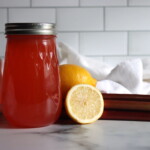
Rhubarb Lemonade Concentrate
This rhubarb lemonade concentrate is a tart-sweet summer drink base you can water bath can for the pantry. Make rhubarb juice, heat it with lemon juice and sugar, and you'll have jars ready to turn into instant lemonade whenever you want.
Servings: 40 servings, about 5 pints
Equipment
- Canning Jars, Lids and Bands
Ingredients
For the Rhubarb Juice
- 9 cups diced rhubarb
- 3 cups water
For the Concentrate
- 6 cups rhubarb juice from above
- 2 cups lemon juice fresh or bottled
- 6 cups granulated sugar
Instructions
Make the Rhubarb Juice
- Combine the diced rhubarb and water in a large pot. Bring to a boil, then reduce the heat and simmer until the stalks are completely soft and falling apart and the liquid is strongly flavored, about 15 minutes. Simmer gently, and keep the pot covered.
- Strain through a jelly bag or a fine-mesh strainer lined with damp cheesecloth, and let it drain. For a clearer juice, do not press the pulp. For a little more yield, press gently. Measure out the rhubarb juice you need for the concentrate.
- At this point, the lemon juice and sugar are optional, and it's perfectly fine to can plain rhubarb juice with these instructions with no additions. To make a propper lemonade concentrate recipe, the juice is mixed with a good bit of lemon juice and sugar for flavor.
Make and Can the Concentrate
- Before you fill jars, prepare a water bath canner and bring the water up to a simmer, and wash your jars and lids in hot soapy water. Keep the jars hot until you fill them so they do not crack when they meet the hot concentrate. There is no need to sterilize, since the jars are processed for more than 10 minutes.
- Juice the lemons and strain the juice well to remove seeds and pulp, which can add bitterness. Set the strained lemon juice aside.
- Combine the rhubarb juice, lemon juice, and sugar in a clean pot. Stir well so the sugar begins to dissolve before the mixture heats up.
- Heat over medium heat, stirring often, until the sugar has fully dissolved and the mixture reaches 190°F. That is hot and steaming, just short of a simmer, so a thermometer takes the guesswork out of it. Do not let it boil.
- Ladle the hot concentrate into the prepared jars, leaving 1/4 inch of headspace. Run a bubble tool or thin spatula around the inside of each jar to release trapped air, then wipe the rims with a clean damp cloth.
- Center a lid on each jar and screw the band down to fingertip tight. Load the jars into the canner, making sure they are covered by an inch or two of water.
- Bring the canner to a full rolling boil, then process for 15 minutes, adjusting the time for your altitude (see notes). Start timing only once the water reaches a full boil.
- When the time is up, turn off the heat and let the jars sit in the canner for 5 minutes before lifting them out. That short rest keeps the liquid from siphoning out.
- Set the jars on a towel and leave them undisturbed for 12 to 24 hours. Do not retighten the bands while they cool, and you may hear them ping as they seal.
- After cooling, check the seals by pressing the center of each lid. A sealed lid will not flex. Store sealed jars in the pantry, and move any that did not seal to the refrigerator to use first.
To serve, reconstitute by mixing 1 part concentrate with 3 parts cold water, then adjust it stronger or weaker to taste.
Notes
Yield: When I make this recipe it yields about 5 pints, though it varies a little with how juicy your rhubarb is. Both the rhubarb juice and the lemon juice are safe to can on their own, so the ratio is not fixed for safety. Rhubarb is acidic enough that it stands in for part of the lemon, which is why this uses less lemon than the other fruit concentrates. Lean toward more rhubarb or more lemon to suit your taste, and raise or lower the sugar however you like, since the sugar is here for flavor rather than preservation. Plan on about 9 cups of diced rhubarb, roughly 2.5 to 3 pounds, simmered with 3 cups of water, to get the 6 cups of juice this batch needs.
Lemon Juice: Fresh or bottled lemon juice both work. Fresh juice, strained well, gives the fullest flavor, while bottled is convenient and has a steady acidity. Either way, use plain lemon juice with nothing else added.
Straining: Straining is required to turn the cooked rhubarb into a juice, but how clear you make it is up to you. Strain through a jelly bag for a clearer juice, or a fine-mesh strainer if you don't mind a little cloudiness. It only changes how the finished drink looks, not its safety.
Reconstituting: One pint of concentrate makes a half gallon of rhubarb lemonade. Mix 1 part concentrate with 3 parts cold water, or pour a pint into a half gallon mason jar and fill the rest with water, then serve over ice. Mix it stronger or weaker to taste, or stir it into sparkling water for a fizzy version.
Storage: Sealed, processed jars keep on the pantry shelf for up to a year. If you are not canning, the concentrate keeps in the refrigerator for a few weeks or in the freezer for up to 6 months. Leave 1 inch of headspace if you are freezing so it has room to expand, and refrigerate after opening.
Altitude Adjustments: Process half pints, pints, and quarts for 15 minutes below 1,000 feet. Between 1,000 and 6,000 feet, process for 20 minutes, and above 6,000 feet, process for 25 minutes. This follows the NCHFP fruit puree times, which are the same across all three jar sizes. Do not can this in half gallon jars, since quart is the largest size.
Nutrition
Serving: 1cup prepared | Calories: 124kcal | Carbohydrates: 32g | Protein: 0.3g | Fat: 0.2g | Saturated Fat: 0.02g | Polyunsaturated Fat: 0.03g | Monounsaturated Fat: 0.01g | Sodium: 2mg | Potassium: 92mg | Fiber: 1g | Sugar: 31g | Vitamin A: 29IU | Vitamin C: 7mg | Calcium: 25mg | Iron: 0.1mg