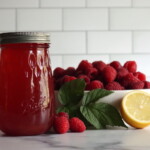
Raspberry Lemonade Concentrate
This raspberry lemonade concentrate is a bright, berry-forward twist on classic lemonade that’s safe for water bath canning. Make a quick raspberry juice, dissolve it with lemon juice and sugar, then can it hot so you can mix up lemonade anytime.
Servings: 32 servings, makes 4 pints
Equipment
- Canning Jars, Lids and Bands
Ingredients
For the Raspberry Juice
- 8 cups raspberries fresh or frozen
- 1 cup water
For the Concentrate
- 2 cups raspberry juice from above, see note
- 4 cups lemon juice fresh or bottled, see note
- 4 cups granulated sugar
Instructions
Make the Raspberry Juice
- Place the raspberries in a large pot with the water to keep them from scorching, and crush them lightly with a potato masher or the back of a spoon.
- Bring to a simmer over medium heat and cook for 5 to 8 minutes, stirring occasionally, until the berries have completely broken down and released their juice.
- Pour the hot mixture into a damp jelly bag or a strainer lined with several layers of damp cheesecloth set over a large bowl. Let it drip for at least 4 hours or overnight, then measure out the finished raspberry juice.
Make and Can the Concentrate
- Prepare a water bath canner, jars, and lids before you begin.
- Juice the lemons and strain well to remove the seeds and pulp.
- Combine the raspberry juice, lemon juice, and sugar in a saucepan and stir to dissolve the sugar.
- Heat the mixture to 190°F, stirring often, until it is steaming hot and the sugar is fully dissolved. Do not boil.
- Ladle the hot concentrate into prepared jars, leaving 1/4 inch headspace. Wipe the rims, center the lids, and apply the bands fingertip tight.
- Process in a boiling water bath for 15 minutes, adjusting for altitude (see notes).
- Turn off the heat and let the jars rest 5 minutes, then remove and cool undisturbed for 12 to 24 hours. Check the seals.
To reconstitute, mix 1 part concentrate with 3 parts cold water.
Notes
Yield: This batch uses 4 cups raspberry juice, 4 cups lemon juice, and 6 cups sugar, and makes about 5 pints of concentrate. The 4 cups of raspberry juice come from about 3 1/2 quarts of raspberries, roughly 14 cups, which is about four 16-ounce bags if you are working from frozen. Raspberries are juicy enough that they do not need any added water to release their juice, and frozen berries tend to break down a little faster since freezing ruptures the cell walls.
Lemon Juice: Fresh or bottled both work here. Fresh lemon juice, strained well to keep out the bitter pulp, tends to taste a little brighter, while bottled is the more consistent option for acidity and flavor from batch to batch and saves time when you are canning larger quantities. The lemon juice is a flavor choice rather than a safety one in this recipe, since raspberry juice is high enough in acid to can on its own, so use whichever you prefer. If you go with bottled, make sure it is plain lemon juice with nothing else added.
Straining: Raspberries are seedy, so this recipe uses strained raspberry juice rather than puree. Simmer the berries to release their juice, mashing as they heat, then strain through a jelly bag or fine mesh strainer to leave the seeds behind. The canning time is the same whether the raspberries go in as strained juice or as puree, so straining is a quality choice rather than a safety one. Strain it once for a smoother drink, run it through dampened cheesecloth a second time for a clearer juice, or leave a little pulp in for more body.
Reconstituting: Mix 1 part concentrate with 3 parts water and adjust to taste from there. A pint jar of concentrate makes about a half gallon of prepared lemonade. For an easy method, pour a pint of concentrate into a half gallon mason jar and fill the rest of the way with cold water. Serve over ice with lemon slices, fresh raspberries, or mint, or mix the concentrate with sparkling water for a fizzy version.
Storage: Sealed jars are shelf-stable in the pantry for up to a year. Refrigerate after opening and use within a few weeks. This same concentrate can also be frozen instead of canned. Leave 1 inch of headspace in freezer-safe jars and use within about 6 months.
Altitude: Process for 15 minutes below 1,000 feet, 20 minutes from 1,001 to 6,000 feet, and 25 minutes above 6,000 feet. The times are the same for half pints, pints, and quarts.
Nutrition
Serving: 1cup prepared | Calories: 127kcal | Carbohydrates: 33g | Protein: 1g | Fat: 0.3g | Saturated Fat: 0.02g | Polyunsaturated Fat: 0.1g | Monounsaturated Fat: 0.02g | Sodium: 2mg | Potassium: 102mg | Fiber: 2g | Sugar: 29g | Vitamin A: 12IU | Vitamin C: 20mg | Calcium: 11mg | Iron: 0.3mg