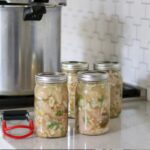
Pressure Canning Meat or Vegetables
Pressure canning recipes vary a bit based on what you're preserving, but the general process is always the same. Use this as a guide, with the time from the tested recipe for your food.
Servings: 2 quarts
Equipment
- Pressure Canner I use an All American Model 930
- Wide Mouth Canning Lids
- Wide Mouth Quart Mason Jars
Ingredients
- Meat Beef, Poultry, Pork, etc.
- Fresh Vegetables Carrots, Potatoes, Beans, Peas, etc.
- Broth Stock, Water, or Juice
- Herbs and Spices Optional
- Salt Optional, but recommended for flavor
Instructions
Prepare the Ingredients
- Trim the fat from the meat and cut it into bite-sized pieces or strips. Meat can go in raw or cooked, but brown ground meat before canning it.
- Wash, peel and chop the vegetables. Some need blanching or precooking first, so follow the tested recipe for each one.
- Make the broth or stock, or use store-bought broth, stock or water. Season it with herbs, salt or spices if you like.
- Add any herbs or spices, but don't thicken the mixture with flour, cornstarch or anything else. Thickeners slow the heat getting into the center of the jar.
Fill the Jars
- For a raw pack, pack the raw meat or vegetables into the jars, leaving 1 inch headspace. Pour boiling broth over them, keeping 1 inch headspace.
- For a hot pack, bring the ingredients to a simmer in a stockpot for 5 minutes, then pack them into the jars, leaving 1 inch headspace.
- Remove air bubbles with a plastic utensil, wipe the rims, and apply the lids and bands fingertip tight.
Process in a Pressure Canner
- Put 2 to 3 inches of water in the pressure canner, or the amount your canner's manual calls for. Heat it to about 140 degrees F for a raw pack or about 180 degrees F for a hot pack.
- Load the jars, lock the lid, and turn the heat to high. Once steam flows from the vent, let it vent for 10 minutes before adding the weight or closing the petcock.
- Process pints for 60 to 100 minutes or quarts for 75 to 100 minutes, depending on the food, at 11 lbs pressure in a dial gauge canner or 10 lbs in a weighted gauge canner, adjusting for altitude (see notes). Use the time from the tested recipe for what you're canning, and start timing once the canner reaches pressure.
Cool and Store
- Turn off the heat and let the canner return to zero pressure on its own. Remove the weight or open the petcock, wait 10 minutes, then take off the lid, tilting it away from you, and lift the jars out.
- Set the jars on a towel or cooling rack and let them cool undisturbed for 12 to 24 hours, then check the seals. A sealed lid is concave and doesn't move when you press the center.
- Store sealed jars in a cool, dark place, ideally 50 to 70 degrees F. Refrigerate any unsealed jars and use them within a few days.
Notes
Canning times: Times vary with the food, so check the tested recipe for what you're canning. Broth or stock is canned for 20 minutes for pints or 25 minutes for quarts. Fish is canned in pints only, for 100 minutes, and soups or other recipes with seafood take 100 minutes too. Most other recipes fall somewhere between those.
Batch size: Process at least 2 quarts or 4 pints at a time, never fewer. The most you can process at once depends on your canner.
Do not can: Dairy, pasta, rice, thickeners like flour or cornstarch, or any ingredient that isn't in a tested recipe.
Prep first: Some vegetables and meats need precooking before canning. Follow the tested recipe for each one.
Storage: Sealed jars keep their flavor and texture for 12 to 18 months in a cool, dark place. Check the seal before you open a jar.
Reheating: Most home canned foods can be eaten straight from the jar, or brought to a simmer on the stove or heated in the microwave before serving.
Altitude adjustments: Use the tested recipe's time at any altitude. Only the pressure changes as you go up.
Dial Gauge Canners
- 0 to 2,000 feet: 11 lbs
- 2,001 to 4,000 feet: 12 lbs
- 4,001 to 6,000 feet: 13 lbs
- 6,001 to 8,000 feet: 14 lbs
- 0 to 1,000 feet: 10 lbs
- Above 1,000 feet: 15 lbs
Nutrition
Calories: 328kcal | Carbohydrates: 68g | Protein: 8g | Fat: 3g | Saturated Fat: 1g | Polyunsaturated Fat: 1g | Monounsaturated Fat: 1g | Sodium: 111mg | Potassium: 1154mg | Fiber: 6g | Sugar: 41g | Vitamin A: 1976IU | Vitamin C: 65mg | Calcium: 66mg | Iron: 6mg