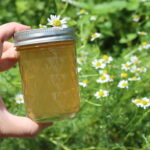
Chamomile Jelly
Flower jellies capture the flavor of fresh blossoms in a sweet floral jelly.
Servings: 48 servings (makes 5 to 6 half pint jars)
Equipment
- Canning Jars, Lids and Bands
Ingredients
For the Chamomile Tea
- 1 to 2 cups fresh chamomile blossoms or 1/2 cup dried chamomile
- 4 cups water
For the Jelly
- 4 cups chamomile tea strained
- 1/4 cup bottled lemon juice or 1 teaspoon citric acid
- 1 box powdered pectin 1.75 oz, regular, such as Sure-Jell original, or 6 Tbsp Bulk Pectin
- 5 cups granulated sugar See notes for low sugar options
Instructions
- Place the chamomile (fresh or dried) in a heatproof bowl or jar. Bring the water to a boil and pour it over the flowers. Steep 10 to 15 minutes.
- Strain the tea through a fine mesh strainer into a large pot, pressing gently. Measure the tea, adding water if needed to reach the full amount called for.
- Add the lemon juice to the tea and bring to a boil over high heat. Whisk in the powdered pectin until fully dissolved and boil for 1 minute.
- Add all the sugar at once and stir to dissolve. Return to a full rolling boil and boil hard for exactly 1 minute. Remove from heat and skim off any foam.
- Ladle hot jelly into prepared jars, leaving 1/4 inch headspace. Wipe rims, center lids, and apply bands fingertip tight.
- Process in a boiling water bath for 10 minutes, adjusting for altitude. Turn off heat and let jars rest 5 minutes, then cool undisturbed 12 to 24 hours before checking seals.
Notes
Fresh or Dried: Dried chamomile tea works just as well as fresh flowers, making this an any-season recipe. Use about 1/2 cup dried, or roughly 2 to 3 times what you'd steep for a cup of tea.
An Allergy Note: If you're allergic to ragweed or other plants in the daisy family, you may react to chamomile.
Use Bottled Lemon Juice: Bottled lemon juice has a steady acidity that fresh lemons don't, and that acidity is what keeps this jelly safe to can. Use the full amount and don't cut it back. Citric acid works as a substitute at 1 teaspoon for the 1/4 cup of lemon juice.
Don't Double the Batch: Pectin jellies set on a precise ratio of liquid, sugar, and pectin, and doubling a batch often keeps it from gelling. Make batches one at a time.
Give It Time to Set: Pectin jelly can take 24 to 48 hours to firm up. If it still looks loose the next day, hold off on re-cooking and check the troubleshooting guide first.
Low Sugar Option: For a less sweet jelly, use Sure-Jell Low Sugar or Pomona's Universal Pectin and follow the package directions for mint jelly. With Pomona's, increase the lemon juice to 1/2 cup, since it doesn't contain added citric acid. Reducing sugar lowers the yield.
Chamomile-Strawberry Variation: Ball has a tested recipe that swaps the water for fresh strawberry juice, infusing the chamomile into the warm juice before setting it into jelly.
Storage: Sealed, processed jars keep on the pantry shelf for 12 to 18 months. Without canning, store in the refrigerator a few weeks or the freezer up to 6 months. Refrigerate after opening.
Altitude Adjustments: 0 to 6,000 feet: 10 minutes. Above 6,000 feet: 15 minutes.
Nutrition
Serving: 1Tbsp | Calories: 84kcal | Carbohydrates: 22g | Protein: 0.01g | Fat: 0.1g | Saturated Fat: 0.001g | Polyunsaturated Fat: 0.001g | Sodium: 3mg | Potassium: 2mg | Fiber: 0.1g | Sugar: 21g | Vitamin A: 0.1IU | Vitamin C: 0.5mg | Calcium: 1mg | Iron: 0.04mg