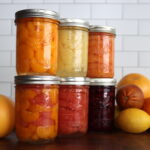
Canning Citrus Sections
Canning citrus sections is a simple water bath canning project that turns peak-season oranges and grapefruit into sweet, ready-to-use jars for winter. The fruit is packed into a light syrup (or juice) and processed for pantry-safe storage, giving you glossy, tender sections that are perfect for yogurt bowls, fruit salads, baking, and quick desserts.
Servings: 64 servings, Makes 9 pints
Equipment
Ingredients
- 13 lbs citrus sectioned (oranges, grapefruit, or a mix; mandarins yield more per pound)
- 1 1/2 cups granulated sugar optional, see notes
- 5 3/4 cups water
- Pectic Enzyme Liquid for pith removal: 1 tsp pectic enzyme + 1 gallon cold water (for soaking sections 3 hours to overnight)
Instructions
- Prepare the citrus sections. Wash fruit. Peel and separate citrus into sections, removing as much white pith and membrane as possible to prevent bitterness. For extra-clean sections, soak the separated segments in 1 tsp pectic enzyme mixed into 1 gallon cold water for 3 hours to overnight, then gently rub/rinse and drain well.
- Prepare the canner and jars. Fill a boiling water canner with enough water to cover jars by at least 1 inch. Begin heating the water. Wash jars, lids, and rings. Keep jars hot until ready to fill.
- Make the light syrup. Combine sugar and water in a saucepan. Heat until the sugar dissolves and the syrup is hot. Keep it hot while you pack jars. Recipe above is for light syrup, see notes for other syrup types.
- Pack the jars. Fill hot jars with citrus sections, packing gently but firmly. Ladle hot light syrup over the sections, leaving 1/2 inch headspace.
- De-bubble and adjust headspace. Slide a bubble remover around the inside of the jar to release trapped air. Re-check headspace and add more hot syrup if needed to return to 1/2 inch.
- Apply lids and process. Wipe rims, apply lids, and screw bands on fingertip tight. Lower jars into the canner. Return water to a full rolling boil, then process using the time listed under Notes: Altitude Adjustments.
- Cool and store. Turn off heat and let jars rest 5 minutes in the canner. Remove jars and cool undisturbed 12–24 hours. Check seals, label, and store.
Notes
Syrup Options (9-Pint Canner Batch)
If you’d rather use a different syrup strength, use these tested ratios (make the syrup the same way: heat just until sugar dissolves, keep hot for packing):- Extra-light syrup: 3/4 cup sugar + 6 1/2 cups water
- Light syrup (recipe card): 1 1/2 cups sugar + 5 3/4 cups water
- Medium syrup: 2 1/4 cups sugar + 5 1/4 cups water
- Heavy syrup: 3 1/4 cups sugar + 5 cups water
- Extra-heavy syrup: 4 1/4 cups sugar + 4 1/4 cups water
Citrus Types and What to Expect in the Jar
- Mandarins/Clementines/Satsumas/Tangerines: Best texture and that classic “canned mandarin” vibe. Easiest to prep.
- Navels: Big easy sections, but they’re airier and can be a bit softer after canning.
- Cara Cara: Great flavor and pretty color, but also softer like navels.
- Blood oranges: Stunning jars; expect color to tint the liquid.
- Grapefruit: Excellent canned, often tastes sweeter than fresh. Great alone or mixed with oranges.
- Valencias: More bitterness risk; I don’t recommend them for sections.
- Lemons: Work well, especially in heavier syrup for a preserve-like result.
- Limes: Very difficult to section cleanly; doable in theory, frustrating in practice.
Removing Pith and Preventing Bitterness
Bitterness almost always comes from white pith and membrane left on the sections. If you want ultra-clean segments, the pectic enzyme soak helps loosen that clinging white tissue so it rinses away more easily. It does not dissolve the pith on its own, so plan to gently rub/rinse after soaking.Altitude Adjustments
Use the same processing time for half-pints, pints, and quarts. Start timing only once the canner is back at a full rolling boil.- 0–1,000 ft: 10 minutes
- 1,001–6,000 ft: 15 minutes
- Above 6,000 ft: 20 minutes
Yield Notes
NCHFP estimates about 13 pounds per 9-pint canner load, but yield depends heavily on fruit type and how tightly you pack. Mandarins usually give more usable sections per pound than navels because there’s less pith and waste. For a standard 7 quart canner batch, you'll need about 15 pounds of fruit (and slightly more syrup).Storage and Serving
For best quality, use within 12–18 months. Refrigerate after opening. The syrup is delicious too—use it in drinks, smoothies, vinaigrettes, or to soak cakes.Nutrition
Calories: 248kcal | Carbohydrates: 66g | Protein: 1g | Fat: 0.1g | Saturated Fat: 0.04g | Polyunsaturated Fat: 0.03g | Monounsaturated Fat: 0.1g | Sodium: 58mg | Potassium: 52mg | Fiber: 1g | Sugar: 60g | Vitamin A: 57IU | Vitamin C: 4mg | Calcium: 36mg | Iron: 0.2mg