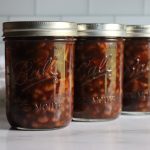
Canning Boston Baked Beans
Canning baked beans is a simple way to enjoy homemade baked beans right off the pantry shelf (without heating up the kitchen).
Servings: 48 Servings (12 pints or 6 quarts)
Equipment
- Pressure Canner I use an All American Model 930
- Canning Jars, Lids and Bands
Ingredients
- 1 Quart dried navy beans
- 1/2 lb salt pork or bacon, or ham, cut into 1/2 inch pieces. Dice small, and don't add extra.
- 3 large onions diced, see notes
- 2/3 cup brown sugar
- 2/3 cup molasses
- 2 tsp dry mustard powder
- 2 tsp salt canning or pickling salt
- 4 cups water or unsalted stock/broth, more as needed to keep it soupy during cooking
Instructions
Making Baked Beans for Canning
- Soak the beans overnight in plenty of cool water. (Alternately, you can use the "quick soak" method which involves bringing them to a boil on the stove with plenty of water, cooking for 2 minutes, then turning off the heat and leaving them to quick soak for an hour. Drain the water and proceed as you would with overnight soaked beans.)
- Place the soaked beans in a pot of water and bring to a boil on the stove. Reduce heat to a simmer, and cook until the beans start to split. The exact time will depend on your beans and how long they've been stored, but it's usually around 45 minutes or so. They should be tender enough to eat, with some of their skins just starting to split, but not falling apart.
- Once cooked, turn off the heat and drain the beans completely before proceeding.
- Next, prepare a sauce by mixing all the other ingredients together. Stir until well mixed and the sugar is dissolved. It should be soupy, with chunks of bacon and onion.
- Pour the sauce over the top of the beans and stir to completely coat all the beans.
- Place the beans in a 8-quart dutch oven with a tight-fitting lid. Bake at 300 F for about 4 hours. Add water as necessary to keep the mixture soupy and the water level just covering the top layer of beans. (Usually, around 4 to 6 cups of water is necessary but more if you don't have a good sealing dutch oven.)
Canning Baked Beans
- Prepare your pressure canner for canning based on the manufacturer's instructions. For most canner models, that means putting in the bottom rack and adding a few inches of water. Pre-heat it on the stove to just simmering, around 180 degrees F.
- Bring a kettle of water to a boil on the stove (to fill any jars if you don't have quite enough liquid in the bean pot).
- Prepare pint or quart jars. Divide the beans evenly across all the jars using a slotted spoon, leaving 1-inch headspace. Top the jars with the canning sauce from the bean pot, still maintaining 1-inch headspace.
- If you're short on liquid, pour in a bit of water from the pre-heated kettle. The beans should be under the liquid line in the jars, but there should still be a 1-inch headspace at the top of each jar.
- Wipe rims, apply canning lids and seal to finger tight with canning rings.
- Load the jars into your pressure canner.
- Put the lid on the canner and bring it up to temperature, but don't seal it yet. Allow the steam to vent for 10 minutes before sealing up the canner and bringing it up to pressure. (See notes for pressures based on altitude.)
- Once at pressure, process the jars for 80 minutes for pints and 95 minutes for quarts.
- After the canning time is complete, turn off the heat and allow the canner to cool completely before unloading the jars.
- Once the jars are unloaded, check seals and store any unsealed jars in the refrigerator for immediate use (within 1 to 2 weeks). Properly canned and sealed jars will maintain their quality on the pantry shelf for 12-18 months.
- Refrigerate after opening.
Notes
Yield
A full batch makes about 10 to 12 pints (5 to 6 quarts). The original source lists a smaller yield, but the Ball Blue Book and other Ball books are notorious for inaccurate yields. The recipe calls for a vague "3 large onions" which works out to about 6 to 7 1/2 cups onions, diced.
Equipment
Baked beans must be pressure canned. They cannot be safely processed in a water bath canner or an electric pressure cooker (Instant Pot). You'll also want a large dutch oven for the slow bake.
Dutch Oven and Baking Tips
Use at least a 7-quart dutch oven (or split between two smaller pots) so the beans have room to bubble during the long bake. Whatever you use needs a tight-fitting lid, or cover tightly with foil, to hold in moisture.
Keep the mixture soupy the whole time and add liquid as needed so the beans stay just under the liquid line, since the sauce caramelizes and will scorch quickly if it runs dry. Bake at about 300 degrees F for roughly 4 hours, until the beans are a rich brown and the flavors come together.
Canning Pressures for Baked Beans
The total canning time does not change with altitude when pressure canning, but the pressure level does change at higher elevations. It also changes depending on the type of canner you're using.
Be sure you know whether you're working with a dial gauge canner (Presto type) or a weighted gauge canner (All American type).
Dial Gauge Canners
- 0 to 2,000 feet: 11 pounds of pressure
- 2,001 to 4,000 feet: 12 pounds of pressure
- 4,001 to 6,000 feet: 13 pounds of pressure
- 6,001 to 8,000 feet: 14 pounds of pressure
- 0 to 1,000 feet: 10 pounds of pressure
- Above 1,000 feet: 15 pounds of pressure
- Peppers for onions: trade an equal volume of diced peppers (sweet or hot) for up to about half the onions, keeping the combined amount the same. Keep them diced, not pureed.
- Meat: salt pork, ham, or bacon all work at the same 1/2 pound. Swap by weight, don't add extra, and be sure to dice small into 1/2 inch pieces.
- Dry mustard: fine-ground prepared yellow mustard can stand in for the dry mustard powder.
- Spices: reasonable amounts of dry spices like garlic powder or paprika are fine, as long as the mix stays soupy and doesn't turn to paste.
- Sugar and molasses: safe to reduce, but they firm and flavor the beans during the bake, so cutting them gives softer, milder beans. Not recommended.
- Avoid: no flour, cornstarch, or other thickeners, no dairy, no pasta, rice, or extra beans, and don't puree the vegetables, shorten the time, or lower the pressure.
Nutrition
Serving: 0.5cup | Calories: 131kcal | Carbohydrates: 19g | Protein: 5g | Fat: 4g | Saturated Fat: 1g | Polyunsaturated Fat: 1g | Monounsaturated Fat: 2g | Cholesterol: 4mg | Sodium: 229mg | Potassium: 323mg | Fiber: 5g | Sugar: 8g | Vitamin A: 0.2IU | Vitamin C: 1mg | Calcium: 44mg | Iron: 1mg